 FIELD
How to identify quartz: crystals, hardness and look-alikes
Quartz is the mineral rockhounds pick up more than any other, and the one most often confused with calcite, glass and a dozen other stones. Six quick checks — shape, hardness, luster, fracture, weight and acid — settle almost every case.
Quartz is silicon dioxide (SiO2), the second most abundant mineral in Earth’s continental crust after the feldspars. It fills veins, lines geodes, makes up most beach and river sand and forms the bulk of sandstone, quartzite and granite. Because it is everywhere, almost every collector starts with it — and because it comes in so many colours and habits, it is also easy to misidentify. This guide shows how to identify quartz with simple field tests, explains the crystal shapes and varieties you will meet, and lists the look-alikes worth ruling out. It builds on our guides to hardness, luster and crystal habit.
What quartz is
Quartz is built from silicon and oxygen atoms linked in a rigid three-dimensional framework of tetrahedra. That framework has no weak planes, which explains the three properties that matter most in the field: quartz is hard, it has no cleavage, and it resists weathering. Long after softer minerals in a rock have rotted to clay, quartz grains survive, which is why streams and beaches are full of them.
Quartz belongs to the trigonal crystal system (see the seven crystal systems). It grows in two broad forms. Macrocrystalline quartz forms crystals you can see with the naked eye: rock crystal, amethyst, smoky quartz and citrine. Microcrystalline quartz, or chalcedony, is made of fibres and grains far too small to see, and includes agate, jasper, chert and flint; those are covered in our agate, jasper and chert guide. This page focuses on the visible crystals and on massive vein quartz.
Field tests for quartz
Quartz passes a short, consistent checklist. Work through it in order, and remember that no single test is conclusive on its own.
Look at the crystal shape
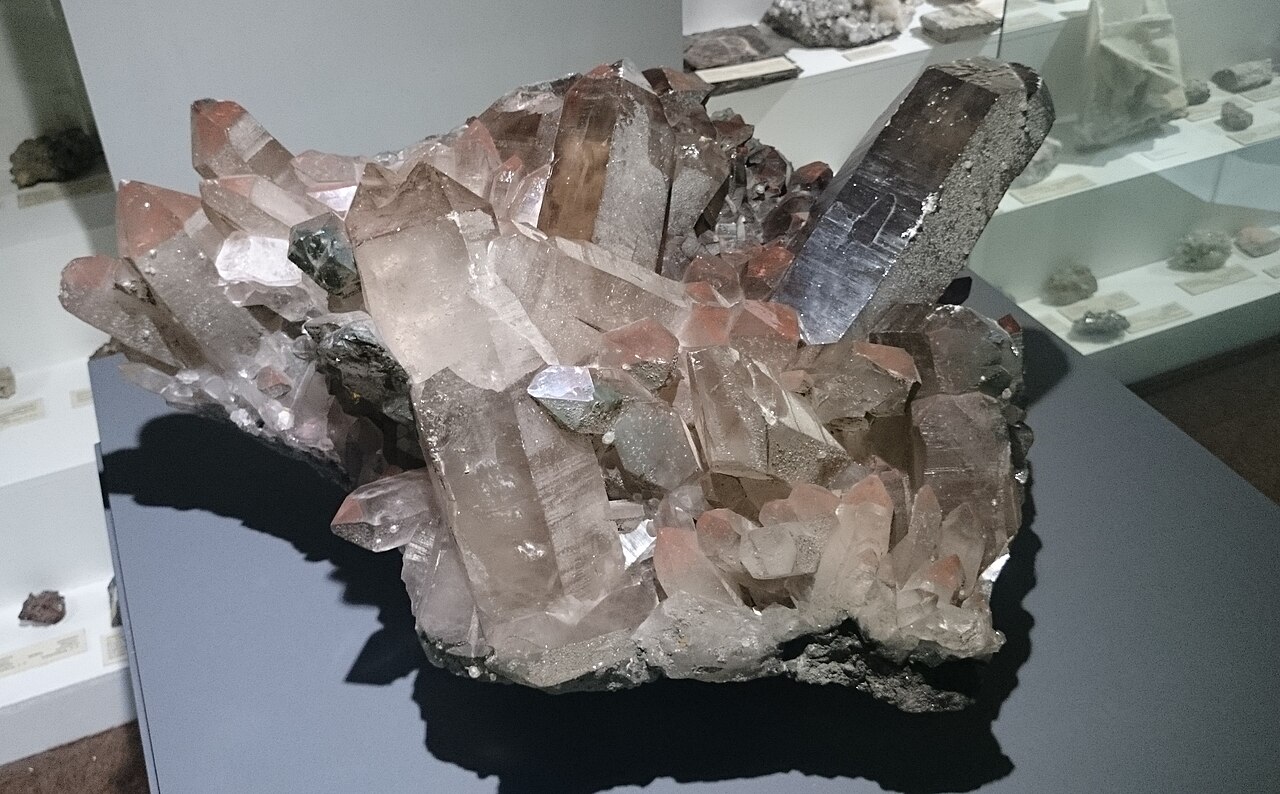
Well-formed quartz grows as a six-sided prism capped by a pointed, six-faced termination, like a sharpened pencil, as in the photograph above. Look closely at the long prism faces: they usually carry fine horizontal striations running across the crystal. That combination of hexagonal outline, pyramidal tip and cross-striations is the single most useful visual clue. Crystals may be single points, clusters, drusy crusts of tiny points or double-terminated crystals such as Herkimer diamonds. Twinned and distorted crystals are common; see crystal twinning.
Test the hardness
Quartz is 7 on the Mohs scale, the reference mineral for that step. It scratches window glass and a steel knife blade easily, and neither will mark it. A steel file barely bites. If a sharp crystal point leaves a clear groove on a glass plate and a knife slides off the specimen, you have a strong quartz candidate. Topaz, corundum and a few gem minerals are harder, but they are much rarer and heavier. Full method in our Mohs hardness scale guide.
Check the luster and the break
Fresh quartz has a bright vitreous (glassy) luster; massive vein quartz can look greasy or waxy. When it breaks, it shows conchoidal fracture — curved, shell-like surfaces — and no cleavage. That last point separates it from calcite, fluorite and feldspar, which split along flat, repeating planes. Our guide to cleavage and fracture shows the difference.
Run a streak and feel the weight
Quartz is harder than a ceramic streak plate, so it scratches the plate and leaves no coloured powder: the streak is white or absent, whatever the colour of the crystal (see the streak test). Its specific gravity is about 2.65, so a piece feels “normal” in the hand — noticeably lighter than barite, topaz or fluorite of the same size.
Try a drop of acid
Quartz does not react with dilute hydrochloric acid or vinegar. A clear crystal that fizzes is calcite, not quartz. The acid test is the quickest way to settle that common confusion, especially for drusy crusts inside geodes.
Varieties you may meet
Pure quartz is colourless. Trace elements, natural radiation and inclusions create the coloured varieties, and colour alone is never proof of identity (see mineral color).
Common varieties
- Rock crystal → colourless and transparent, the classic quartz point
- Milky quartz → white and cloudy from countless tiny fluid inclusions
- Amethyst → purple, from iron impurities plus natural irradiation
- Smoky quartz → brown to near-black, from natural radiation acting on aluminium
- Citrine → yellow to orange; much commercial citrine is heat-treated amethyst
- Rose quartz → pink, usually massive rather than in crystals
Quick checks
- Count the sides — six prism faces and a pointed tip
- Look for striations — fine lines across the prism faces
- Scratch glass — quartz does it easily
- No fizz — no reaction to dilute acid
- Check inside — needles, phantoms and bubbles are common
Many crystals carry visible inclusions — rutile needles, chlorite, tourmaline or liquid-filled cavities. They do not change the identification, and they often add interest; our guide to quartz inclusions explains what you are seeing.
Look-alikes to rule out
Several minerals and man-made materials can pass for quartz at a glance. Each fails at least one of the tests above.
- Calcite is much softer (3), splits into rhombohedral blocks, fizzes in acid and, in clear pieces, shows double refraction.
- Fluorite is softer (4), forms cubes and breaks along four cleavage directions; see how to identify fluorite.
- Gypsum and selenite are soft enough (2) to scratch with a fingernail and split into thin flexible sheets.
- Feldspar is close in hardness (6) but shows two flat cleavages at near right angles and blocky crystals rather than pointed prisms.
- Glass is softer (about 5.5), often shows round bubbles or swirl marks, and has no striated prism faces. Clear “crystals” sold as quartz are sometimes moulded glass. Natural obsidian is volcanic glass, not quartz.
- Topaz and beryl are harder (8 and 7.5–8); topaz is markedly heavier and has a perfect basal cleavage, while beryl forms flat-topped hexagonal prisms rather than pointed ones.
- Barite forms tabular crystals and feels surprisingly heavy, with a specific gravity around 4.5.
Where to find quartz
Quartz turns up almost everywhere, but certain settings produce good crystals: hydrothermal veins, pegmatites, cavities in limestone and dolomite, and the hollow centres of geodes. In the United States, well-known collecting areas include the Mount Ida quartz mines in Arkansas, the Herkimer diamond mines in New York, Crystal Park in Montana, Deer Hill in Maine and the Diamond Hill mine in South Carolina. Always confirm land status and current rules before you dig; our collecting ethics page explains the basics, and beginners can start with how to start rockhounding.
Cleaning and keeping your finds
Most quartz needs only water, a soft brush and a little dish soap. Iron staining can be removed with oxalic acid by careful collectors, but read our guide to how to clean rock finds first and never mix cleaning chemicals. Store crystals apart so their points do not chip each other. Keep amethyst and smoky quartz out of strong, prolonged sunlight, because their colour can fade over time. Quartz is also popular in crystal-healing traditions; those beliefs are cultural, not established science, and nothing on this page is medical advice.
Frequently asked questions
How can I tell if a rock is quartz?
Check that it scratches glass (hardness 7), has a glassy luster, breaks with curved conchoidal fracture and no cleavage, and does not fizz in dilute acid. Well-formed crystals are six-sided prisms with pointed tips and horizontal striations on the prism faces.
What is the difference between quartz and calcite?
Calcite is far softer (3 on the Mohs scale), splits into rhombus-shaped blocks along three cleavages and fizzes in dilute hydrochloric acid. Quartz is hardness 7, has no cleavage and does not react to acid.
How do you tell quartz from glass?
Quartz scratches glass, while glass cannot scratch quartz. Glass often contains round gas bubbles or swirl marks, has no natural striations and feels slightly warmer to the touch. Natural crystals show six striated prism faces.
What is the hardness of quartz?
Quartz is 7 on the Mohs hardness scale and is the reference mineral for that value. It scratches a steel knife blade and window glass.
Are agate and jasper types of quartz?
Yes. Agate, jasper, chert and flint are microcrystalline quartz, made of crystals too small to see. They share quartz’s hardness and chemistry but do not form visible prisms.
Why are some quartz crystals purple or brown?
Amethyst owes its purple colour to traces of iron combined with natural irradiation. Smoky quartz gets its brown to black colour from natural radiation acting on traces of aluminium in the crystal lattice.
Want a labelled quartz specimen to compare your finds against?
Sponsored — partner shop · Minerals Kingdom
Quartz is easy to confirm once you stack the clues. Scratch-test it against the Mohs scale, study the prism faces with a hand lens, check the shell-like fracture and rule out calcite with the acid test.
Once identified, give each piece a number and a label; our guide to cataloging a rock collection shows how.
Written by The Field & Stone Editors · Published by KEVALEX Group.