 FIELD
FIELD Quartz inclusions: what is trapped inside your crystal
Quartz inclusions are the minerals, liquids and gas bubbles caught inside a crystal as it grew. Learn to read them with a hand lens and you can tell rutile from tourmaline, a phantom from a fracture, and natural quartz from glass.
Quartz inclusions are foreign materials enclosed within a quartz crystal: tiny needles of rutile, flakes of chlorite, films of iron oxide, pockets of water, even bubbles of gas. Because quartz is clear and so common, it is the best natural window we have into what was happening underground while a crystal grew. This guide explains how inclusions form, how to recognise the ones you will meet most often, and how to examine them with simple tools. It pairs well with our guides to using a hand lens, transparency and crystal habit.
What counts as an inclusion
An inclusion is anything that was physically enclosed by the host crystal. It can be a solid (another mineral), a liquid (usually water carrying dissolved salts) or a gas (steam, carbon dioxide or methane). Many crystals hold two or three of these together: a liquid-filled cavity with a bubble, for example, or a mineral grain sitting in a pocket of fluid.
Inclusions are not the same as the surface features of a crystal. Growth steps, etched faces and coatings of iron stain sit on the outside; true inclusions are sealed within the quartz. They are also different from twinning, which is a structural feature of the quartz itself, and from fractures, which are cracks that may or may not have healed. Telling these apart is half the skill, and it is why a careful look at a clean, well-lit crystal is worth the time.
How inclusions get into quartz
Geologists classify inclusions by when they were trapped relative to the host crystal. The terms are technical, but the idea is simple and useful when you are puzzling over a specimen.
Before the crystal: protogenetic inclusions
These minerals were already present when the quartz began to grow, and the crystal grew around them. A needle of tourmaline or a flake of mica sitting on a rock surface can be swallowed this way. They often sit near the base or the core of the crystal.
During growth: syngenetic inclusions
Many of the most attractive inclusions form while the crystal grows. A pause in growth lets a thin film of clay, chlorite or iron oxide settle on the crystal faces, and the next layer of quartz seals it in. Repeat this a few times and you get a phantom: a ghost outline of an earlier, smaller crystal inside the final one. Fluid inclusions form in the same way when growth briefly bridges over a pocket of liquid.
After growth: epigenetic inclusions
Later fluids can seep along tiny cracks and deposit minerals or bubbles inside the crystal. Cracks that heal leave trails of tiny fluid droplets arranged in planes, often described as fingerprints, feathers or veils. These are common, and they are normal rather than a flaw.
The inclusions you will meet most often
Quartz can enclose dozens of minerals, but a handful account for most of what collectors find. Colour alone is a poor guide here, as our guide to mineral color explains, so confirm with shape and context.
Rutile needles
Rutile is titanium dioxide and forms thin golden, reddish or brassy needles that can cross each other in sprays or lie parallel. Quartz full of them is sold as rutilated quartz. Rutile is hard, around 6 to 6.5, and dense, with a specific gravity near 4.2, but you cannot test either property on a needle sealed inside the host. Judge it by its metallic to adamantine shine and its straight, slender habit. When the needles are fine and aligned, a polished dome can show a moving line of light, an effect covered in our guide to optical effects in minerals.
Tourmaline needles
Black tourmaline, usually the variety schorl, forms stout to slender black prisms inside quartz. Unlike rutile, tourmaline needles are black or very dark and often show faint lengthwise grooves under magnification. They are typically thicker and more angular than rutile.
Chlorite and phantoms
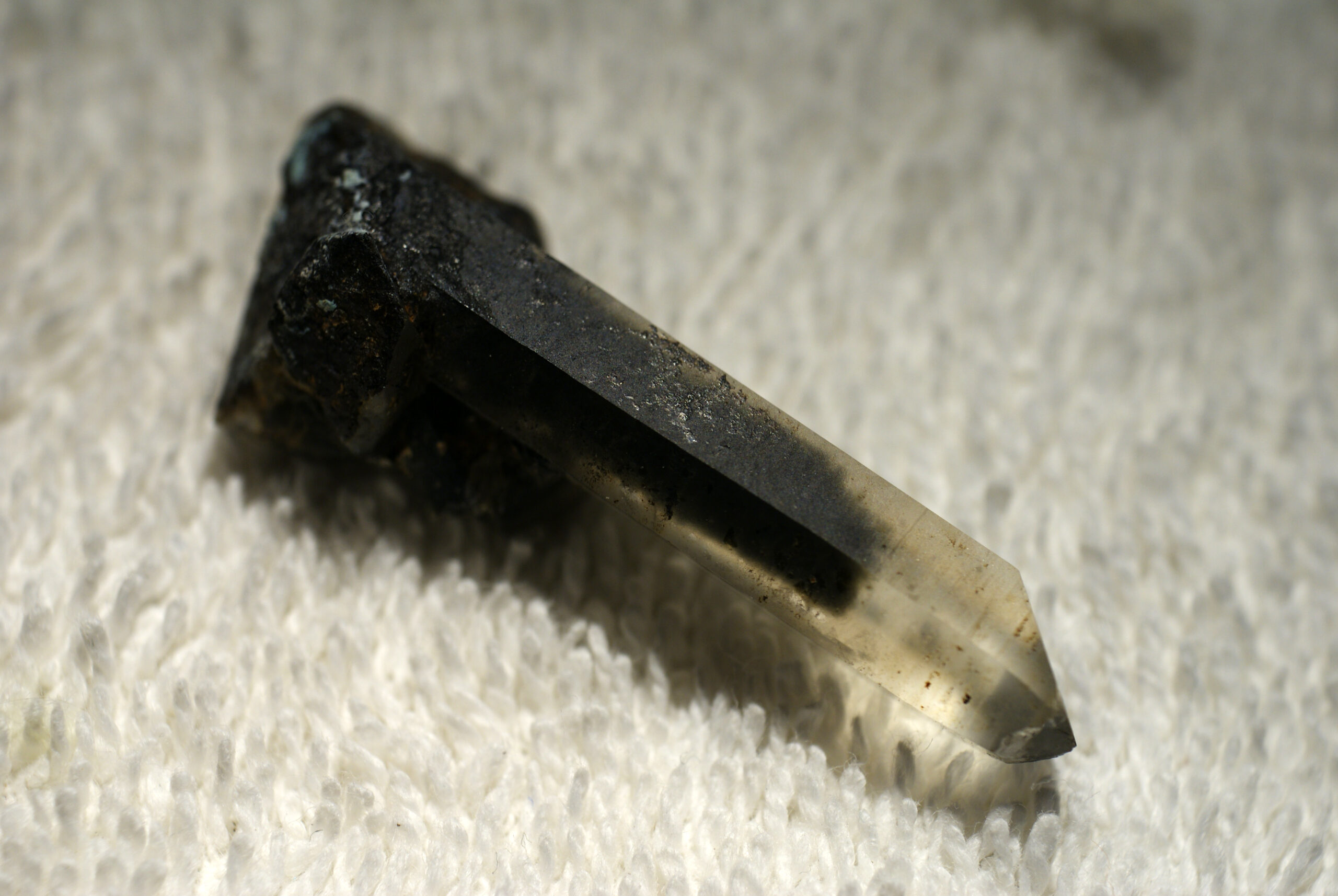
Chlorite is a group of soft, green sheet minerals. Inside quartz it forms green flakes, dusty coatings and drifting clouds, as in the photograph above. When a chlorite film outlines older crystal faces you get a green phantom; dealers sometimes sell heavily included green material as garden quartz, a trade name rather than a precise mineral term. Phantoms can also be outlined in white clay, grey dust or red iron oxide.
Iron oxides
Thin films of hematite or related iron minerals give quartz red, orange or brown tints and can create flashes of colour as light passes through the layers. Strawberry quartz owes its pink to red look to scattered iron-bearing inclusions. Heavy iron staining on the outside of a crystal is a surface feature, not an inclusion, and can often be removed; see how to clean rock finds.
Fluid and gas bubbles
Many clear crystals hold microscopic pockets of liquid and gas. Occasionally a pocket is large enough to see a bubble that moves when you tilt the stone. Such pieces are called enhydro quartz. Fluid inclusions are especially valuable to scientists because they preserve a tiny sample of the water that was present when the crystal formed.
Carbon-rich inclusions
The water-clear, double-terminated quartz crystals known as Herkimer diamonds often contain black specks and films of carbon-rich material along with liquid inclusions. If you plan to dig them, our Herkimer diamond mines guide explains how the sites work.
How to examine inclusions
You need very little equipment to read inclusions well. A 10x lens and a steady light are enough for most work.
What to look for
- Needles → straight, slender lines: think rutile, tourmaline or amphibole
- Flakes and films → green chlorite, white clay or rusty iron oxide
- Round bubbles → fluid or gas pockets, sometimes with a moving bubble
- Layered ghosts → phantoms marking earlier crystal faces
- Planes of dots → healed fractures, common and harmless
Quick checks
- Side light — shine a penlight from the side against a dark background
- Wet the surface — a drop of water or a clear oil reduces glare on rough faces
- Turn the stone — a real inclusion stays put while cracks flash
- Take a photograph — a phone against the lens often shows more than the eye
Start with the whole crystal in daylight, then move to the lens, and focus beneath the surface rather than on it. If the specimen is cloudy, look for the clearest window, because a small polished or naturally clear face will reveal much more than the rough outside.
Natural inclusions or imitation?
Natural inclusions look irregular. Needles vary in thickness, bubbles differ in size and shape, and growth films follow crystal faces. Be cautious when everything looks too perfect.
- Glass often contains round gas bubbles that are all about the same size, and swirl marks. In natural quartz a moving bubble sits in an angular, liquid-filled cavity rather than in a smooth glassy mass. Compare with how to identify obsidian, which explains natural volcanic glass and its true inclusions.
- Surface dendrites are branching black or brown manganese oxide patterns that look like tiny plants. They grow along thin cracks and are not true inclusions, although they are often sold as included stones. They are most common in chalcedony; see agate, jasper and chert.
- Synthetic quartz is grown in factories and can show breadcrumb-like specks or tiny spike-shaped inclusions near a seed plate. A gemmological laboratory can identify these reliably, and a single clue is not proof.
- Dyed or coated quartz may show colour trapped in cracks or a skin that scratches off. A coating is not an inclusion.
Why inclusions matter
For a collector, inclusions are what make a crystal individual. A phantom or a perfect rutile spray can lift a common crystal into a display piece. For scientists they are far more: fluid inclusions help estimate the temperature, pressure and chemistry of the water that formed a vein, and mineral inclusions show what else was growing at the same time. Gemmologists use inclusions as fingerprints to distinguish natural from synthetic and treated material.
It is worth saying plainly that inclusions are a geological record. This guide treats them as clues to how a crystal formed. We make no claims about healing or energy, and nothing here is advice about health.
Where to find included quartz
Quartz is found almost everywhere, and included crystals turn up wherever hot fluids moved through rock. Public and fee-dig sites in the United States include Crystal Park in Montana and Mount Ida in Arkansas. Rutile is the headline mineral at Graves Mountain in Georgia. Always confirm land status and collecting rules first, and read our collecting ethics page. If you are just starting out, begin with how to start rockhounding.
Caring for included crystals
Treat crystals that contain fluid inclusions gently. Sudden heat or a hard knock can crack the host and release or spoil the inclusion, so avoid hot water, dishwashers and ultrasonic cleaners. Quartz itself is hard (7 on the Mohs scale), so ordinary dust and mud come off with water and a soft brush. Store specimens in padded trays and keep the best faces uncovered for photography.
Frequently asked questions
What are inclusions in quartz?
Inclusions are solids, liquids or gases enclosed within a quartz crystal. Common examples are rutile needles, chlorite flakes, iron oxide films and tiny pockets of water with a gas bubble.
How do you tell an inclusion from a crack?
Turn the crystal under a bright light. A true inclusion stays in the same place inside the crystal at every angle, while a crack flashes silver or rainbow colours and seems to shift as you move the stone.
What is a phantom quartz?
A phantom is a ghost outline of an earlier crystal stage inside a larger crystal. It forms when a thin film of chlorite, clay or iron oxide settled on the faces during a pause in growth and was then covered by new quartz.
Are rutile and tourmaline needles the same thing?
No. Rutile needles are usually golden, reddish or brassy and very slender. Tourmaline needles are black or very dark, thicker, and often show faint lengthwise grooves under magnification.
Does an inclusion make quartz more valuable?
Sometimes. Attractive, well-placed inclusions such as sharp rutile sprays or clear phantoms can raise interest and price, while dull clouds or heavy cracking rarely do. Value depends on clarity, size, rarity and the individual stone.
Can I use inclusions to tell natural quartz from synthetic?
They help, but they are not conclusive on their own. Natural quartz shows irregular fluid inclusions and growth features, while synthetic quartz can show breadcrumb-like specks near a seed plate. A gemmological laboratory gives a reliable answer.
Want to study quartz inclusions up close?
Sponsored — partner shop · Minerals Kingdom
Inclusions reward patience. Examine them with a hand lens, judge clarity with our transparency guide, and compare with the structure of the host in the seven crystal systems.
To keep a record of where each crystal came from, see how to catalog a rock collection.
Written by The Field & Stone Editors · Published by KEVALEX Group.