 FIELD
FIELD The seven crystal systems: reading crystal symmetry in the field
Behind the endless variety of crystal shapes lies a short, tidy list. Every well-formed crystal in the world belongs to just one of seven symmetry families — and knowing which one you are looking at is a quiet superpower.
The seven crystal systems are the framework mineralogists use to sort every crystalline substance by its internal symmetry. Each system is defined by the geometry of the crystal’s repeating unit — the lengths of its three (or four) reference axes and the angles between them — and that hidden geometry shows itself in the outward shapes a mineral can take. The systems run from the fully symmetrical cubic family down to the lopsided triclinic one, and they underpin much of what you read off a specimen in the field. This guide names all seven, gives a mineral you already know for each, and shows how symmetry ties into habit and cleavage.
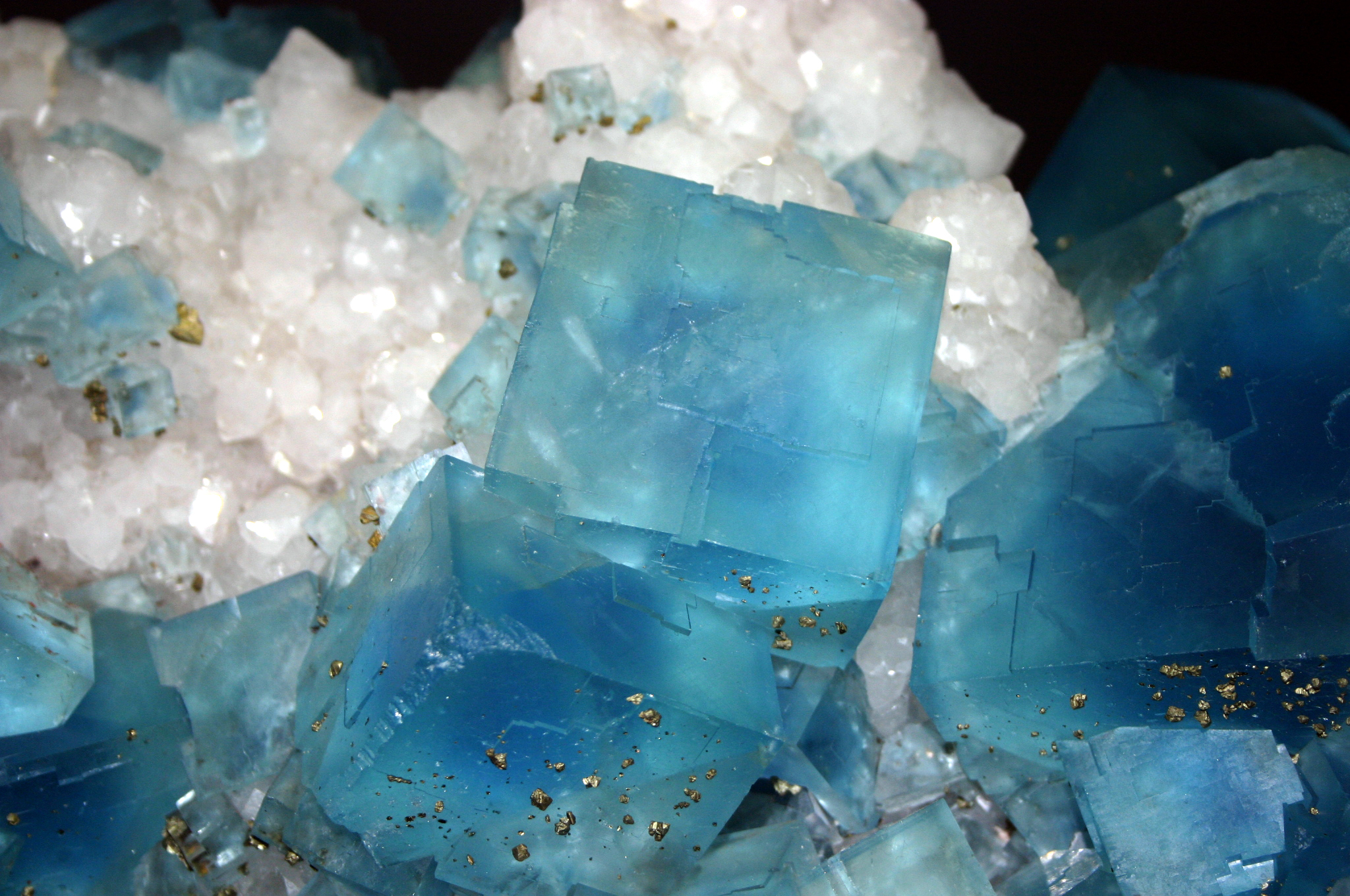
What the crystal systems are
A crystal is a solid whose atoms sit on a repeating three-dimensional grid, the lattice. To describe that grid we set up reference axes and measure their relative lengths and the angles between them. Group all the possibilities together and they collapse into just seven distinct systems, from the most symmetrical to the least. The system is a deeper property than habit: habit is the particular shape a crystal happens to grow into, whereas the system is the underlying symmetry that limits which shapes are even possible. One mineral can show several habits, but it belongs to only one system. Note a common wrinkle in the counting: some references list six systems by folding the trigonal into the hexagonal, because the two share a similar axial setup. We keep the standard seven here and flag the overlap where it matters.
The seven systems at a glance
Here are the seven, each with an everyday mineral to anchor it in memory.
- Cubic (isometric) — three equal axes at right angles; the most symmetrical. Cubes and octahedra: fluorite, galena, pyrite, garnet, diamond.
- Tetragonal — two equal axes and one longer or shorter, all at right angles. Square prisms: zircon, cassiterite, rutile.
- Hexagonal — a six-fold axis; hexagonal prisms: beryl (emerald, aquamarine), apatite.
- Trigonal (rhombohedral) — a three-fold axis, often grouped with hexagonal: quartz, calcite, tourmaline, corundum.
- Orthorhombic — three unequal axes, all at right angles. Blocky or tabular: topaz, olivine, barite, staurolite.
- Monoclinic — three unequal axes, one pair not at a right angle. Very common: gypsum, orthoclase feldspar, mica, epidote.
- Triclinic — three unequal axes, none at a right angle; the least symmetrical: plagioclase feldspar, kyanite, turquoise.
Higher-symmetry systems
- Cubic — fluorite, garnet, pyrite
- Tetragonal — zircon, cassiterite
- Hexagonal — beryl, apatite
- Trigonal — quartz, calcite
Lower-symmetry systems
- Orthorhombic — topaz, barite, olivine
- Monoclinic — gypsum, orthoclase, mica
- Triclinic — plagioclase, kyanite
- (Amorphous — opal, glass: no system)
How to read symmetry in the field
You will rarely measure axes on a hillside, but you can read symmetry by eye. Start by counting how many times the crystal looks the same as you rotate it: a shape that repeats every 90° around an axis suggests a four-fold (tetragonal or cubic) symmetry, every 60° a six-fold (hexagonal), every 120° a three-fold (trigonal). Look at the cross-section of a prism — square points to tetragonal, hexagonal to the hexagonal or trigonal systems, a flattened rhombus to the lower systems. Note whether faces meet at right angles or oblique angles: consistent right angles fit the cubic, tetragonal and orthorhombic systems, while a persistent slant is the signature of monoclinic and triclinic minerals. A hand lens and a habit of turning the specimen slowly, as you would to catch optical effects, make these patterns far easier to see. Perfect crystals are the exception, so read symmetry from the best-formed faces you can find.
Systems, habit and cleavage
The crystal system quietly governs several other properties you already test. It sets the ceiling on habit: quartz can be stubby or long, but its six-sided prism is fixed by its trigonal symmetry. It controls cleavage, because cleavage follows planes of weak bonding that are themselves arranged by the lattice — the perfect cubic cleavage of galena and the three-direction rhombohedral cleavage of calcite are direct expressions of their systems. Symmetry also decides whether a mineral can show certain optical effects and how it behaves in polarised light: cubic minerals are optically isotropic, while the lower systems are anisotropic. And it interacts with twinning, since the twin laws a mineral obeys are drawn from the symmetry of its system. Learn the seven and a great deal of mineralogy falls into order.
Cautions and common mistakes
The first trap is to confuse system with habit. A cube-shaped crystal is not automatically cubic-system: pyrite is cubic, but many blocky crystals belong to other systems, and a pseudomorph can wear a shape that has nothing to do with its own symmetry. Judge the system from symmetry, not from a single silhouette. Second, remember that not every solid has a crystal system at all: amorphous materials such as opal, obsidian and natural glass have no ordered lattice and so belong to none of the seven. Third, do not over-read a broken or distorted crystal — growth conditions can stretch or squash faces, so estimate symmetry from several faces rather than one. Finally, be relaxed about the six-versus-seven-systems question: it is a matter of convention, not a real disagreement, and either way quartz and calcite behave the same. When a specimen is ambiguous, fall back on the field tests — hardness, cleavage, streak — and let the symmetry be one clue among several.
Frequently asked questions
What are the seven crystal systems?
They are cubic (isometric), tetragonal, hexagonal, trigonal, orthorhombic, monoclinic and triclinic. Each is defined by the relative lengths of a crystal’s reference axes and the angles between them, running from the most symmetrical (cubic) to the least (triclinic).
Is it six or seven crystal systems?
Both counts are used. The standard modern list has seven systems. Some references combine the trigonal and hexagonal systems, which share a similar axial setup, into a single hexagonal system, giving six. The difference is a matter of convention, not of the minerals themselves.
What is the difference between a crystal system and crystal habit?
The crystal system is the underlying symmetry of a mineral’s lattice and limits which shapes are possible. Habit is the particular shape an individual crystal actually grew into. One mineral belongs to a single system but can show several habits.
Which crystal system is the most symmetrical?
The cubic, or isometric, system. It has three equal axes meeting at right angles and the highest symmetry of the seven, producing cubes, octahedra and dodecahedra in minerals such as fluorite, garnet, pyrite and diamond.
How can I tell a crystal’s system in the field?
Read the symmetry: count how often the shape repeats as you rotate it, look at the prism cross-section (square, hexagonal or rhombic), and note whether faces meet at right angles or oblique angles. Right angles favour the higher systems; a persistent slant points to monoclinic or triclinic.
Do all minerals belong to a crystal system?
No. Only crystalline minerals, whose atoms sit on an ordered lattice, belong to one of the seven systems. Amorphous materials such as opal, obsidian and natural glass have no ordered internal structure and so belong to none.
Want well-formed crystals to study?
Sponsored — partner shop · Minerals Kingdom
The seven systems are the backbone that crystal habit, cleavage and twinning all hang from, and they explain why a pseudomorph can be so misleading. Pair them with luster and the Mohs hardness scale for a full field read. New to the hobby? Start with how to start rockhounding.
Written by The Field & Stone Editors · Published by KEVALEX Group.