 FIELD
FIELD Cleavage and fracture: how minerals break
The way a mineral splits or shatters is written into its atomic structure — learn to read a broken surface and you gain one of the most reliable field-ID clues there is.
When a mineral breaks, it reveals something about its internal structure. Split it and you get one of two results: smooth, flat surfaces that follow planes of weakness in the crystal — cleavage — or rough, curved or jagged surfaces that ignore the atomic grid entirely — fracture. Because both are governed by how the atoms are bonded inside the crystal, they stay remarkably consistent for each mineral, which makes the way a specimen breaks one of the fastest clues in the field.
What cleavage really is
Cleavage happens when a crystal contains planes where the atomic bonds are weaker than in other directions. Strike or squeeze the mineral and it splits cleanly along those planes, leaving one or more flat, often shiny surfaces. Geologists describe cleavage in two ways: its quality — from perfect (mica) through good and distinct down to poor — and the number and directions of the planes. A single perfect cleavage produces sheets; two, three or more intersecting cleavages produce blocks, rhombs or more complex fragments.
The reason cleavage is so useful is that it repeats. Break a cleavable mineral into a hundred pieces and every piece splits along the same planes at the same angles, because those planes are a property of the crystal structure itself rather than of any one specimen. That consistency is what lets you use breakage as a diagnostic test at all.
Counting cleavage directions
- One direction — mica (muscovite, biotite) peels into thin, flexible sheets.
- Two directions at about 90° — feldspar breaks into blocky, stair-stepped fragments.
- Two directions not at 90° — amphibole (roughly 56° and 124°) versus pyroxene (about 87° and 93°), a classic way to separate those two dark minerals.
- Three directions at 90° — halite and galena cleave into near-perfect cubes.
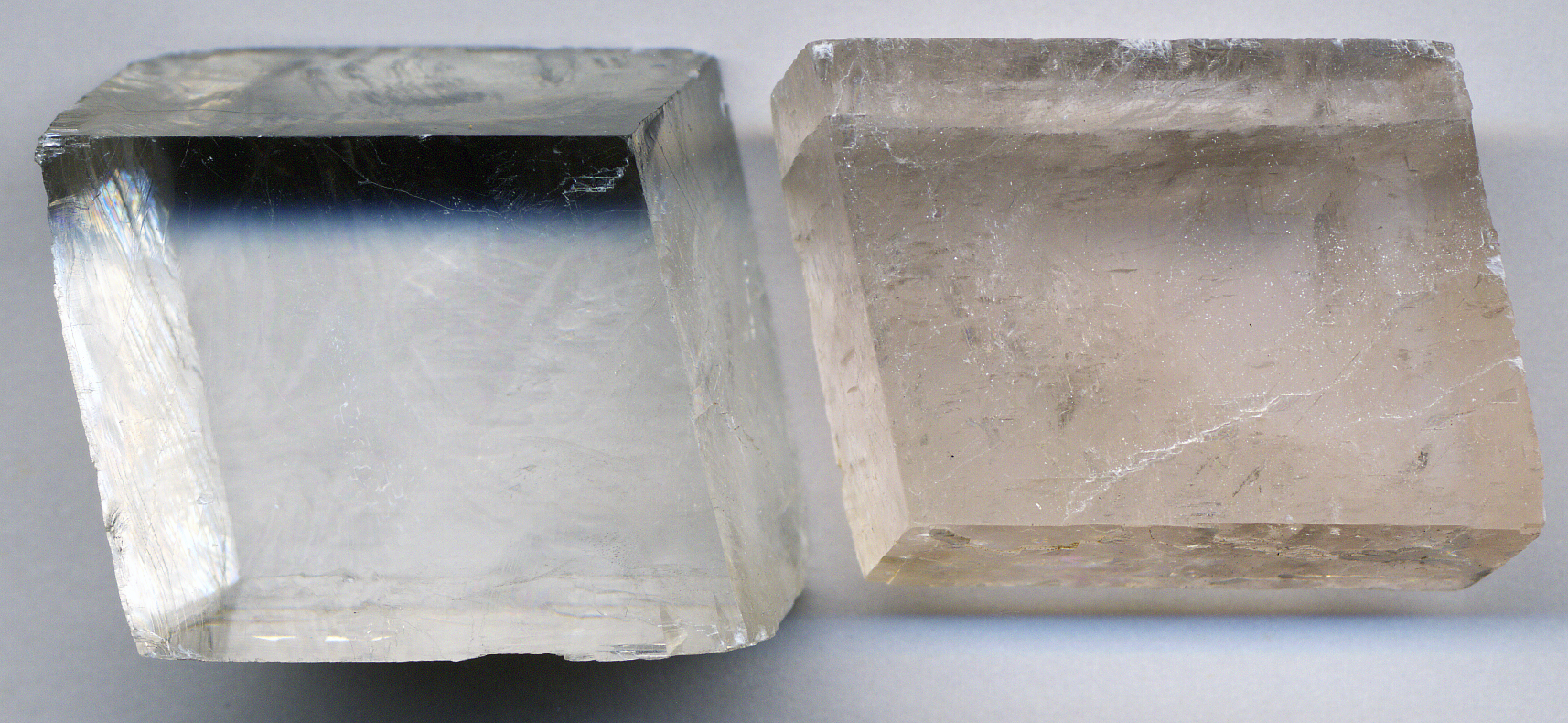
- Three directions not at 90° — calcite splits into rhombohedra, the leaning box shape shown above.
- Four directions — fluorite cleaves into octahedra, and diamond shares this, which is how cutters once split rough stones.
What fracture is
Not every mineral has cleavage. When bonding is roughly equal in all directions, a mineral has no planes of weakness and instead breaks by fracture, along irregular surfaces. The most useful type to recognise is conchoidal fracture — smooth, curved, shell-like surfaces with concentric ripples, seen in quartz, obsidian and flint. It is the same property that let ancient toolmakers knap sharp edges. Other fracture types include hackly (jagged, torn points, typical of native metals such as copper), splintery (fibrous minerals like kyanite or serpentine), uneven (rough and irregular, the most common of all) and earthy (crumbly and dull, as in limonite or kaolinite).
Reading cleavage
- Flat, reflective surfaces that flash as one sheet
- Repeats identically on every fragment
- Parallel steps or intersecting facets
- Angles you can measure and match to a mineral
Reading fracture
- Curved or rough surfaces, never flat
- No two breaks look quite alike
- Conchoidal ripples on quartz, obsidian and glass
- Jagged metallic points on native copper
How to test a break in the field
Look at a freshly broken surface under good light and tilt it back and forth. Flat faces that flash as a single sheet of reflection are cleavage; a surface that scatters light in curved ripples is fracture. Count how many flat directions you can see and estimate the angles between them. Be gentle about it: you only need a small chip from an inconspicuous edge, and you should never break a display-quality specimen or a faced gemstone just to test it. Combine what you see with hardness and the streak test before committing to an identification, since no single property names a mineral on its own. Note, too, whether the fragment shatters or instead bends and dents, a separate clue covered in our guide to mineral tenacity.
Cleavage is not the same as crystal faces
A common beginner mistake is to confuse a cleavage surface with a natural crystal face. Crystal faces form as a mineral grows freely and appear on the outside of an uncut crystal; cleavage surfaces appear only when you break the mineral open. A quartz crystal has beautiful growth faces but no cleavage at all, so it will never split flat — it fractures. Learning to separate grown faces from broken planes is also the bridge to reading crystal habit, the characteristic shape a mineral grows into, and to understanding the wider distinction between a rock and a mineral.
Frequently asked questions
What is the difference between cleavage and fracture?
Cleavage is a clean break along flat planes of weakness in a crystal’s atomic structure, repeating identically on every fragment. Fracture is an irregular break — curved, jagged or rough — that occurs when a mineral has no such planes.
Why does quartz have no cleavage?
In quartz the silicon–oxygen bonds are equally strong in every direction, so there is no plane of weakness for it to split along. Instead it breaks by smooth, curved conchoidal fracture.
How can cleavage tell feldspar from quartz?
Feldspar has two good cleavages meeting at about 90°, so it breaks into blocky, stair-stepped fragments with flat, reflective faces. Quartz has no cleavage and breaks with curved conchoidal surfaces.
What does “perfect” cleavage mean?
Perfect cleavage means the mineral splits extremely easily into smooth, flat sheets or fragments with almost no rough surface. Mica is the textbook example, peeling into thin, flexible sheets.
Can one mineral show both cleavage and fracture?
Yes. A mineral with cleavage in some directions can still fracture across the directions that have no cleavage plane, so a single specimen can show both flat cleavage faces and rough fracture surfaces.
Does cleavage matter for gemstones?
Yes, for both identification and durability. Minerals with perfect cleavage, such as fluorite or topaz, can split if knocked along a plane, which is why lapidaries orient the stone carefully when cutting and setting it.
Want cleavable minerals to practise on?
Sponsored — partner shop · Minerals Kingdom
Cleavage and fracture work best alongside the rest of your ID kit — pair them with our Mohs hardness scale guide and the streak test, then see how a mineral’s grown shape differs in our crystal habit guide, and learn why a cleavage direction can change orientation across a boundary in crystal twinning. New to the hobby? Start with how to start rockhounding.
Breakage is only half the story on a fresh surface — the other half is how minerals reflect light, which often separates two species that fracture identically.
Written by The Field & Stone Editors · Published by KEVALEX Group.