 FIELD
FIELD Geodes, thundereggs & nodules
They all look like plain lumps on the outside — but crack them open and each hides a different geological story.
A dull, rounded rock that rattles or feels surprisingly light can hide a lining of crystals. Geodes, thundereggs and nodules are three of the most rewarding finds in rockhounding, and although collectors often use the words loosely, they describe genuinely different things.
What is a geode?
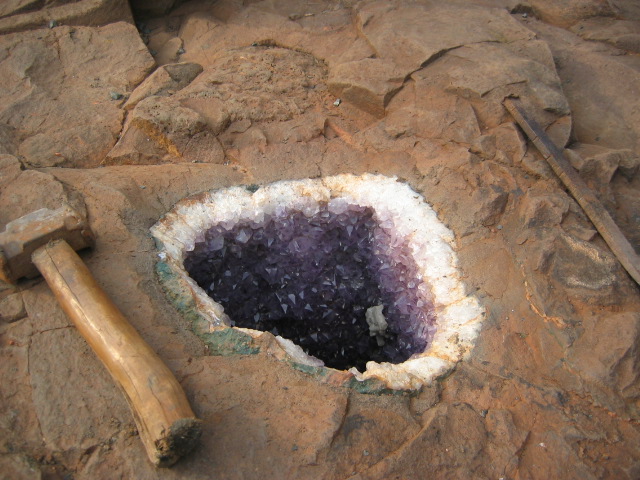
A geode is a hollow, roughly spherical rock with a crystal-lined cavity inside. Most begin as a void in the host rock — a gas bubble in volcanic lava, or a cavity left by dissolved material in sedimentary limestone. Over long periods, mineral-rich water seeps in and deposits layer after layer on the cavity walls. A hard outer shell of chalcedony usually forms first, protecting the interior, and inside it quartz — often as clear crystals, amethyst or agate banding — grows inward toward the centre.
Because the crystals grow into an open space, a geode is at least partly hollow: that is the defining feature. A geode that has filled completely solid is, strictly, no longer a geode. This is why a true geode often feels lighter than expected for its size, and why a loose crystal or two can sometimes be heard rattling inside.
What is a thunderegg?
A thunderegg is a specific kind of nodule that forms in rhyolitic volcanic ash and lava. From the outside it looks like a knobbly, potato-shaped ball of drab rock, but a cut face reveals a star- or flower-shaped core filled with agate, chalcedony, jasper or common opal. Unlike a classic geode, a thunderegg is usually solid rather than hollow — the central cavity filled in completely as silica-rich fluids replaced and infilled it.
The name comes from a Native American legend of the Pacific Northwest, and thundereggs are the state rock of Oregon. They are almost always cut with a saw rather than cracked, because the beauty is in the internal pattern, not a crystal pocket.
What is a nodule?
Nodule is the broadest term of the three. Geologically, a nodule is any rounded, concretionary mass that formed differently from the rock around it. Chert and flint nodules grow in chalk and limestone; agate nodules form in gas cavities in basalt; and thundereggs are, technically, a type of nodule. A nodule may be solid, partly hollow, or crystal-filled — the word only tells you the shape and mode of formation, not the contents.
How to spot one in the field
Look for
- Rounded, ball- or egg-shaped stones weathering out of ash beds, basalt or limestone
- A bumpy, warty or rind-like outer texture
- Stones that feel light for their size (possible cavity)
- Concentrations in gravel bars, washes and eroding slopes where they collect
Where they occur
- Volcanic regions: thundereggs and agate nodules in old ash and basalt
- Sedimentary basins: geodes in limestone and shale
- Classic US sites include Oregon’s ash beds, and geode beds in Utah, Iowa and California
How to open them without ruining them
The method depends on what you have. For a likely hollow geode, many collectors use a soft-jaw pipe cutter (chain cracker), which tightens a chain around the stone until it splits along a natural line, giving two clean halves. A hammer and cold chisel works too, but risks shattering delicate crystals. For a thunderegg or solid nodule, the only way to see the pattern is a diamond-blade lapidary saw, which produces a flat, polishable face.
Whatever the tool, wear eye protection — flying rock chips are the main hazard — and go slowly. A geode split cleanly in two is worth far more than one smashed into fragments.
Why the interior varies so much
The contents record the chemistry and timing of the fluids that filled the cavity. Slow growth in an open, water-filled void tends to produce well-formed crystals; rhythmic changes in fluid chemistry create the concentric bands of agate; and iron, manganese and other trace elements colour the quartz — purple amethyst, grey smoky quartz, red and yellow jasper. Two geodes from the same bed can look completely different inside, which is a large part of their appeal.
Frequently asked questions
What is the difference between a geode and a nodule?
A geode is hollow with a crystal-lined cavity; a nodule is any rounded concretion and may be solid or hollow. All geodes are a kind of nodule, but not all nodules are geodes.
Are thundereggs hollow like geodes?
Usually not. A thunderegg is typically solid, with an agate or jasper core, and is cut with a saw to reveal its pattern. A geode is hollow and is cracked open to reveal crystals.
How can I tell if a rock is a geode before opening it?
Look for a rounded shape, a bumpy rind, and a weight that feels light for the size. Nothing is certain until it is opened, which is part of the fun.
What is the best way to open a geode?
A chain-style geode cracker gives the cleanest halves; a hammer and chisel works but risks damage. Solid thundereggs need a diamond lapidary saw. Always wear eye protection.
Where can I find geodes and thundereggs?
In volcanic and sedimentary regions across the US. See our locality guides to Dugway geode beds, Keokuk geodes and Oregon’s Richardson thundereggs.
Prefer to buy a cut geode?
Sponsored — partner shop · Minerals Kingdom
New to the hobby? Read how to start rockhounding and the Hauser geode beds guide before planning a dig. A solid, crystal-free look-alike that is not hollow may be a concretion rather than a geode.
Written by The Field & Stone Editors · Published by KEVALEX Group.