 FIELD
How to identify calcite: rhombs, fizz and look-alikes
Calcite is one of the most common minerals on Earth and one of the most often mistaken for something else. Four quick checks — hardness, cleavage, a drop of acid and a doubled line — settle almost every case.
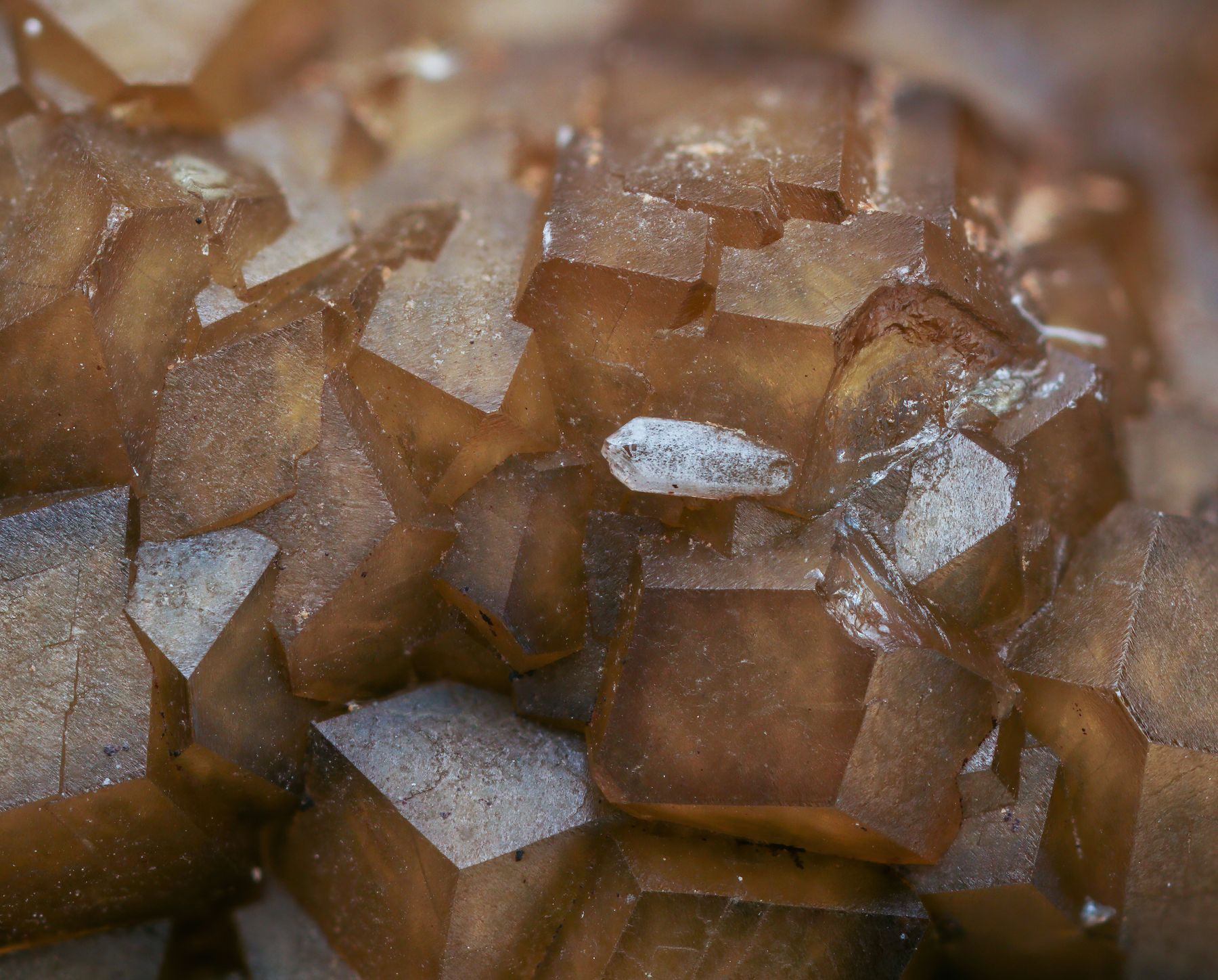
Calcite is calcium carbonate (CaCO3), the mineral that builds limestone, marble, cave formations and the white veins that streak so many outcrops. It comes in more crystal shapes than almost any other mineral, and it can be clear, white, honey-brown, pink, green or blue, so colour alone tells you very little. What does give it away is a short, reliable set of properties: it is soft enough to scratch with a steel knife, it breaks into slanted rhombs, it fizzes in cold dilute acid and clear pieces double anything seen through them. This guide shows how to identify calcite in the field, step by step, and how to rule out the minerals most often confused with it. It builds on our guides to the Mohs hardness scale, cleavage and fracture and the acid test for carbonates.
What calcite is
Calcite is the most stable form of calcium carbonate at the Earth’s surface. It crystallises in the trigonal system (see the seven crystal systems), and that symmetry explains two of its most useful traits: the rhombohedral cleavage and the strong double refraction. It forms in three main ways. Marine organisms build shells and skeletons from it, and those remains pile up as limestone and chalk. Groundwater carrying dissolved calcium carbonate deposits it in cracks, cavities and caves, producing veins, crystal-lined pockets and stalactites. And heat and pressure recrystallise limestone into marble, a rock made almost entirely of interlocking calcite grains (see igneous, sedimentary and metamorphic rocks).
Pure calcite is colourless or white. Traces of iron, manganese and other elements, or inclusions of other minerals, tint it yellow, brown, pink, orange, green or blue. That is why colour is the least reliable clue for this mineral: the same species can look completely different from one locality to the next.
Field tests for calcite
Each test below narrows the field; together they make calcite one of the easiest minerals to confirm without a lab. Work through them in order, on a fresh surface.
Scratch test: hardness 3
Calcite defines 3 on the Mohs scale. A copper coin (about 3.5) will barely mark it, a steel knife or nail (about 5.5) scratches it easily, and your fingernail (about 2.5) will not scratch it at all. Calcite in turn cannot scratch glass. That simple bracket — harder than a fingernail, softer than a knife — already rules out quartz, feldspar and most other common glassy minerals.
Cleavage: slanted rhombs
Calcite has perfect cleavage in three directions that do not meet at right angles. Tap a piece with a hammer and it breaks into small, lopsided boxes called rhombs, with faces meeting at roughly 75 and 105 degrees. Even massive white vein calcite flashes with flat, mirror-like cleavage faces when you turn it in sunlight. A cubic mineral such as halite splits into true cubes instead, while quartz shows curved conchoidal fracture and no cleavage at all.
The acid test: fizz on contact
This is the classic calcite check. A drop of cold, dilute hydrochloric acid (about 10 percent) on calcite fizzes immediately and vigorously as carbon dioxide is released. Household vinegar works too, more slowly: look for a steady stream of tiny bubbles under a hand lens. Dolomite, a close relative, barely reacts unless it is powdered first or the acid is warm. Our acid test guide covers technique and the reaction of other carbonates.
Double refraction
Place a clear piece of calcite over a printed line or dot and you will see two images; rotate the crystal and one image circles the other. Calcite’s birefringence is so strong that this is visible to the naked eye, which few other common minerals can match. Clear rhombs sold as Iceland spar show it best. The full method is in double refraction: the calcite test.
Luster, streak and weight
Crystal and cleavage faces show a vitreous (glassy) to slightly pearly luster; massive and fibrous forms can look dull or silky. The streak is always white, whatever the colour of the specimen. Calcite has a specific gravity of about 2.7, average for a light-coloured mineral, so it feels neither heavy nor unusually light in the hand.
Crystal shapes to recognise
Calcite is famous for its variety of crystal habits. Hundreds of forms have been described, and twinned crystals are common (see crystal twinning). These are the ones a rockhound meets most often.
Common habits
- Rhombohedron → slanted box shape, the same as its cleavage fragments
- Dogtooth spar → sharp, pointed scalenohedral crystals
- Nailhead spar → prisms capped by a flat, shallow top
- Massive and vein calcite → white masses full of cleavage flashes
- Cave formations → banded flowstone, stalactites and travertine
Quick checks
- Knife — scratches it easily; fingernail does not
- Acid — brisk fizz in cold dilute acid
- Print — clear pieces double a line
- Break — slanted rhomb-shaped fragments
Fluorescence
Many calcite specimens glow under ultraviolet light, but not all of them, and the colour varies with trace elements: red, pink, orange, blue or white. The most famous examples come from Franklin and Sterling Hill in New Jersey, where calcite fluoresces bright red beside green willemite; see our Franklin fluorescent minerals site guide and fluorescent minerals and UV light. Treat fluorescence as a bonus clue, never as proof on its own.
Look-alikes to rule out
Most confusions take less than a minute to resolve with a knife and a drop of acid.
- Quartz is harder (7), scratches glass, has no cleavage, breaks with curved fracture and never fizzes. Its crystals are six-sided prisms with pointed tips; see how to identify quartz.
- Dolomite looks almost identical, often with curved, saddle-shaped crystals, but reacts only weakly to cold acid unless powdered.
- Aragonite has the same chemistry and fizzes too, but forms needles, columns or six-sided twinned “pseudo-hexagonal” crystals and lacks the rhombohedral cleavage.
- Gypsum and selenite are softer (2), scratch with a fingernail and do not fizz; compare with our Great Salt Plains selenite guide.
- Fluorite is a little harder (4), grows as cubes, cleaves into octahedra and does not react with acid; see how to identify fluorite.
- Halite forms cubes with cubic cleavage, tastes salty and dissolves in water.
- Barite can look like white calcite but feels noticeably heavy, with a specific gravity near 4.5, and does not fizz.
Calcite also replaces other minerals and fossils, keeping their outward shape; our guide to pseudomorphs explains how to spot this. Banded calcite cut and polished is often sold as “onyx” or “Mexican onyx”, although true onyx is a banded form of chalcedony quartz.
Where to look for calcite
Calcite is everywhere limestone and marble occur, which covers large parts of the Midwest, the Appalachians and the Ozarks. Look in road cuts, quarry spoil, stream beds below limestone bluffs and veins cutting through darker rock. Crystal-lined pockets are common: the geodes of the Keokuk region often hold calcite crystals beside quartz (see Keokuk geodes and geodes, thundereggs and nodules). Leave cave formations alone: collecting speleothems is prohibited in caves on federal land, and illegal or strongly restricted in many states. Always check land status and get permission on private property; our collecting ethics and the law page sets out the basics.
Cleaning and keeping calcite
Never clean calcite with acid: the same reaction that identifies it will etch and dull its faces. Use water, a soft brush and, for stubborn clay, a short soak; avoid ultrasonic cleaners, which can open cleavage cracks. More tips are in how to clean rock finds. Because it is soft and cleaves easily, store calcite apart from harder specimens, keep clear pieces out of strong heat and label each find as you go, as shown in how to catalog a rock collection.
Frequently asked questions
What is the easiest way to identify calcite?
Combine three checks: a steel knife scratches it but a fingernail does not (hardness 3), it breaks into slanted rhomb-shaped fragments, and it fizzes immediately in cold dilute hydrochloric acid. Clear pieces also show a doubled image of a line seen through them.
Does calcite fizz in vinegar?
Yes, but slowly. Vinegar is a weak acid, so instead of a brisk fizz you see a steady stream of small bubbles, best watched with a hand lens. Dilute hydrochloric acid gives a much faster, more obvious reaction.
How can I tell calcite from quartz?
Quartz is much harder: it scratches glass and a steel knife cannot scratch it, while calcite is easily scratched by a knife. Quartz has no cleavage and never reacts with acid; calcite cleaves into rhombs and fizzes.
What is the difference between calcite and dolomite?
Both are carbonates with similar hardness and rhombohedral cleavage. Calcite fizzes vigorously in cold dilute acid, while dolomite reacts weakly or not at all unless it is scratched into powder or the acid is warmed.
Why does calcite make double images?
Calcite is strongly birefringent: its trigonal crystal structure splits light entering it into two rays that travel at different speeds and emerge separated, so anything viewed through a clear crystal appears twice.
Does all calcite glow under UV light?
No. Many specimens fluoresce red, pink, orange, blue or white, depending on trace elements, but many others show no reaction. Fluorescence is a useful extra clue, not a definitive test.
Want a reference calcite specimen to compare your finds against?
Sponsored — partner shop · Minerals Kingdom
Calcite is simple to confirm once you stack the clues. Scratch it against the Mohs scale, look for rhomb-shaped cleavage, run the acid test and check a clear piece for double refraction.
New to the hobby? Start with how to start rockhounding, then give each find a number and a label.
Written by The Field & Stone Editors · Published by KEVALEX Group.