 FIELD
FIELD Igneous, sedimentary & metamorphic: telling rock types apart
Every rock you pick up belongs to one of three families, and the label matters less than the clues on the surface — crystal grain, layering and banding tell the story of how it formed.
Pick up any rock in the field and it falls into one of three categories: igneous, sedimentary or metamorphic. The names describe how the rock formed — from melted material, from settled particles, or from an older rock reshaped by heat and pressure — and each process leaves a distinct texture you can read with the naked eye in under a minute.
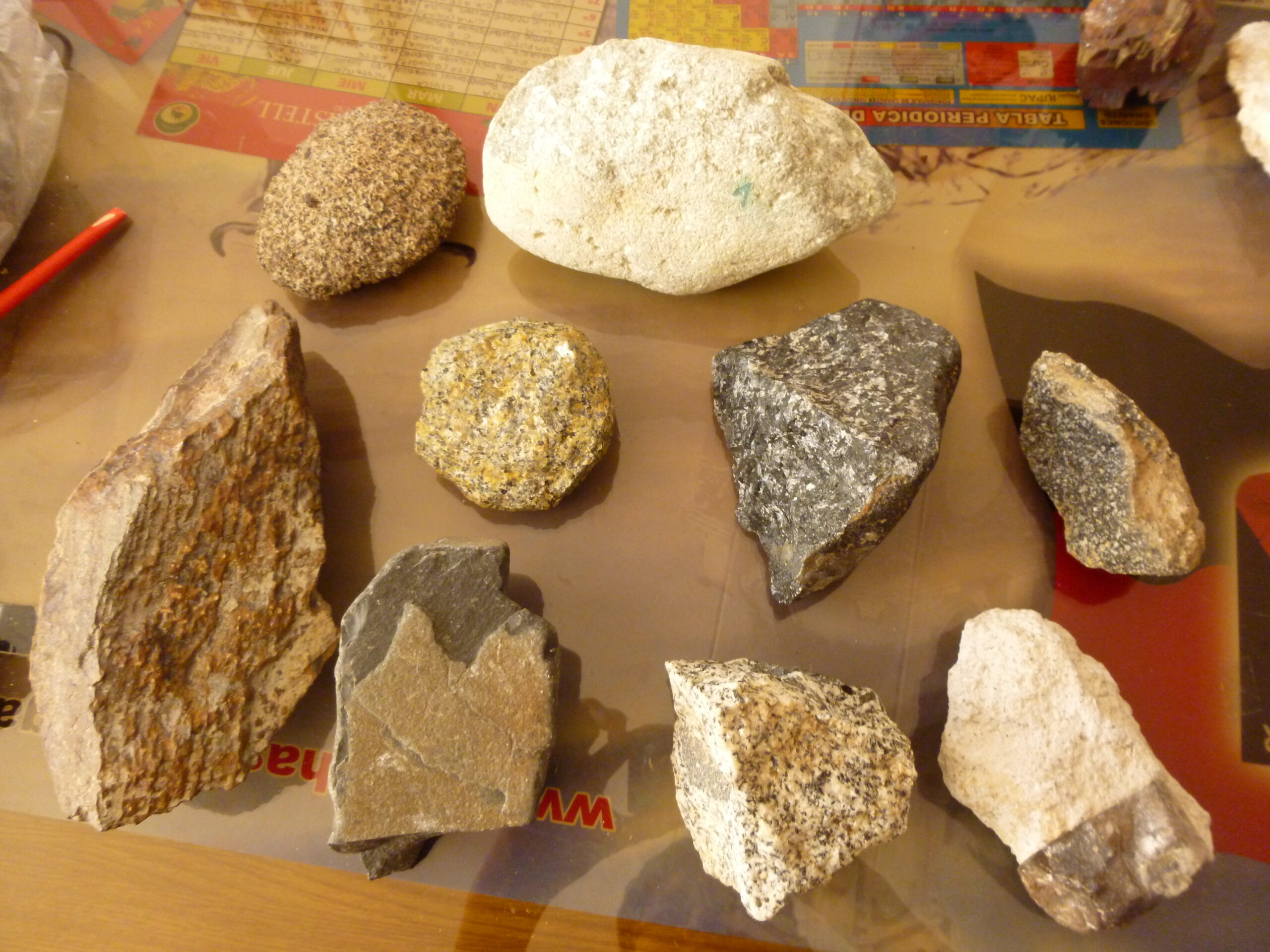
What the three rock families actually are
Geologists sort every rock by how it formed, not by colour or where you found it. Igneous rock crystallises from molten rock, either underground or after a volcanic eruption. Sedimentary rock builds up from particles — sand, mud, shell fragments, dissolved minerals — that settle in layers and cement together over time. Metamorphic rock starts as one of the other two, then gets baked and squeezed by heat and pressure deep in the crust until its minerals recrystallise into a new texture, without ever fully melting.
The rock cycle links all three: erosion turns any rock into the sediment that becomes sedimentary rock, heat and pressure can metamorphose any rock, and enough heat melts anything back into magma to start again as igneous rock.
Igneous rock: crystals from melted stone
Igneous rock is defined by interlocking crystals with no layering. Grain size tells you how it cooled: rock that cooled slowly underground, like granite, has crystals large enough to see and pick out individually. Rock that erupted and cooled fast at the surface, like basalt, has crystals too small to see, or no crystals at all in glassy obsidian. A speckled, salt-and-pepper look with visibly different mineral grains locked together is the classic igneous signature.
Sedimentary rock: built in layers
Sedimentary rock is the layered family. Look for visible bedding — parallel bands or stripes running through the rock — along with rounded grains you can sometimes see or feel, and a softer, sometimes crumbly feel compared to igneous or metamorphic rock. Many sedimentary rocks, especially limestone and shale, also contain fossils, which never occur in igneous or metamorphic rock because both processes destroy any trace of prior life.
Metamorphic rock: reshaped under heat and pressure
Metamorphic rock keeps some memory of what it used to be while gaining a new texture. The giveaway is usually foliation: platy or elongated minerals like mica squeezed into parallel, often wavy bands under directional pressure, as in gneiss and schist. Some metamorphic rocks instead recrystallise into an even, sugary texture with no banding at all, such as marble (from limestone) and quartzite (from sandstone) — these can be trickier and are usually identified by hardness and a parent rock that no longer shows any original layering.
Crystalline rocks (igneous or metamorphic)
- Interlocking mineral grains, no rounded particles
- No fossils, ever
- Igneous: random crystal orientation, speckled look
- Metamorphic: often banded, streaky or foliated
Layered rocks (sedimentary)
- Parallel bedding or stripes
- Rounded grains, sometimes visibly gritty
- Softer, sometimes crumbly or flaky
- May contain fossils or shell fragments
Igneous vs. metamorphic: the one mix-up worth knowing
The classic field confusion is granite versus gneiss. Both are hard, speckled, pale-to-grey rocks full of quartz, feldspar and mica. Granite’s minerals point every which way, giving it a uniform, salt-and-pepper look all over. Gneiss’s minerals are aligned into visible streaky bands, often slightly wavy, because it formed under directional pressure rather than simply cooling in place. If you can trace parallel stripes running through the rock, you are holding gneiss, not granite.
A 60-second field test
- Look for layers. Parallel stripes or bedding planes running through the rock point to sedimentary.
- Look for fossils or rounded grains. Either one confirms sedimentary on the spot.
- Look for banding without layering. Wavy, streaky mineral bands in a hard, crystalline rock point to metamorphic.
- Check crystal size. Large, individually visible crystals with no banding suggest slow-cooled igneous rock; a fine, glassy texture suggests fast-cooled igneous rock.
Why this matters for rockhounding
Knowing the host rock tells you what to expect inside it. Banded agate and crystal-lined geodes form in cavities within volcanic (igneous) rock, garnets and other gem minerals often turn up in metamorphic schist, and fossils are worth searching for only in sedimentary rock. Once you can sort a rock into its family at a glance, you can decide in seconds whether a stone is worth a closer look with a hand lens or a hardness test.
Frequently asked questions
What are the three main types of rock?
Igneous (formed from cooled molten rock), sedimentary (formed from layered, cemented particles) and metamorphic (formed when heat and pressure reshape an existing rock without melting it).
How can I tell igneous rock from metamorphic rock?
Both have interlocking crystals with no rounded grains, but metamorphic rock is often banded or streaky from directional pressure, while igneous rock is usually uniform in texture with crystals pointing every which way.
Do all sedimentary rocks contain fossils?
No. Fossils are common in limestone and shale but absent from many sedimentary rocks, such as pure sandstone. However, if a rock does contain a fossil, it is always sedimentary.
What is the difference between foliated and layered rock?
Foliation is metamorphic banding caused by minerals aligning under pressure, often wavy and made of platy minerals like mica. Sedimentary layering (bedding) comes from particles settling over time and tends to be flatter and more regular.
Can one rock type turn into another?
Yes — that is the rock cycle. Erosion turns any rock into sediment for new sedimentary rock, heat and pressure can metamorphose any rock, and enough heat melts any rock back into magma to cool as igneous rock.
Is grain size a reliable way to identify rock type?
It is a useful clue for igneous rock — coarse grains mean slow underground cooling, fine grains mean a fast surface eruption — but it should always be combined with layering, banding and fossil evidence rather than used alone.
Want reference rock samples to practise on?
Sponsored — partner shop · Minerals Kingdom
New to identifying stones? Get clear on the difference between a rock and a mineral, start with how to start rockhounding, then test hardness with our Mohs hardness scale guide and compare banded stones with our agate vs. jasper vs. chert guide.
Written by The Field & Stone Editors · Published by KEVALEX Group.