 FIELD
How to identify jade: nephrite, jadeite and the look-alikes
“Jade” is two different rocks that happen to look alike, and a dozen green stones that only pretend. Weight, hardness, luster and what you see through a thin edge will sort most of them out before you ever need a lab.
Few stones are misidentified as often as jade. The name covers two distinct materials — nephrite, a tough mat of amphibole fibres, and jadeite, a dense mass of interlocking pyroxene crystals — and the market is full of serpentine, aventurine, dyed quartzite and glass sold under the same word. For a rockhound picking up a green cobble on a river bar or a desert flat, the question is just as real: is this jade or just a green rock? This guide shows how to identify jade with simple field and kitchen-table tests, explains how nephrite and jadeite differ, lists the common impostors and notes where jade is actually found in the United States. It builds on our guides to hardness, specific gravity and mineral tenacity, the three properties that matter most here.
Two jades, not one
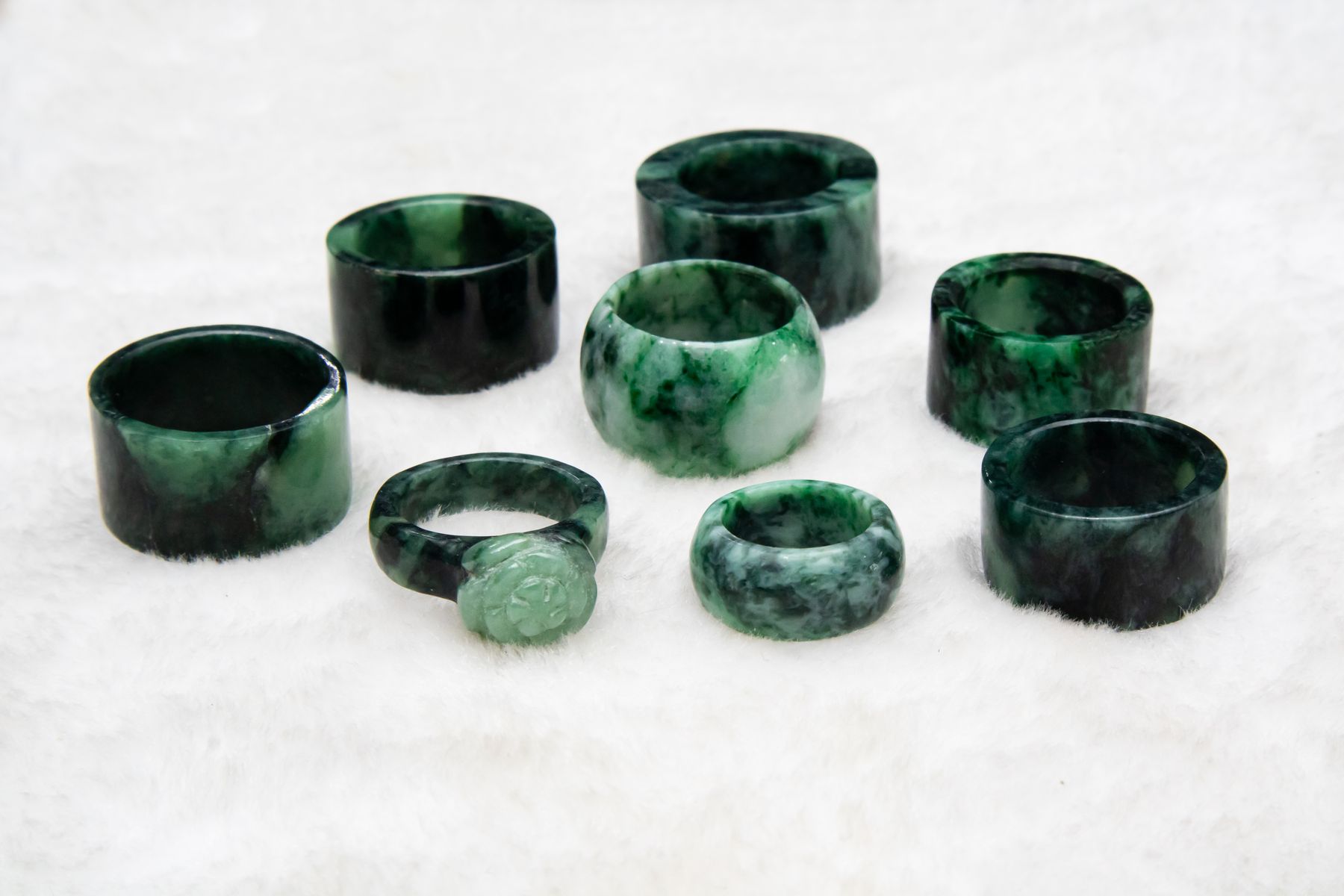
Until the nineteenth century, everything carved as jade was treated as a single stone. In 1863 the French mineralogist Augustin Damour showed that Chinese and Burmese carvings were made of two chemically different materials. Both are still called jade, and both are legitimate, but they behave differently under your tests.
Nephrite
- What it is → a rock made of tremolite–actinolite amphibole fibres, felted together
- Hardness → about 6 to 6.5 on the Mohs scale
- Specific gravity → roughly 2.90 to 3.03, typically near 2.95
- Luster → oily to waxy when polished, dull on weathered rind
- Colours → spinach to olive green, black, grey, cream (“mutton fat”)
- US sources → Wyoming, California, Alaska
Jadeite
- What it is → a sodium–aluminium pyroxene, a mass of small interlocking grains
- Hardness → about 6.5 to 7
- Specific gravity → roughly 3.30 to 3.38, typically near 3.33
- Luster → vitreous to greasy, often brighter than nephrite
- Colours → white, emerald green, lavender, yellow, black
- Main source → Myanmar; minor US occurrences in California
Both form under high pressure in metamorphic settings. Nephrite usually grows where serpentinite or dolomitic marble meets other rocks along fault zones; jadeite forms at very high pressure and relatively low temperature in subduction-zone rocks. That shared geology explains why jade so often turns up next to serpentine, its most common impostor. If those rock families are new to you, start with telling rock types apart and rock vs. mineral.
Why jade is so tough
Jade is not exceptionally hard — quartz is harder than nephrite — but it is extraordinarily tough. In nephrite, millions of microscopic fibres are woven together like felt, so a crack has to wander around them instead of running straight through. Jadeite’s interlocking grains do something similar. That toughness is why prehistoric people across the world used jade for axes and adzes, and it is also your best single clue in the field: real jade is very difficult to chip with a hammer, and fresh breaks are splintery or granular, never glassy and shell-like. Our tenacity and cleavage and fracture guides explain the difference.
How to identify jade, test by test
No single check proves jade. Work through the list below and look for a stone that passes all of them; serpentine, aventurine and glass each fail at least one.
1. Heft: does it feel heavy for its size?
Jade is noticeably denser than most green stones. Quartz-based look-alikes sit at about 2.65 and serpentine around 2.5 to 2.6, while nephrite is near 2.95 and jadeite around 3.33. Bounce a suspected piece in your palm next to a quartz pebble of the same size and the difference is often obvious. For a real number, weigh it in air and suspended in water, as shown in our specific gravity guide. This is the most reliable non-destructive home test, and it also separates nephrite from jadeite.
2. Hardness: knife and glass
Nephrite and jadeite both sit above ordinary steel and window glass. On rough material, try to scratch an inconspicuous spot with a steel pocketknife (about 5.5): genuine jade will not take a scratch, though the steel may leave a grey metal streak that rubs off. Serpentine, soapstone and green calcite scratch easily. The stone should also scratch glass. Never do this on finished jewellery or carvings, and remember that quartz-based fakes also pass the knife test, so hardness rules out soft impostors but not hard ones. See the Mohs scale for technique.
3. Luster on a fresh or polished surface
Polished nephrite has a soft, oily or waxy glow; jadeite is a little brighter and can look almost glassy. Aventurine and glass look sharper and more brilliant, and aventurine often shows tiny glittering flakes of mica. Weathered jade boulders wear a dull brown or white rind, so judge luster only on a cut or polished “window,” not on the outside. Our mineral luster guide shows the vocabulary.
4. Light through a thin edge
Shine a small flashlight through a thin edge or slice. Most jade is translucent, and under a 10× hand lens you should see structure inside the light: a fibrous, cottony or felted texture in nephrite, or a fine granular mosaic in jadeite. Glass shows round gas bubbles or swirl lines instead; dyed stone shows colour concentrated in cracks and along grain boundaries.
5. Fracture and texture
If a broken surface is available, look closely. Nephrite breaks with a rough, splintery surface; jadeite with a granular, sugary one. A smooth, curved, conchoidal break points to glass, chalcedony or quartz rather than jade.
6. Streak and colour
Both jades leave a white streak on unglazed porcelain, as do most of their imitators, so the streak test mainly helps rule out metallic or strongly coloured minerals. Colour on its own is almost useless: jade comes in many colours and many green rocks are not jade. Natural nephrite green is usually slightly greyed or olive, with darker flecks of chromite or magnetite in some pieces.
Common jade look-alikes
Most stones sold or found as “jade” that turn out not to be fall into a few groups. Learning their signatures saves a lot of disappointment.
- Serpentine (“new jade,” bowenite): green, translucent and often found right beside nephrite, but softer (about 2.5 to 5.5) and lighter (SG about 2.5 to 2.6). Many pieces scratch with a knife and feel soapy.
- Green aventurine quartz (“Indian jade”): hardness 7 and SG 2.65; look for glittering mica flakes under a lens.
- Dyed quartzite (“Malaysia jade”): bright, uniform green, with dye concentrated between sugary quartz grains.
- Chrysoprase and green chalcedony: waxy and translucent, but light (SG about 2.6) with smooth conchoidal fracture; see agate vs. jasper vs. chert.
- Prehnite, vesuvianite (“Californite”) and grossular garnet (“Transvaal jade”): real minerals that can be tough and pretty, but with different density and texture.
- Green calcite and soapstone: soft enough to scratch with a coin or knife; calcite also fizzes in acid, as in our acid test guide.
- Glass: conchoidal fracture, gas bubbles and swirl marks; SG varies but bubbles give it away.
Treated jade and when to use a lab
In the gem trade, jadeite is often sorted into three types. Type A is natural jadeite with only surface waxing. Type B has been bleached in acid and impregnated with polymer resin to hide stains, and Type C has been dyed, sometimes in addition to bleaching. Treated stones can pass every field test above, and resin-filled material is less durable over time. Gemmological laboratories identify treatments with a refractometer, spectroscope, ultraviolet light and infrared spectroscopy. If a stone carries a high price or a claim of natural colour, ask for a report from an independent lab rather than relying on home tests or a seller’s word.
Where jade is found in the United States
American jade is almost all nephrite, and the best-known sources are covered in our state guides.
- Wyoming: nephrite is the state gem, historically found as float in the central basins around the Sweetwater River and Jeffrey City. Much of the easy surface material is gone, and the checkerboard land pattern makes ownership checks essential; see rockhounding in Wyoming.
- California: nephrite washes out of serpentinite along the Big Sur coast, notably around Jade Cove, and jadeite occurs in the Franciscan rocks of the Coast Ranges. Coastal collecting is tightly regulated by the managing agencies; see rockhounding in California.
- Alaska: jade is the state gem, and large nephrite deposits occur in the Kobuk River region and the Jade Mountains of the northwest; see rockhounding in Alaska.
Wherever you search, look in stream gravels and beaches downstream of serpentinite belts, and watch for cobbles that stand out because they are smooth, heavy and resist the wear that rounds other stones.
Frequently asked questions
How can you tell if jade is real at home?
Combine three checks: it should feel heavy for its size (specific gravity about 2.95 for nephrite or 3.33 for jadeite), resist a steel knife on an unseen spot of rough material, and show a fibrous or granular texture inside when lit through a thin edge. Glass, serpentine and quartz-based fakes fail at least one of these.
What is the difference between nephrite and jadeite?
Nephrite is a fibrous amphibole rock with a hardness of about 6 to 6.5 and specific gravity near 2.95. Jadeite is a granular pyroxene, slightly harder at about 6.5 to 7 and denser at about 3.33. Weighing a stone in water is the easiest way to tell them apart.
Does real jade scratch?
A steel knife, at about 5.5 on the Mohs scale, should not scratch genuine jade, although it may leave a grey metal mark that wipes off. Harder materials such as quartz sand or corundum will scratch it, so jade can still wear over time.
What stone is most often mistaken for jade?
Serpentine is the most common look-alike, partly because it forms in the same rocks as nephrite. It is lighter and softer than jade and often scratches with a knife. Green aventurine and dyed quartzite are the most common imitations in jewellery.
Can you find jade in the United States?
Yes. Nephrite occurs in Wyoming, California and Alaska, and small amounts of jadeite occur in California. Collecting rules vary by land manager, and many famous localities are on private or protected land, so check access before you go.
Is the ring or tap test reliable for jade?
No. Many dense stones ring when tapped and feel cool to the touch. Specific gravity, hardness and the internal texture seen with a light and a hand lens are far more dependable.
Want a verified nephrite or jadeite specimen for comparison?
Sponsored — partner shop · Minerals Kingdom
Jade rewards careful testing more than a quick look. Measure density with our specific gravity method, confirm hardness with the Mohs scale, and study the inside of a thin edge with a hand lens.
Record where each piece came from and what tests it passed; our guide to cataloging a rock collection shows how.
Written by The Field & Stone Editors · Published by KEVALEX Group.