 FIELD
FIELD Diaphaneity: how much light a mineral lets through
Hold a stone to the light and it will do one of three things — let the view through clearly, glow with a blurred light, or stay stubbornly dark. That single observation has a name, and it quietly narrows a great many identifications.
Diaphaneity is the mineralogist’s word for how much light passes through a mineral — whether you can read newsprint through a slice, see only a soft glow, or nothing at all. It costs nothing to judge beyond a scrap of daylight, it takes a second, and paired with luster it splits the mineral world into broad groups faster than almost any other single look. A pale crystal you can see straight through is telling you something quite different from a dense lump that blocks the sun, and this guide explains how to read it.
What diaphaneity actually means
Diaphaneity — sometimes loosely called transparency or translucency — describes how freely light travels through a mineral rather than being absorbed or scattered back out. It is a property of the material and its condition, not of colour: a deep purple amethyst can still be perfectly transparent, while a snow-white piece of quartz can block light entirely. What matters is whether light rays pass through in an orderly way, pass through while being scattered, or are stopped altogether. Because the effect depends heavily on how thick the piece is, diaphaneity is always judged on a thin edge or a clean face, never on the bulk of a chunky specimen. Even a mineral that looks solid black in the hand may glow at its thinnest sliver, which is one of the more useful surprises the property has to offer.
The three grades worth knowing
Mineralogists recognise a short ladder of grades, but three of them do almost all the work in the field. Learn these first and treat the in-between terms as refinements you reach for only when a specimen sits awkwardly between them.
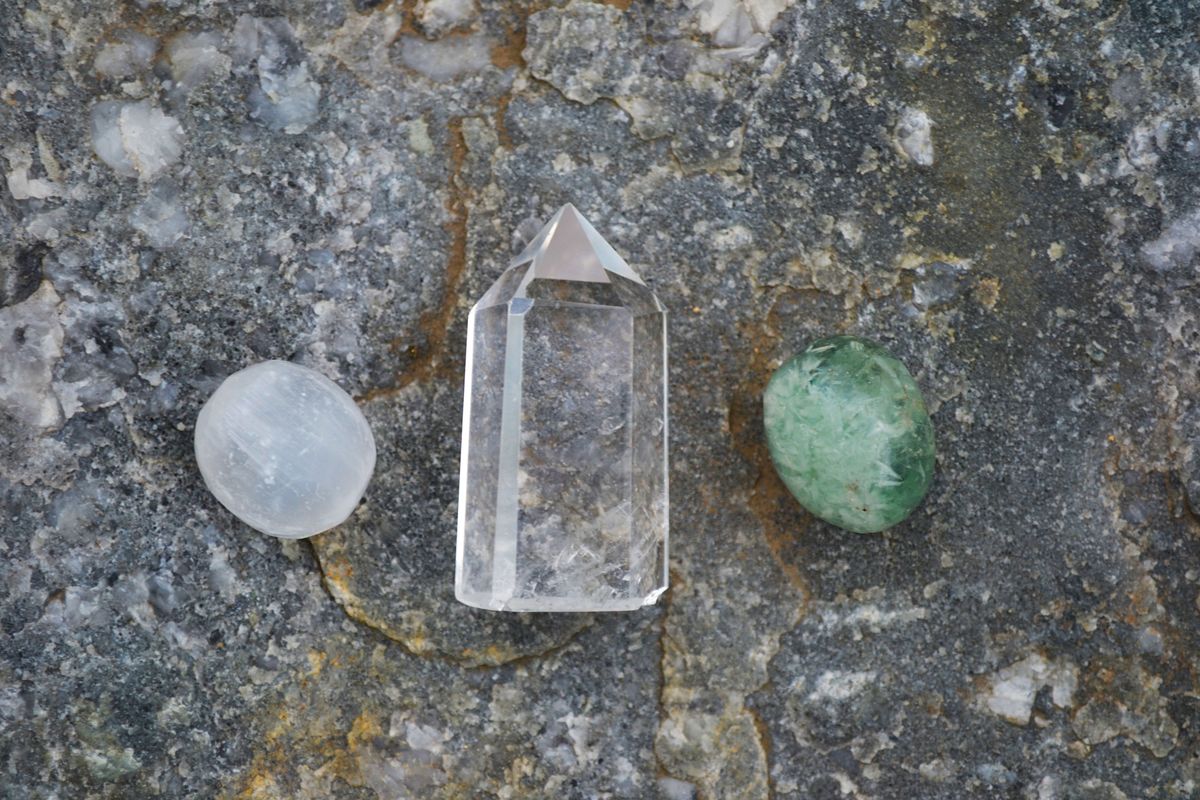
- Transparent — you can see an object clearly through the mineral, as through window glass. Clear quartz, gem selenite and Iceland-spar calcite are textbook examples.
- Translucent — light passes through but images do not; the mineral glows without letting you see detail. Chalcedony, milky quartz and much jade sit here.
- Opaque — no light passes even on a thin edge. Most metallic minerals, such as pyrite, magnetite and galena, are opaque.
- Semitransparent — a hazy image comes through, blurred but recognisable.
- Subtranslucent — light shows only at the very thinnest edges, and the body reads as almost opaque.
Lets light through
- Clear quartz — transparent
- Selenite & gem gypsum — transparent
- Iceland-spar calcite — transparent
- Chalcedony & opal — translucent
Blocks light
- Pyrite — opaque
- Magnetite — opaque
- Galena — opaque
- Hematite — opaque in the mass
How to test diaphaneity in the field
The test is as simple as it sounds. Pick the thinnest clean edge of the specimen, hold it up between your eye and the sky or a lamp, and note what comes through. If you can read the text of a field notebook held behind it, the mineral is transparent; if the edge lights up but the words are lost, it is translucent; if the edge stays dark, it is opaque. A small torch or phone light pressed against the back of the piece is even better, because it drives light through material that ordinary daylight cannot, and it will reveal a faint glow in many minerals that look solid at first glance. Always test a fresh surface: a weathered rind, a dusty coating or a frosted broken face will all scatter light and make a transparent mineral read as translucent or worse.
Why one mineral can show every grade
Diaphaneity is not fixed for a species, which is exactly why it must be judged carefully. The same quartz that is glass-clear in a thin sliver can look milky and translucent in a fist-sized lump, because countless microscopic fluid inclusions and healed fractures scatter the light on its way through. Thickness alone does much of this: any mineral becomes effectively opaque if the piece is thick enough, and even gold-standard transparent gems are only transparent because they are cut thin and clean. Inclusions, gas bubbles, tiny cracks and fine intergrowths all scatter light and drag a mineral down the scale. Hematite makes the point vividly — a solid lump is completely opaque, yet a wafer-thin edge or splinter transmits a deep blood red, which is the same red you see in its streak. Reading diaphaneity therefore means reading the condition of the piece as much as the mineral itself.
Where diaphaneity fits with the other field tests
On its own, diaphaneity rarely names a mineral, but it is a superb filter that tells you which slower tests are worth running. Its strongest partnership is with luster: a metallic luster combined with full opacity points hard at the sulfides and oxides — pyrite, galena, magnetite, hematite — while a mineral that is transparent or translucent is almost certainly non-metallic and belongs in the silicate, carbonate and halide camp. Layer in colour, crystal habit and hardness and the field narrows quickly: a transparent, glassy, hexagonal crystal that scratches steel is quartz; a transparent stone that shows a doubled image through it is Iceland-spar calcite, whose famous double refraction is a diaphaneity clue in itself. Diaphaneity also sets up the more spectacular tests — the play-of-colour and sheen covered in our guide to optical effects in minerals only appear in stones that let light in to begin with.
Cautions and common mistakes
A few things routinely fool beginners. The biggest is surface condition: a genuinely transparent mineral hidden under a weathered crust, mud or a frosted fracture will look translucent or opaque until you find a clean window or wet the surface. Give a promising piece a quick clean and test a fresh edge. Thickness is the second trap — never call a mineral opaque from a thick block alone; chip or find a thin edge first. Finally, do not confuse diaphaneity with colour or luster. A dark stone is not necessarily opaque, a pale stone is not necessarily transparent, and a shiny surface tells you about reflection, not transmission. Judge each property separately and let them agree.
Frequently asked questions
What is diaphaneity in minerals?
Diaphaneity is the degree to which a mineral transmits light — whether you can see through it, see only a blurred glow, or see nothing at all. It is judged on a thin edge and is closely related to, but distinct from, colour and luster.
What are the three types of diaphaneity?
Transparent (an object is clearly visible through the mineral), translucent (light passes but images are blurred) and opaque (no light passes even on a thin edge). Semitransparent and subtranslucent describe the grades in between.
How do you test transparency in the field?
Hold the thinnest clean edge of the specimen up to the sky or a lamp, or press a small torch against the back of it. If you can read text through it, it is transparent; if it only glows, translucent; if it stays dark, opaque. Always use a fresh, clean surface.
Can the same mineral be both transparent and opaque?
Yes. Thickness, inclusions and fractures all scatter light, so a mineral that is transparent in a thin, clean sliver can be milky or opaque in a large or flawed piece. Hematite is opaque in the mass yet transmits deep red on a thin edge.
Which minerals are opaque?
Most minerals with a metallic luster are opaque, including pyrite, galena, magnetite and massive hematite. As a rule of thumb, a metallic look and full opacity go together, while non-metallic minerals are usually at least translucent.
Is diaphaneity related to luster?
Closely. Metallic minerals are almost always opaque, and transparent or translucent minerals almost always have a non-metallic luster. Judging diaphaneity and luster together is one of the quickest ways to sort an unknown into a broad group.
Want clear reference crystals to train your eye?
Sponsored — partner shop · Minerals Kingdom
Diaphaneity works best alongside the rest of the field-test toolkit — mineral luster, the streak test, mineral colour, the Mohs hardness scale and crystal habit. New to the hobby? Start with how to start rockhounding.
Clarity is also affected by what is inside a crystal; see how to read needles, flakes and bubbles in our guide to quartz inclusions.
Written by The Field & Stone Editors · Published by KEVALEX Group.