 FIELD
How to identify garnet in rocks, sand and streams
Garnet is one of the most common gem minerals a rockhound will ever pick up — and one of the easiest to recognise once you know its ball-like crystals, its hardness and its weight. A few quick checks separate it from ruby, spinel, staurolite and red glass.
Garnet is not a single mineral but a family of closely related silicate minerals that share the same cubic crystal structure. Dark red almandine is the one most people picture, but garnets also come in orange, green, brown, black and pink. In the field they turn up as rounded, many-faced crystals sitting in schist and gneiss, as loose grains in river gravel and beach sand, and as the heavy red specks left in a gold pan. This guide shows how to identify garnet with simple tests, explains the main garnet species, and lists the look-alikes to rule out. It pairs well with our guides to crystal habit, hardness and specific gravity.
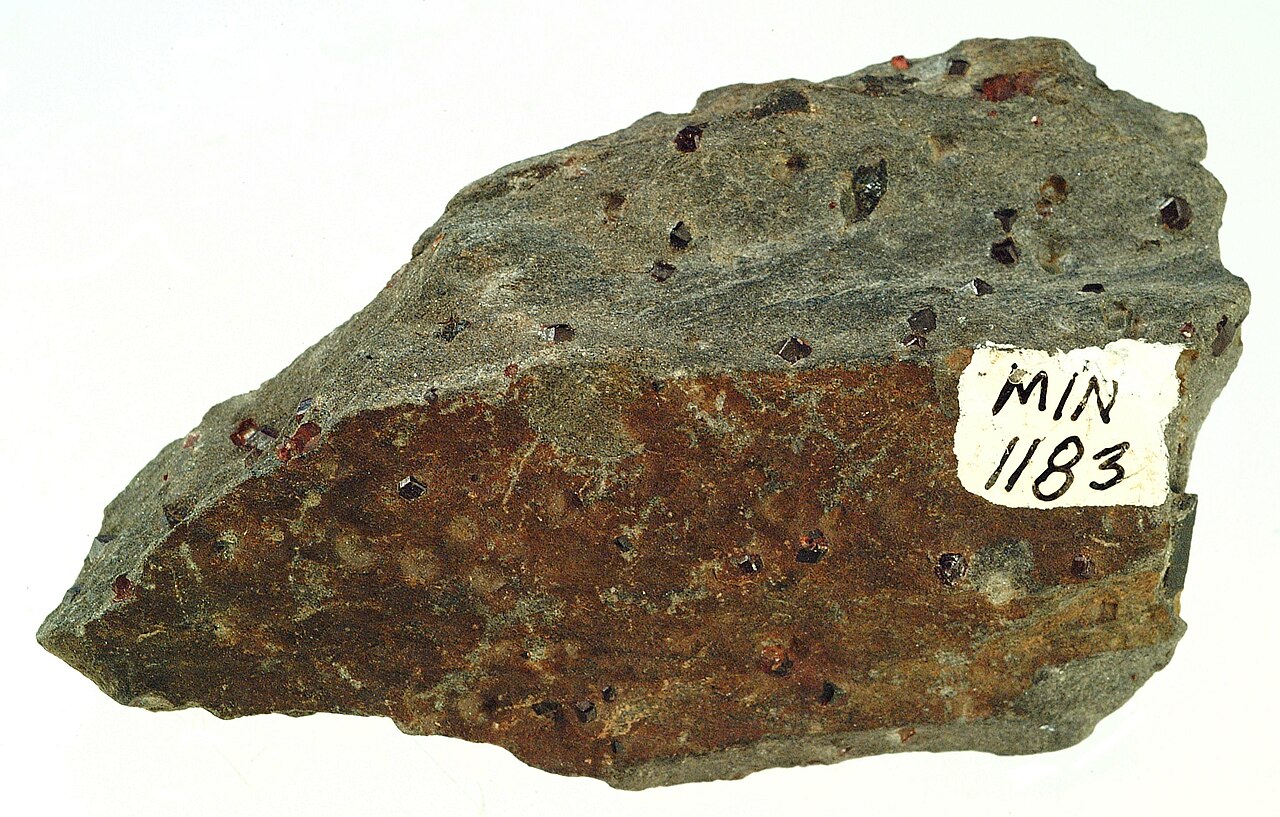
What garnet actually is
Garnets are nesosilicates: isolated silica tetrahedra bound together by metal ions such as iron, magnesium, calcium, manganese, aluminium and chromium. Swap one metal for another and you get a different species, but the framework stays the same, which is why all garnets look and behave so alike. Mineralogists usually split the family into two series. The pyralspite series contains pyrope, almandine and spessartine; the ugrandite series contains uvarovite, grossular and andradite. Real specimens are almost always mixtures, so a stone is named for the end-member that dominates.
Garnet belongs to the isometric (cubic) crystal system. That single fact explains most of its field character: equant, ball-like crystals, no cleavage, and light that passes through it without splitting in two.
Where garnet forms
Most garnet grows during metamorphism, when heat and pressure recrystallise clay-rich rocks into mica schist and gneiss. Almandine is the classic metamorphic garnet, and its crystals often stand out from the rock like raisins in a cake. Grossular and andradite form in skarns, where hot fluids react with limestone or marble. Spessartine is typical of granite pegmatites, pyrope comes from deep mantle rocks such as peridotite and kimberlite, and a few garnets grow in cavities in volcanic rocks like rhyolite. If you are unsure which rock family you are standing on, start with igneous vs. sedimentary vs. metamorphic.
Because garnet is hard, heavy and resists weathering, it survives long after its host rock has crumbled. It collects in stream gravels and beach sands, often as pink, red or purple bands, and it is one of the most familiar heavy minerals in the concentrate at the bottom of a gold pan.
Field tests for garnet
As with any mineral, no single property clinches it. Garnet passes a short checklist that few look-alikes pass together.
Look at the crystal shape
This is the best clue. Garnet crystals are usually dodecahedra (twelve diamond-shaped faces) or trapezohedra (twenty-four four-sided faces), or a combination of both. Either way they look rounded and roughly spherical, not long or flat. Even worn grains in sand tend to stay chunky and equant. A hand lens often reveals flat faces and sharp edges on crystals as small as a pinhead.
Check hardness
Garnets measure roughly 6.5 to 7.5 on the Mohs scale. A fresh crystal will scratch glass and a steel knife blade, and most will scratch or match quartz. That rules out soft red minerals such as cinnabar, red calcite and many glass imitations. Test on an inconspicuous spot.
Feel the weight
Garnet is noticeably heavy for a non-metallic mineral. Its specific gravity runs from about 3.6 for pyrope and grossular to about 4.3 for almandine, compared with about 2.65 for quartz. A garnet-rich chunk of schist feels heavier than it looks, and garnet grains sink with the other heavy minerals when you pan.
Look at luster, fracture and streak
Fresh surfaces show a vitreous to resinous luster. Garnet has no cleavage; broken pieces show conchoidal to uneven fracture, sometimes with flat parting planes. The streak is white or very pale, whatever the colour of the crystal, although the hardness of garnet means it may scratch a streak plate instead of leaving powder.
Try a strong magnet
Iron-rich garnets, especially almandine and andradite, and manganese-rich spessartine are often drawn to a strong neodymium magnet, while magnesium-rich pyrope and calcium-rich grossular react weakly or not at all. Hang a loose grain from a thread and bring the magnet close. The response is weak compared with magnetite, as explained in testing minerals with a magnet, but it is a useful clue for sorting garnet species and separating garnet from non-magnetic red stones.
The main garnet species
Colour narrows things down, but colour is the least reliable clue on its own, so read it together with the host rock.
Pyralspite garnets
- Almandine → deep red to purplish or brownish red; schist and gneiss; the most common garnet
- Pyrope → blood red, often clear; mantle rocks and the gravels derived from them
- Spessartine → orange to reddish brown; pegmatites and manganese-rich rocks
- Rhodolite → trade name for a pinkish-purple pyrope–almandine mix
Ugrandite garnets
- Grossular → colourless, cinnamon, orange or green; skarns and marbles (hessonite, tsavorite)
- Andradite → brown, black or yellow-green; skarns (melanite is black, demantoid is green)
- Uvarovite → emerald green, usually tiny crystals; chromium-bearing rocks
Some almandine contains fine needles of rutile aligned along the crystal structure. Cut as cabochons, these stones show a four- or six-rayed star, an effect covered in optical effects in minerals. Idaho is famous for them; see our Emerald Creek star garnet site guide.
Look-alikes to rule out
- Ruby (red corundum) is much harder (9) and forms six-sided barrels or flat plates, not ball-like crystals. It is also doubly refractive, while garnet is singly refractive.
- Red spinel also belongs to the cubic system but typically forms sharp octahedra (eight triangular faces) and is harder, around 8.
- Staurolite is brown, forms elongated prisms and famous cross-shaped twins (see crystal twinning), and often grows beside garnet in the same schist.
- Red or pink tourmaline (rubellite) forms long, striated prisms with a rounded triangular cross-section.
- Zircon can be red-brown and heavy, but its crystals are square prisms capped by pyramids, and it shows strong double refraction under a lens.
- Glass and slag are softer (about 5.5), lighter, and often show round gas bubbles or mould seams.
- Cuprite and cinnabar are red but soft, give red streaks and feel distinctly heavier or more metallic.
Where to look for garnet
Garnet is widespread across the United States. Metamorphic belts in New England, the Appalachians, the northern Rockies and Alaska host abundant almandine; Connecticut has adopted almandine as its state mineral, New York and Vermont have garnets as their state gems, and Idaho has chosen the star garnet. Good public starting points on this site include Garnet Hill near Ely, Nevada, where dark red garnets weather out of volcanic rock, and the Emerald Creek fee area in Idaho. Stream gravels below garnet schist are worth panning almost anywhere. New to the hobby? Read how to start rockhounding first.
Cleaning and keeping your finds
Garnet is tough enough for a soft brush, water and a little dish soap; iron stains on crystals in schist can be reduced with patient soaking, as described in how to clean rock finds. Avoid knocking crystals out of their matrix, because garnets “on rock” usually make the better display piece. Rough garnet tumbles well thanks to its hardness and lack of cleavage (see how to tumble rocks), though heavily fractured pieces may break up. January’s traditional birthstone, garnet is also used industrially as an abrasive in sandpaper, blasting media and waterjet cutting.
Frequently asked questions
How can I tell if a red stone is a garnet?
Check the shape, hardness and weight together. Garnets usually form rounded twelve- or twenty-four-faced crystals, scratch glass with a hardness of about 6.5 to 7.5, feel heavy for their size, have no cleavage and leave a white streak. Iron-rich garnets are often weakly attracted to a strong magnet.
What rocks contain garnet?
Garnet is most common in metamorphic rocks such as mica schist, gneiss and skarn. It also occurs in granite pegmatites, some volcanic rocks, mantle rocks such as peridotite, and as weathered grains in river gravels and beach sands.
What is the hardness of garnet?
Garnet measures about 6.5 to 7.5 on the Mohs scale, depending on the species. It scratches glass and a steel knife blade and is close to quartz in hardness.
Is garnet magnetic?
Iron- and manganese-rich garnets such as almandine, andradite and spessartine are often weakly attracted to a strong neodymium magnet. Pyrope and grossular usually show little or no response. Garnet is far less magnetic than magnetite.
What is the difference between garnet and ruby?
Ruby is corundum, with a hardness of 9, six-sided crystals and double refraction. Garnet is softer, about 6.5 to 7.5, forms rounded cubic-system crystals and is singly refractive.
Why do I find red sand in my gold pan?
Red, pink or purple grains that stay in the pan with black sand are very often garnet. Garnet is dense and resistant to weathering, so it concentrates with gold, magnetite and other heavy minerals in stream gravels.
Want a labelled garnet specimen to compare your finds against?
Sponsored — partner shop · Minerals Kingdom
Garnet is easy to confirm once you stack the clues. Read the ball-like crystal habit, scratch-test it against the Mohs scale, heft it with our specific gravity guide, and check the shine with our luster guide.
Once identified, give each piece a number and a label; our guide to cataloging a rock collection shows how.
Written by The Field & Stone Editors · Published by KEVALEX Group.