 FIELD
FIELD How to identify obsidian (volcanic glass)
Obsidian looks like black glass because it is glass — lava that cooled too fast to grow crystals. A few quick checks on luster, fracture, hardness and edge translucency separate the real thing from slag, tourmaline and other dark look-alikes.
Obsidian is natural volcanic glass: a hard, brittle, usually black rock that forms when silica-rich lava is chilled so quickly that its atoms never organise into crystals. It is one of the easiest rocks to recognise once you know the signs — a mirror-like surface, curved shell-shaped breaks and razor-sharp edges — and one of the easiest to confuse with manufactured glass or other dark stones if you do not. This guide shows how to identify obsidian in the field with simple tests, explains the varieties you may meet, from snowflake to rainbow, and lists the look-alikes worth ruling out. It works best alongside our guides to hardness, luster and cleavage and fracture.
What obsidian actually is
Obsidian forms when thick, silica-rich lava — usually rhyolite, with roughly 70 percent silica or more — cools so fast that crystals have no time to grow. That happens at the chilled edges of lava flows and domes, and where lava meets water, ice or cold air. The result is an amorphous solid: a true natural glass with no internal crystal lattice. Strictly speaking that makes it a mineraloid rather than a mineral (see rock vs. mineral), and it is classed as an igneous rock. Its dark colour comes from tiny inclusions of iron-bearing minerals scattered through the glass; pure silica glass would be colourless.
Because glass is unstable over geological time, obsidian tends to be geologically young. Over millions of years it slowly absorbs water and alters, eventually breaking down into the pale, crumbly volcanic glass called perlite, or crystallising into a dull fine-grained rock. That is why most obsidian you can collect comes from relatively recent volcanic fields.
Field tests for obsidian
No single test is decisive, but obsidian passes a short checklist that few look-alikes pass all at once. Work through these in order.
Look at luster and surface
Fresh obsidian has a bright vitreous (glassy) luster, often almost mirror-like on a clean break. Weathered pieces can wear a dull grey or brown rind, so always judge the stone by a fresh broken surface, not by the outside. A hand lens will show smooth glass with no grains, plus fine details such as flow banding or tiny gas bubbles.
Check the fracture
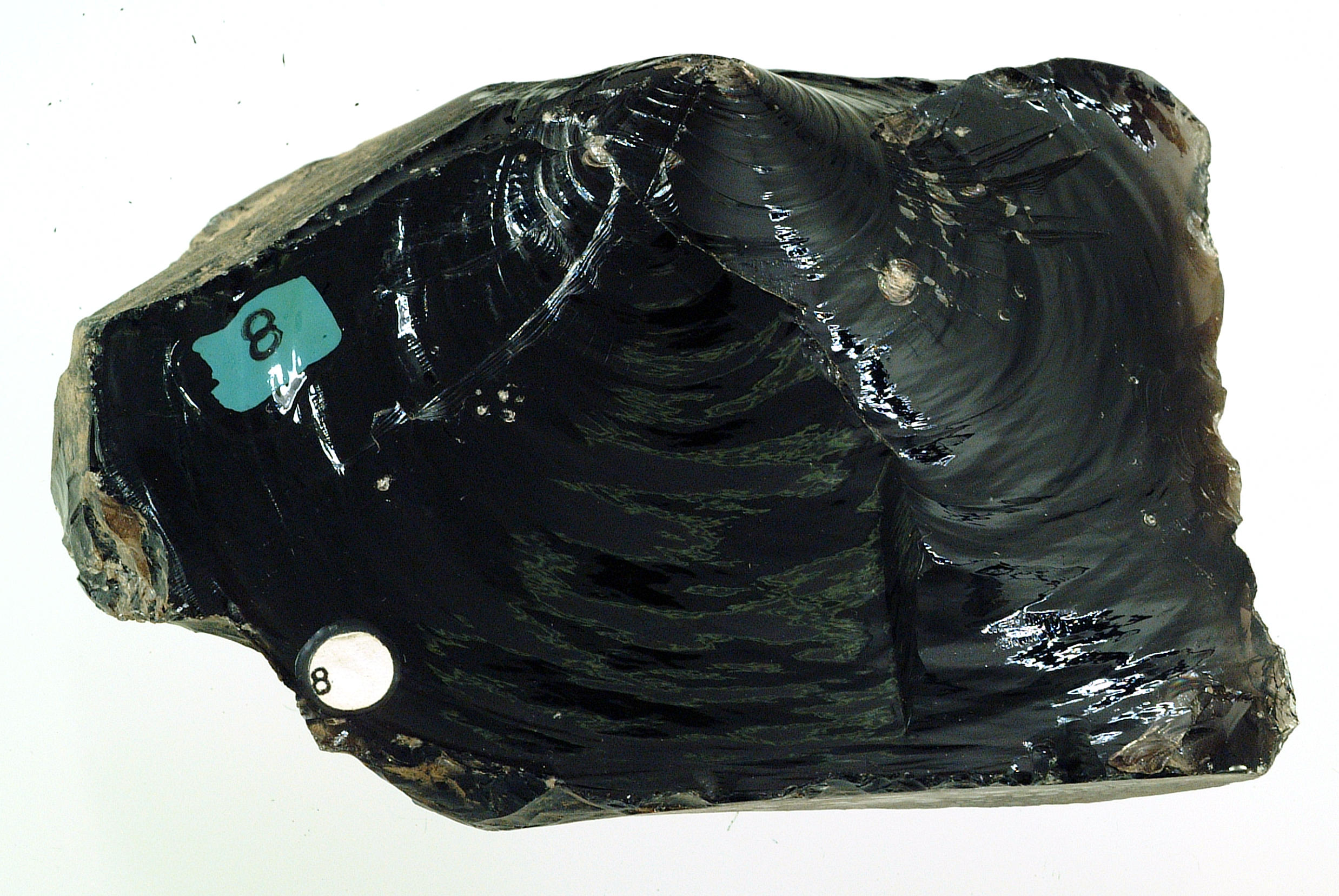
This is the single best clue. Obsidian breaks with conchoidal fracture: smooth, curved surfaces marked with concentric ripples, like the inside of a clam shell, as visible in the photograph above. There are no flat cleavage faces because there is no crystal structure to split along. Thin broken edges are razor-sharp, which is why people made cutting tools from obsidian for thousands of years.
Test hardness and streak
Obsidian measures about 5 to 5.5 on the Mohs scale: harder than a copper coin, close to window glass and a knife blade, and softer than quartz, which will scratch it. Test on a hidden spot, because a hard scratch can chip the edge. Rubbed on a ceramic plate, obsidian leaves a pale grey to white powder, as explained in our streak test guide.
Hold a thin edge to the light
Even jet-black pieces are usually translucent along thin edges, glowing smoky grey or brown against a bright sky. Opaque black stones such as chert, basalt and jet stay dark at the edge. See transparent, translucent and opaque for how to judge this.
Feel the weight
Obsidian has a specific gravity of around 2.4 to 2.6, about the same as quartz. That feels light for a dark stone, and it helps rule out heavy black minerals such as hematite and magnetite, which are roughly twice as dense.
Varieties you may meet
Plain black is the norm, but impurities and tiny structures inside the glass create several recognisable types. Many show effects described in our guide to optical effects in minerals.
Common varieties
- Black → the classic form, glassy and smoky at thin edges
- Mahogany → red-brown swirls from fine iron oxide in the glass
- Snowflake → white to grey radiating spots of tiny cristobalite crystals
- Sheen and rainbow → gold, silver or banded colour from aligned bubbles or inclusions
- Apache tears → rounded, smoky nuggets found inside perlite
Quick checks
- Tilt it — sheen and rainbow effects appear only at certain angles
- Use a lens — look for flow banding, bubbles and radial spots
- Break a thin edge — most varieties turn smoky and translucent
- Check the rind — a dull outer skin is normal weathering
Look-alikes to rule out
Several dark materials can pass for obsidian at a glance, and each fails at least one of the tests above.
- Manufactured glass and slag often shows round gas bubbles, mould seams or unnaturally bright blue, green or purple colour. Brilliant green “obsidian” sold in shops is typically man-made glass.
- Black tourmaline (schorl) forms striated prismatic crystals and is harder, around 7 to 7.5. It also occurs as needles inside quartz; see quartz inclusions.
- Jet is fossil wood: soft (about 2.5 to 4), warm to the touch and brown in streak.
- Basalt is a dull, fine-grained crystalline rock, often dotted with small cavities, without glassy luster.
- Black chert and flint have a waxy rather than glassy shine and stay opaque at thin edges; see our agate, jasper and chert guide.
- Pitchstone is volcanic glass with more water in it, so it looks duller and resinous rather than brilliant.
- Tektites are glass formed by meteorite impacts. They are usually pitted and sculpted; our meteorite guide helps with unusual glassy finds from non-volcanic ground.
Where to look for obsidian
Obsidian turns up wherever silica-rich volcanoes have erupted. In the western United States, notable fields lie in Oregon, California, Nevada, Idaho, Wyoming, Arizona and New Mexico. One of the best-known public collecting areas is covered in our Glass Butte obsidian site guide. Always confirm land status and local rules before you dig: collecting is prohibited in national parks, and agencies set their own limits on federal land. If you are new to the hobby, start with how to start rockhounding.
Cleaning and keeping your finds
Rinse obsidian in water and scrub gently with a soft brush; it needs nothing harsher (more in how to clean rock finds). It is brittle, so store pieces apart from harder stones that could chip the edges, and avoid tossing it in a tumbler with coarse grit unless you accept that edges will round off quickly. Obsidian is also popular for cabochons, carving and display pieces, valued for its mirror-like finish and for its long role in human toolmaking.
Frequently asked questions
What is obsidian and how does it form?
Obsidian is natural volcanic glass. It forms when silica-rich lava, usually rhyolite, cools so quickly that atoms cannot arrange into crystals. The result is a hard, glassy rock that is typically black because of tiny iron-bearing inclusions.
How can you tell real obsidian from black glass?
Look for conchoidal fracture with concentric ripples, a smoky translucent thin edge, flow banding or tiny crystal spots under a lens, and a hardness near 5 to 5.5. Manufactured glass often has round bubbles, mould seams or unnaturally bright colours, though a careful test chain is the only reliable answer.
What is the hardness of obsidian?
Obsidian measures about 5 to 5.5 on the Mohs scale, similar to window glass and a steel knife blade. It scratches a copper coin but can be scratched by quartz.
What are snowflake obsidian and Apache tears?
Snowflake obsidian is black glass with white to grey radiating spots of tiny cristobalite crystals. Apache tears are small rounded nodules of obsidian found inside perlite, usually smoky and translucent when held to the light.
Is obsidian a mineral?
Not strictly. A mineral needs an ordered crystal structure, and obsidian is amorphous glass, so geologists call it a mineraloid. It is classed as an igneous rock.
Is obsidian dangerous to handle?
Fresh obsidian can have edges sharper than a steel razor. Wear cut-resistant gloves and eye protection when breaking or trimming it, and handle broken pieces carefully.
Want a real obsidian specimen to compare your finds against?
Sponsored — partner shop · Minerals Kingdom
Obsidian is simple to confirm once you stack the clues. Check the shell-like fracture, scratch-test it against the Mohs scale, read the surface with a hand lens, and confirm the glassy shine with our luster guide.
Once identified, give each piece a number and a label; our guide to cataloging a rock collection shows how.
Written by The Field & Stone Editors · Published by KEVALEX Group.