 FIELD
FIELD How to identify meteorites
A genuine meteorite is a rock older than the Earth’s crust, delivered free to a field or desert floor. Real ones are rare — but they carry a short list of tell-tale clues you can check with a magnet and a hand lens.
Meteorites are fragments of asteroids — and, rarely, of the Moon or Mars — that survived the fiery plunge through Earth’s atmosphere and reached the ground. To a rockhound they are the ultimate find, but true meteorites are genuinely scarce, and the great majority of rocks brought in as « space rocks » turn out to be ordinary terrestrial stones or industrial slag. The good news is that a real meteorite carries a small set of diagnostic properties you can check with a magnet, a hand lens and a kitchen scale, using the same disciplined approach you already bring to the magnet test or the streak test. This guide explains what a meteorite actually is, sorts the three main families, walks through the field checks that separate a true fall from a hopeful look-alike, and points you to the specialists who can confirm a genuine find.
What a meteorite is
A meteoroid is a chunk of rock or metal travelling through space; when it enters the atmosphere and blazes across the sky it is a meteor, or shooting star; and any piece that survives to land is a meteorite. Most come from the asteroid belt between Mars and Jupiter, broken from bodies that formed at the very birth of the Solar System some 4.5 billion years ago — which makes even a small specimen older than any rock you will ever pick up on Earth. As it falls, the outer skin melts and streams away, leaving a thin, dark fusion crust. The interior stays cool and unaltered, so a broken face reveals fresh material that looks nothing like the weathered rind. Because meteorites are so often rich in iron-nickel metal, they tend to be unusually heavy for their size and to tug at a magnet — two of the first clues any field test relies on.
The three main families of meteorite
Meteorites are traditionally divided into three broad groups by how much metal they contain. Knowing which family a suspect rock might belong to tells you which field tests will be most useful.
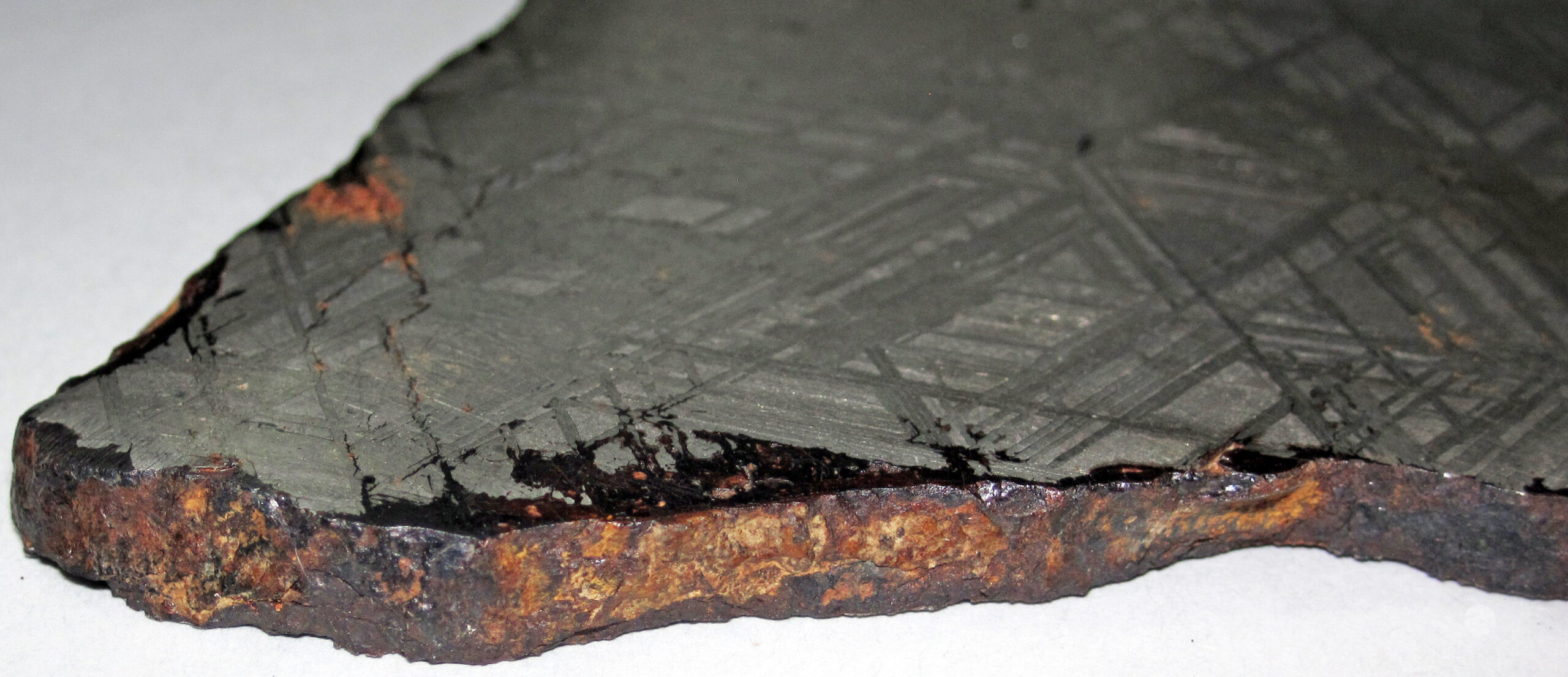
- Iron meteorites — almost solid iron-nickel metal. Dense, strongly magnetic, and the type that shows the famous Widmanstätten pattern when a cut face is polished and etched with acid.
- Stony meteorites — by far the most common, made mostly of silicate minerals. Ordinary chondrites contain tiny round grains called chondrules and specks of metal, so they are moderately heavy and mildly magnetic.
- Stony-iron meteorites — rare and beautiful mixtures of metal and silicate. Pallasites carry green or amber olivine crystals set in a nickel-iron matrix.
Two clarifications matter in the field. First, most stony meteorites are chondrites, and their chondrules are a strong clue, but the rarer achondrites lack them and can be very hard to spot. Second, a few Moon and Mars meteorites exist, but they are extraordinarily rare and are confirmed only by laboratory analysis, never by eye.
Signs that point to a meteorite
- Thin dark fusion crust over a lighter interior
- Unusually heavy for its size (dense)
- Attracts a magnet, often strongly
- Shiny metal flecks on a broken face
- No holes, bubbles or layering inside
Signs it is probably a meteorwrong
- Vesicles (gas holes) or a bubbly, glassy look
- Sedimentary layering or visible quartz crystals
- Leaves a coloured streak on a tile
- Light in the hand, or not magnetic at all
- Rounded like a river cobble, with no crust
How to test a suspect rock in the field
No single test is conclusive, but a short sequence quickly weeds out most impostors. Start with a magnet: nearly all meteorites contain iron-nickel metal, so a strong neodymium magnet will cling to, or at least noticeably drag on, a genuine specimen. A rock that ignores the magnet entirely is almost never a meteorite. Next, judge the weight: meteorites feel distinctly heavier than ordinary rocks of the same size because of that metal, a property you can put numbers on with the specific-gravity test. Look for a fusion crust — a smooth, dull-black or brown skin, sometimes with shallow thumbprint-like depressions called regmaglypts — and grind a tiny window on one corner: a fresh face showing bright metal flecks or small round chondrules is very promising. Finally, run the streak test. A true meteorite leaves little or no streak on an unglazed tile, whereas the common look-alikes hematite and magnetite leave a red-brown or grey-black mark. Used together, these checks — magnet, heft, crust, window and streak — will settle the great majority of cases.
The Widmanstätten pattern and cutting a specimen
The single most beautiful confirmation belongs to iron meteorites. When a slab is cut, polished and lightly etched with dilute acid, many irons reveal the Widmanstätten pattern — an interlocking lattice of long metallic bands that formed as nickel-iron alloys cooled over millions of years deep inside an asteroid. No terrestrial process makes it, and no human foundry can fake it, so a clear Widmanstätten pattern is proof positive of an iron meteorite. Cutting a specimen is a job for a lapidary saw and should be done only once you are confident of a find, because it permanently alters the piece; many collectors prefer to keep a whole individual with its crust intact and buy a separate etched end-cut to display the pattern. A hand lens, patience and a habit of turning the specimen to catch the light — the same care you use to read luster — go a long way before any saw comes out.
Meteorwrongs: the usual suspects
Far more rocks look like meteorites than actually are, and learning the common « meteorwrongs » saves a lot of disappointment. Industrial slag from old smelters is the classic false alarm: it is heavy and sometimes magnetic, but it is full of gas holes and has a glassy, bubbly texture no meteorite shows. Magnetite and hematite are dense, iron-rich and magnetic, but they leave a distinct streak — grey-black for magnetite, red-brown for hematite — whereas meteorites do not. Basalt and other dark volcanic rocks can look the part but are lighter, may contain visible gas vesicles, and lack any fusion crust. Ordinary iron concretions and man-made bits of cast iron round out the list. The tell-tale differences are consistent: real meteorites have no vesicles, no sedimentary layering, no quartz crystals and no strong streak, and they carry a genuine crust rather than rust. When two or three of these red flags appear together, you are almost certainly holding a terrestrial rock.
Getting a find confirmed
Field tests can make a strong case, but only a specialist can give a genuine meteorite its name. If a rock passes the magnet, heft, crust, window and streak checks, resist the urge to saw or clean it aggressively and instead contact a university geology department, a natural-history museum or an established meteorite laboratory. Confirmation usually involves examining a thin section under the microscope and measuring the nickel content of the metal, work that separates a true fall from a convincing look-alike beyond doubt. Photograph the specimen where it lay and note the location, since a documented find is far more valuable to science. This is the same spirit of careful, evidence-based identification that runs through every field test — the Mohs hardness scale, the magnet, the streak plate — where a confident answer rests on several clues agreeing, not on a single hopeful glance.
Frequently asked questions
What is a meteorite?
A meteorite is a piece of rock or metal from space — usually a fragment of an asteroid, rarely of the Moon or Mars — that survived its fall through the atmosphere and landed on Earth. Most are about 4.5 billion years old, older than any rock formed on Earth itself.
How can I tell if a rock is a meteorite?
Run a short sequence of tests: try a strong magnet, feel whether the rock is unusually heavy for its size, look for a thin dark fusion crust, grind a small window to check for metal flecks or chondrules, and run a streak test. A meteorite is magnetic, dense, crusted and leaves little or no streak.
Are all meteorites magnetic?
Almost all are at least mildly magnetic, because most contain iron-nickel metal. Iron and stony-iron meteorites are strongly magnetic; ordinary stony chondrites are moderately so. A rock that a strong magnet ignores completely is very unlikely to be a meteorite, though a few rare achondrites have little metal.
What is the Widmanstätten pattern?
It is an interlocking lattice of metallic bands revealed when a cut and polished iron meteorite is etched with dilute acid. The pattern forms as nickel-iron alloys cool over millions of years inside an asteroid, and because no earthly process reproduces it, a clear Widmanstätten pattern proves a genuine iron meteorite.
What is a « meteorwrong »?
A meteorwrong is a terrestrial rock or man-made object mistaken for a meteorite. The usual suspects are industrial slag, magnetite, hematite, basalt and iron concretions. Gas holes, sedimentary layering, visible quartz and a strong coloured streak are all signs you are holding a meteorwrong.
How do I get a suspected meteorite confirmed?
Contact a university geology department, a natural-history museum or an established meteorite laboratory. Confirmation typically involves a thin section under the microscope and a measurement of the metal’s nickel content. Avoid cutting or heavily cleaning the specimen first, and record exactly where you found it.
Want a real meteorite for your collection?
Sponsored — partner shop · Minerals Kingdom
Identifying a meteorite draws on the same quick tests you carry into the field — the magnet, the heft of specific gravity and the streak plate — and it pairs naturally with knowing how to tell a fossil from a rock. New to the hobby? Start with how to start rockhounding, then keep a magnet in your kit for the day a heavy, dark stone refuses to let go.
Written by The Field & Stone Editors · Published by KEVALEX Group.