Rising from the high desert between Bend and Burns, Glass Butte and Little Glass Butte hold one of the finest obsidian deposits in North America — and the Bureau of Land Management has set aside roughly 36 square miles of it as a free-use collecting area. It is the only place in Oregon where you can legally collect obsidian, and for the range and quality of glass it produces, few sites in the country compare.
The geology behind the glass
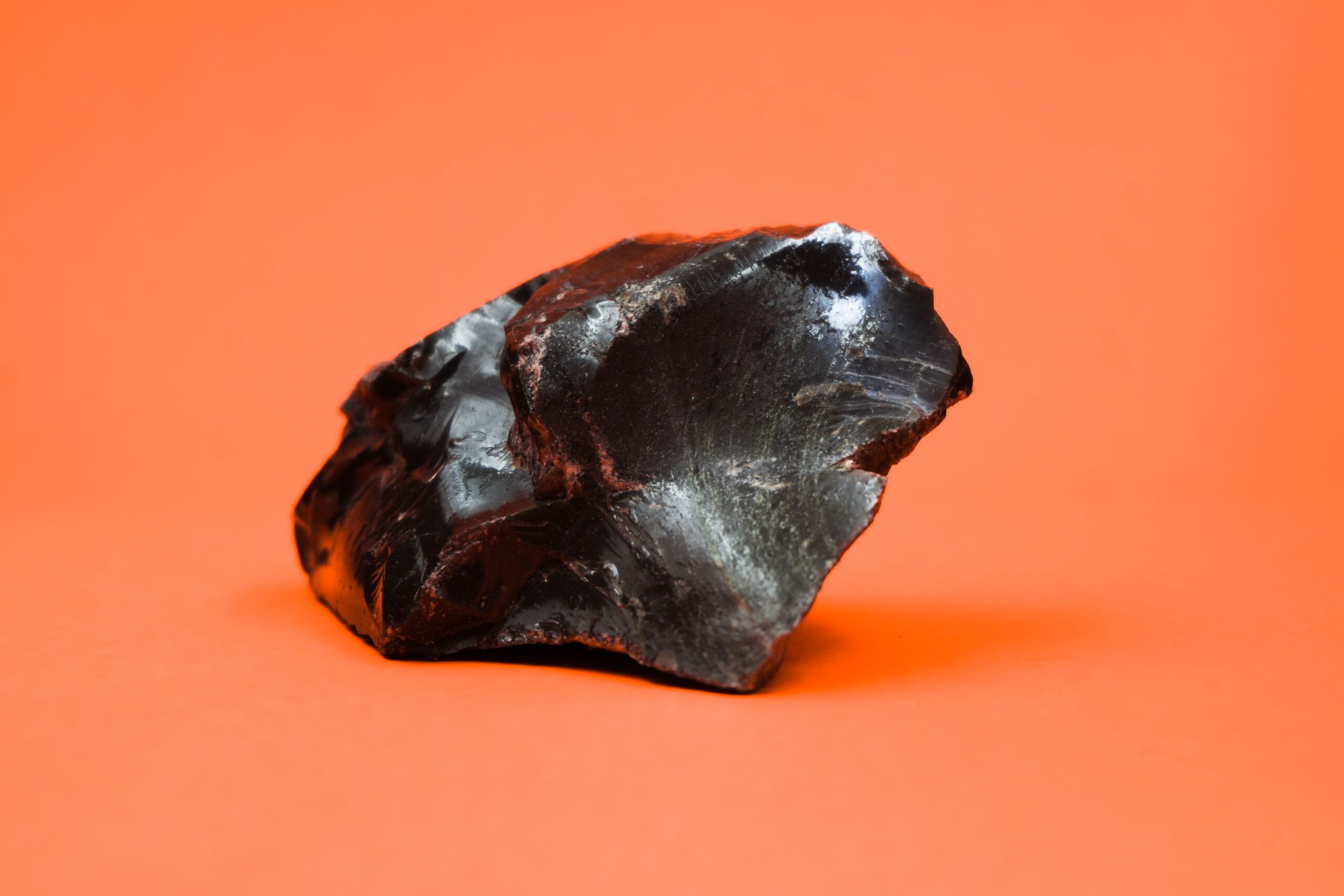
Obsidian is volcanic glass: rhyolite lava so rich in silica, and cooled so quickly, that its atoms never organized into crystals. Around Glass Butte, a cluster of rhyolite domes erupted this glassy lava a few million years ago, and later flows overran earlier ones. Where two chemically different flows met and mingled, the glass took on bands and iridescent layers — the origin of the prized “rainbow,” “double-flow” and sheen material. Weathering has since spread obsidian float across the slopes, so collectors find it both loose on the surface and in seams within the hills.
The obsidian varieties
Glass Butte is famous less for one type than for its variety. Alongside ordinary jet-black glass you can find:
The obsidian
- Rainbow & fire — iridescent sheens that flash color at the right angle (the prize)
- Gold & silver sheen — a soft metallic shimmer from micro-bubbles
- Mahogany & brown — iron-stained, often banded with black
- Snowflake & midnight lace — grey crystallite “flowers” and lacy patterns
- Double-flow, pumpkin & red — where distinct lavas mixed
Access & the law
- BLM free-use area (~36 sq mi) — personal-use quantities, a reasonable daily amount.
- Private claims are mixed in among the free ground — be certain you are not on a claim.
- Commercial collecting needs a special BLM permit.
- Pack out all trash and fill any holes you dig.
The iridescent types — rainbow, fire and the sheens — are what draw collectors from across the world. Their color is not a pigment but an optical effect: light bouncing off microscopic layers or bubble trains inside the glass. That is why a piece can look plain black until you split it, wet it and turn it to the sun.
How to collect
There are two ways to work the area. The easiest is to surface-hunt: obsidian float litters the open slopes, and a slow walk with the sun low will pick out glassy pieces glinting in the sagebrush. For better material, collectors dig and split — following seams that weather out of the hillsides, then breaking cobbles open to check for sheen and banding inside. A rock hammer, a small pry bar and a screen cover most needs. Serious knappers haul out larger “spalls” for tool-making.
Getting there
The collecting area lies off US Route 20 near milepost 77, roughly 78 miles east of Bend and 57 miles west of Burns, then in on unpaved roads. Those roads are rough, dusty and can be impassable when wet, so a high-clearance or 4WD vehicle is strongly recommended. This is genuinely remote country with no services: carry plenty of water, extra fuel, food and at least one spare tire, and tell someone your route.
When to go
Plan for late spring through fall. Summer days are hot but the ground is dry and the roads passable; winter brings snow and mud that close access to the buttes. Early morning and late afternoon are not only cooler — the low-angle light also makes obsidian easier to spot and its sheens easier to read.
Gear & field tips
- Rock hammer, small pry bar and a screen for working seams and dig piles.
- Heavy leather gloves and eye protection — obsidian shatters to razor edges.
- A spray bottle of water to check pieces for sheen and banding in the field.
- Sturdy boots, sun protection, and far more water than you think you need.
- A GPS or offline map to stay inside the free-use area and off private claims.
Plan your trip
Pair this with the wider Oregon rockhounding guide, and if you are new to telling one glassy rock from another, our field guide to agate vs. jasper vs. chert is a useful primer, and our guide to identifying obsidian and its look-alikes explains the glass tests in more detail. Above all, read collecting ethics & the law before you go.
Frequently asked questions
Is it legal to collect obsidian at Glass Butte?
Yes — the BLM has set aside a large free-use area where personal collecting is allowed within reasonable daily limits. It is the only place in Oregon where obsidian collecting is legal. Commercial collecting requires a permit, and private claims within the area are off-limits.
How much can I take?
A reasonable amount for personal use — commonly described as a trunk load or a few hundred pounds per day, not commercial quantities. When in doubt, take less and confirm current BLM limits.
What is “rainbow” or “fire” obsidian?
Obsidian whose internal layers or bubble trains reflect light as bands of color. The effect is optical, not a pigment, and only shows at certain angles — which is why you wet and tilt a fresh face to find it.
Do I need special tools?
Not much: a rock hammer, gloves, eye protection and a screen will do. Surface-hunting needs nothing but sharp eyes and gloves for handling.
Can I visit in winter?
Not easily. Snow and mud close the unpaved roads to the buttes for much of winter. Late spring through fall is the reliable window.
Want polished obsidian?
Sponsored — partner shop · Minerals Kingdom
Written by The Field & Stone Editors. Informational only — verify BLM rules, claim boundaries and access with the managing agency before collecting. Published by KEVALEX Group.
 FIELD & STONE
Field & Stone is the American rockhounding field guide — where to find rocks, minerals and fossils across all fifty states. Real localities, the best seasons, collecting law and the rock & gem clubs that keep the craft alive, from the Olympic Peninsula agate beaches to the diamond fields of Arkansas.