 FIELD
How to identify feldspar
Feldspar is the most common mineral group in Earth’s crust, yet beginners walk past it every day. Two blocky cleavages, a hardness just above glass and, on plagioclase, fine parallel striations are the clues that give it away.
Pick up almost any piece of granite, pegmatite or beach sand and you are holding feldspar. The trouble is that it comes in white, cream, pink, salmon, grey, green and even iridescent blue, so colour alone tells you very little. This guide shows how to identify feldspar with a few simple field tests: hardness, the way it breaks, its luster and the tell-tale striations of plagioclase. It also explains how to separate the two main families, potassium feldspar and plagioclase, and how to rule out the look-alikes that trip up new rockhounds. If you are new to these tests, start with our guides to the Mohs hardness scale and cleavage and fracture.
What feldspar is
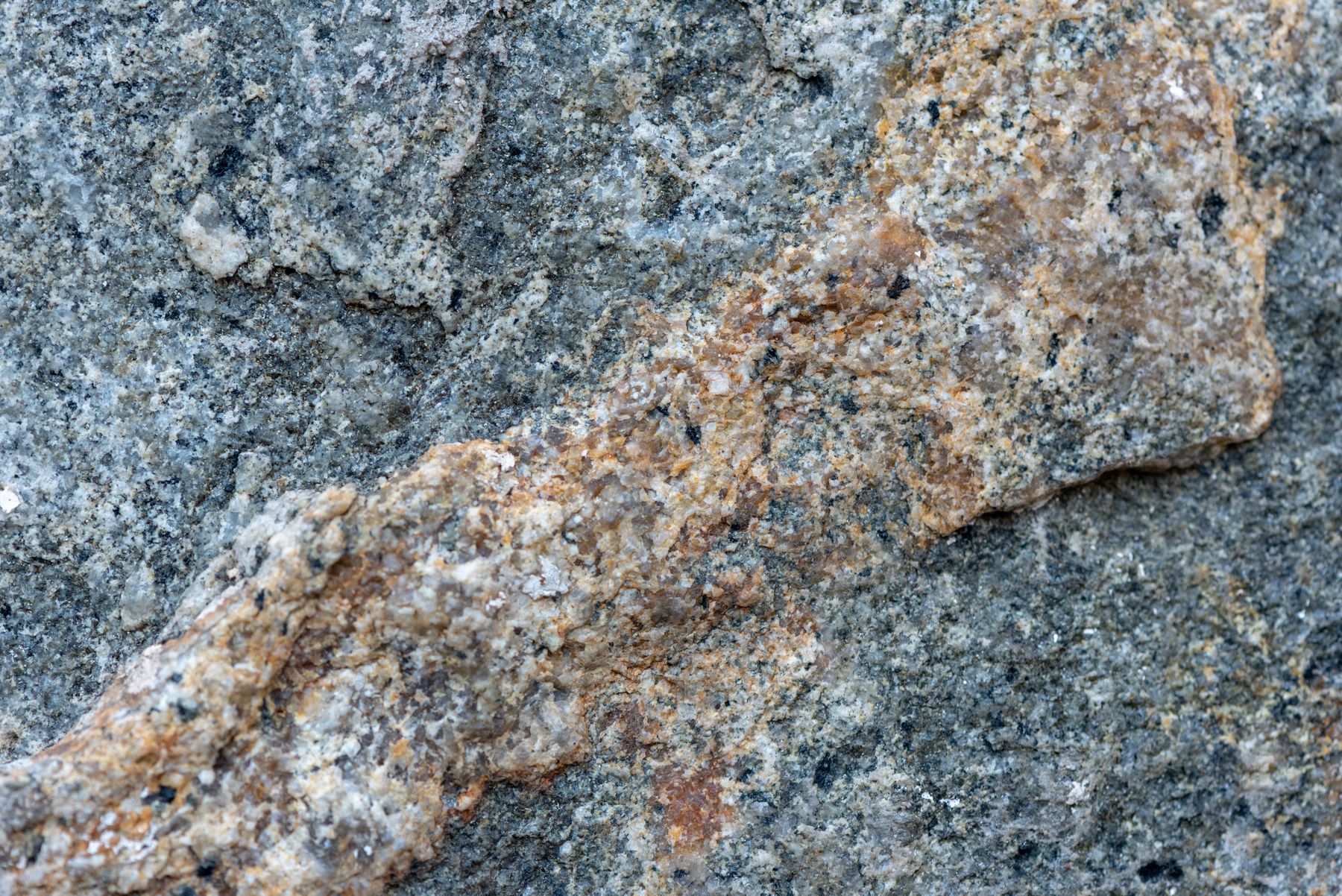
Feldspar is not a single mineral but a group of aluminium silicates that share the same framework structure. Mineralogists split it into two families. Potassium feldspars (also called K-feldspar or alkali feldspar) include orthoclase, microcline and sanidine, all with the formula KAlSi3O8. Plagioclase is a continuous series that runs from sodium-rich albite (NaAlSi3O8) to calcium-rich anorthite (CaAl2Si2O8), with labradorite in between.
Together these minerals make up a large share of igneous and metamorphic rock: granite, granodiorite, gabbro, basalt, gneiss and pegmatite all contain feldspar, and it weathers into the clay minerals that form much of the world’s soil. Knowing feldspar is therefore the first step to naming common rocks; our guide to igneous, sedimentary and metamorphic rocks shows where it fits.
Step 1: Check the hardness
Feldspar sits at 6 to 6.5 on the Mohs scale; orthoclase is in fact the reference mineral for hardness 6. In practice that means:
- A steel knife or nail (about 5.5) will not scratch a fresh feldspar surface.
- Feldspar will scratch ordinary window glass, but only with some pressure.
- Quartz (7) will scratch feldspar; feldspar will not scratch quartz.
Test on a fresh, unweathered face. Weathered feldspar turns chalky and soft as it alters to clay, and a powdery surface can give a misleadingly low result.
Step 2: Look for two blocky cleavages
Cleavage is the single most useful clue. Feldspar breaks along two good cleavage planes that meet at or near 90 degrees, so broken grains look like small steps or blocks with flat, shiny faces. Turn the specimen under a light: the cleavage faces flash together as you rotate it. In orthoclase the angle is exactly 90 degrees (the name comes from the Greek for “straight break”); in plagioclase it is close to 86 or 94 degrees, which is hard to see by eye.
This is what separates feldspar from quartz, its most frequent companion. Quartz has no cleavage and breaks with a curved, glassy conchoidal fracture. A hand lens makes the difference obvious in a granite: feldspar grains show flat, reflective steps, while quartz grains look like greasy broken glass.
Step 3: Luster, streak and weight
Fresh feldspar has a vitreous (glassy) luster, often slightly pearly on cleavage faces; see our guide to mineral luster for the vocabulary. The streak is white, which is true of most light-coloured silicates, so a streak test mainly helps to rule out metallic minerals. Feldspar feels ordinary in the hand, with a specific gravity of roughly 2.55 to 2.76, close to quartz. A pale mineral that feels unusually heavy is more likely barite; our specific gravity guide explains how to check.
Step 4: Tell plagioclase from potassium feldspar
Once you know a mineral is feldspar, the next question is which family. Colour gives a hint, but the decisive field clue is twinning.
Plagioclase
- Striations → fine, straight, parallel lines on one cleavage face, caused by repeated (polysynthetic) twinning
- Colour → usually white to grey; darker grey in gabbro and basalt
- Special effect → labradorite can flash blue, green or gold (labradorescence)
- Typical rocks → basalt, gabbro, diorite, andesite
Potassium feldspar
- No striations — but often simple Carlsbad twins, two halves that reflect light differently
- Colour — commonly pink, salmon or cream; microcline can be green (amazonite)
- Perthite — wavy or patchy streaks of albite inside the crystal
- Typical rocks — granite, pegmatite, syenite, rhyolite
To see striations, tilt a cleavage face until it catches the light, then look with a 10x lens. The lines are perfectly straight and evenly spaced, like a ruled page, and they run across the whole face. Our guide to crystal twinning explains why they form. Colour is only a hint: pink plagioclase and white K-feldspar both exist, so treat striations as the stronger evidence.
Gem and collector feldspars
Several popular gems are feldspars, and recognising the group helps you identify them:
- Amazonite is green to blue-green microcline, found in pegmatites such as those at Crystal Peak in Colorado and the Morefield Mine in Virginia.
- Sunstone shows a sparkle or schiller from tiny inclusions. Oregon sunstone is a labradorite with copper inclusions; see our page on the Plush Sunstone Public Collecting Area.
- Labradorite displays labradorescence, a play of colour from light interfering in thin internal layers.
- Moonstone shows a soft, floating blue-white glow (adularescence) from intergrown layers of two feldspars.
These effects are described in more detail in optical effects in minerals. Note that metaphysical claims made about these stones belong to tradition and belief, not mineralogy, and are not a substitute for medical advice.
Common look-alikes
- Quartz: harder (7), no cleavage, conchoidal fracture. Our guide on how to identify quartz covers the details.
- Calcite: much softer (3), scratched easily by a knife, three cleavages forming rhombs and fizzes in dilute acid. See how to identify calcite and the acid test.
- Barite: soft (3 to 3.5) and noticeably heavy for its size.
- Nepheline and scapolite: less common pale silicates that can look like feldspar; nepheline has a greasy luster and poor cleavage, and is found in silica-poor rocks. If in doubt, record the find as “feldspar (probable)” and confirm later.
Where to find feldspar
Feldspar is everywhere granite or gneiss is exposed: road cuts, quarries, river gravels and beaches. The largest crystals form in pegmatites, coarse-grained igneous bodies where single feldspar crystals can reach a metre or more. Always check land status and rules before collecting, and read our collecting ethics page first.
Frequently asked questions
How can I tell feldspar from quartz?
Look at how it breaks. Feldspar has two flat cleavage planes that make blocky, step-like surfaces, while quartz has no cleavage and breaks with curved, glassy fractures. Quartz is also slightly harder and will scratch feldspar.
What are the lines on my feldspar?
Fine, straight, parallel lines on a cleavage face are twinning striations. They are characteristic of plagioclase feldspar and are absent from potassium feldspar.
Is pink feldspar always orthoclase?
No. Pink and salmon colours are common in potassium feldspars such as orthoclase and microcline, but colour is not diagnostic. Microcline is often pink too, and some plagioclase is pinkish. Twinning and lab tests are more reliable.
Can a knife scratch feldspar?
A steel knife will not scratch fresh feldspar, which has a hardness of 6 to 6.5. If a knife scratches it easily, the mineral is probably calcite, barite or weathered feldspar that has started to turn to clay.
Are moonstone, sunstone and labradorite feldspars?
Yes. All three are members of the feldspar group, and their special optical effects come from inclusions or very thin internal layers.
Why is my feldspar chalky and dull?
Feldspar weathers to clay minerals such as kaolinite. A white, powdery surface is normal on old exposures; break the specimen to see the glassy cleavage underneath.
Want reference feldspar specimens for your collection?
Sponsored — partner shop · Minerals Kingdom
Feldspar is the mineral you will meet most often in the field. Learn its cleavage and striations once and granite, gneiss and pegmatite suddenly make sense. Pair this guide with rock vs. mineral and how to catalog a rock collection to keep good records of your finds.
Written by The Field & Stone Editors · Published by KEVALEX Group.