 FIELD
How to identify hematite: red streak, heft and look-alikes
Hematite can look silver-black and mirror-bright, or rusty red and dull as dried clay. Whatever the outside looks like, the powder is always red-brown — and that single clue, backed by weight and a magnet, solves most hematite puzzles in the field.
Hematite is iron oxide (Fe₂O₃), the most important ore of iron and one of the most widespread minerals on Earth. It colours red sandstones, soils and jaspers, forms glittering metallic crystals in veins and builds the vast banded iron formations of the Lake Superior region. Because it appears in so many guises, beginners often fail to recognise it — or mistake magnetite, goethite and even manufactured jewellery for it. This guide shows how to identify hematite with a short chain of field tests, describes the varieties you are likely to find and lists the look-alikes worth ruling out. It pairs well with our guides to the streak test, specific gravity and testing minerals with a magnet.
What hematite actually is
Hematite is a simple compound of iron and oxygen that crystallises in the trigonal system. Its name comes from the Greek word for blood, a nod to the deep red colour of its powder, which people have ground into red ochre pigment for tens of thousands of years. Iron in this fully oxidised state is extremely stable at the Earth’s surface, which is why hematite is everywhere: it forms in hydrothermal veins, in metamorphic rocks, as a weathering product of other iron minerals, and as the chemical sediment that built banded iron formations more than two billion years ago. It even occurs on Mars, where small hematite spherules found by NASA’s Opportunity rover pointed to past water.
The key point for identification is that hematite’s appearance varies enormously while its physical properties stay remarkably constant. Crystalline hematite is steel-grey to black with a metallic luster; fine-grained or earthy hematite is red to brownish red and dull. Both share the same streak, density and lack of strong magnetism — so learn to read those properties rather than the colour. Our guide to mineral color explains why colour alone so often misleads.
Field tests for hematite
No single test proves hematite, but very few minerals pass all of the checks below. Work through them in order on a clean, fresh surface.
Start with the streak
This is the decisive test. Rub the specimen firmly across the back of an unglazed ceramic tile: hematite leaves a red to reddish-brown streak, often described as “cherry” or “blood” red, even when the specimen itself is shiny black. Magnetite, ilmenite and most black metallic minerals leave a black or dark grey streak instead, and goethite leaves yellow-brown. Very hard crystalline pieces can be reluctant to mark the plate; press harder or scrape a little powder off with a steel point. Full technique is in our streak test guide.
Read the luster
Crystalline and specular hematite has a bright metallic to submetallic luster; kidney ore can look almost polished. Earthy hematite is dull, like dried mud, and often stains the fingers red. Seeing both lusters on a single rock is common, and both point to hematite if the streak agrees. See mineral luster for how to describe what you see.
Feel the weight
Hematite is heavy. Its specific gravity is about 5.3, roughly twice that of quartz or feldspar. A hematite cobble feels noticeably dense in the hand compared with an ordinary rock of the same size. Porous earthy and oolitic varieties are lighter, but still feel heavier than you expect. This heft also explains why hematite collects alongside black sand in a gold pan; see how to pan for gold.
Test hardness
Crystalline hematite measures about 5.5 to 6.5 on the Mohs scale: it scratches glass with difficulty and resists a steel knife, while quartz scratches it. Earthy forms crumble and seem much softer because the grains are loosely bound, not because the mineral itself is soft. Hematite is brittle and breaks with an uneven to splintery fracture; it has no good cleavage, though some crystals part along flat planes (see cleavage and fracture).
Bring out a magnet
Pure hematite is not attracted, or only very weakly attracted, to an ordinary magnet. That simple check separates it from magnetite, which jumps to the magnet and has a black streak. A noticeable pull from a red-streaking rock usually means hematite mixed with magnetite, or martite — hematite that has replaced magnetite crystals. Our magnetic minerals guide explains how to read faint reactions.
Varieties you may meet
Hematite takes on several distinctive forms, many of them described in our guide to crystal habit. Recognising them makes field identification much faster.
Common forms
- Specular hematite (specularite) → glittering, mirror-like flakes or plates
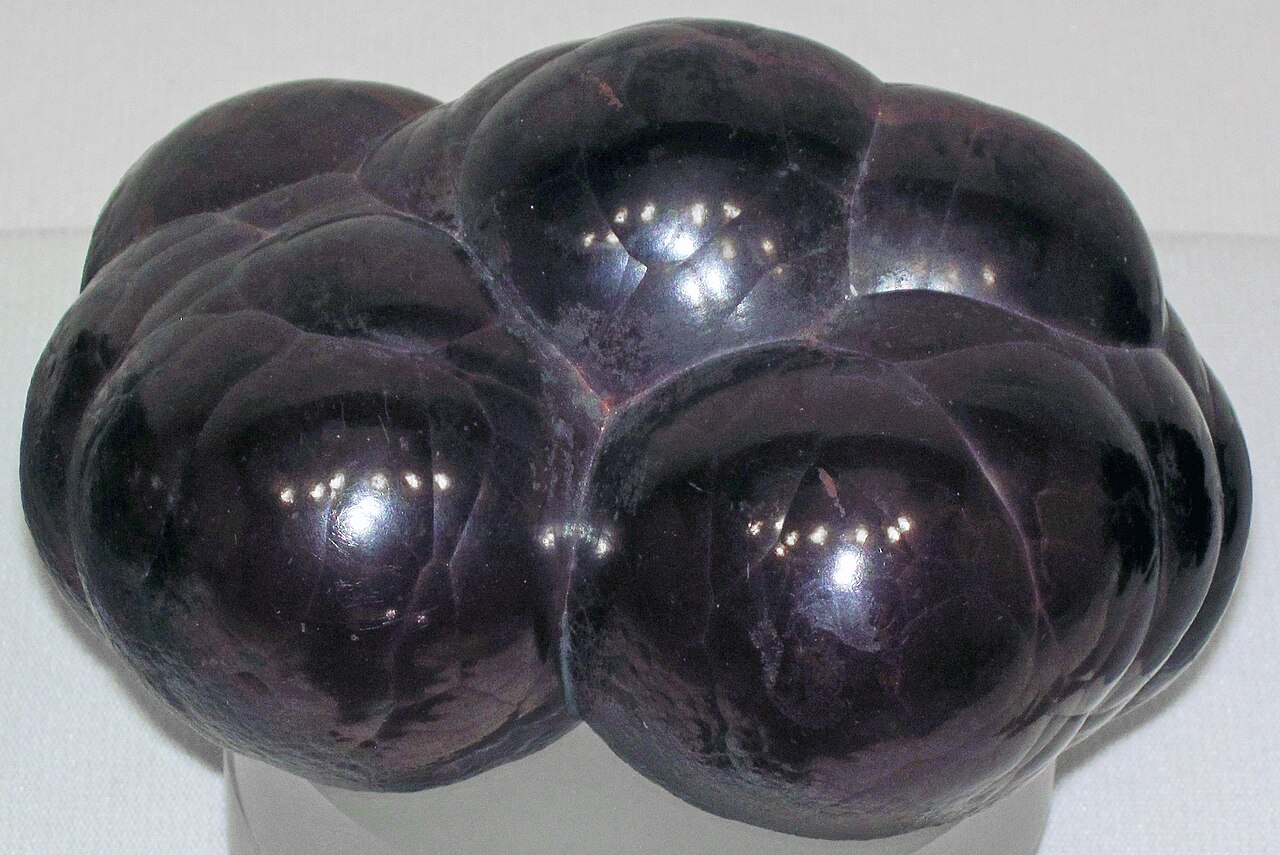
- Kidney ore → rounded, botryoidal masses with a metallic shine and fibrous interior
- Earthy hematite (red ochre) → soft, dull, deep red and finger-staining
- Oolitic hematite → tiny red spheres packed into sedimentary iron ore
- Iron roses → rosette clusters of thin tabular crystals
- Tiger iron → bands of metallic hematite alternating with red jasper
Quick checks
- Streak it — always red to red-brown
- Heft it — heavier than an ordinary rock
- Magnet — no pull, or only a faint one
- Use a lens — look for flakes, fibres or tiny spheres
- Tilt it — some thin flakes show iridescent tarnish
Thin hematite flakes also turn up as red or metallic inclusions inside quartz and feldspar, producing the sparkle in some sunstone and the red tint in “strawberry” quartz; see quartz inclusions and optical effects in minerals.
Look-alikes to rule out
Each of these can pass for hematite at a glance, and each fails at least one of the tests above.
- Magnetite is black and metallic like crystalline hematite, but it gives a black streak and is strongly magnetic.
- Goethite and limonite are rusty brown iron oxides-hydroxides. Their streak is yellow-brown to ochre, not red, and they are lighter.
- Ilmenite is black, slightly magnetic and has a black to brownish-black streak.
- Galena is metallic grey but much softer (about 2.5), with perfect cubic cleavage and a lead-grey streak.
- Cuprite is red with a brownish-red streak but softer (3.5 to 4) and usually occurs with green copper minerals.
- Cinnabar has a scarlet streak and is very heavy, but it is soft (2 to 2.5). It contains mercury, so do not grind, heat or lick it, and wash your hands after handling.
- “Magnetic hematite” or “hematine” sold as beads and jewellery is usually a manufactured ceramic or ferrite. Its strong magnetism and uniform look give it away; natural hematite is not strongly magnetic.
- Weathered meteorites can wear a rusty hematite-goethite crust. A strong magnetic pull and a metallic interior call for our meteorite guide.
Brassy sulfides such as pyrite sometimes weather to a hematite or goethite skin; if a fresh break shows gold-coloured metal, read how to identify pyrite.
Where to look for hematite
Hematite is common across the United States. The classic region is the Lake Superior iron country: the Mesabi and other iron ranges of Minnesota and the Marquette and Menominee ranges of Michigan, where banded iron formation, tiger iron and jaspilite turn up in road cuts and on old mine dumps. The Clinton-type oolitic iron ores of the Appalachians, around Birmingham in Alabama, and the Iron Mountain and Pilot Knob district of Missouri are also well known. Specular hematite occurs with rutile and other minerals at Graves Mountain in Georgia. Earthy red hematite stains sedimentary rocks throughout the West. Always confirm land status and permission before collecting; active and private mine sites are off-limits without written consent. New to the hobby? Start with how to start rockhounding.
Cleaning and keeping your finds
Rinse hematite in water and scrub with a soft brush; earthy specimens can lose their surface if scrubbed hard, so go gently (more in how to clean rock finds). Avoid strong acids, which attack iron oxides. Kidney ore and specular hematite take a high polish and are popular for cabochons and carving, but expect red sludge in the tumbler and on your hands. Store earthy pieces in their own boxes, because they shed red powder onto neighbouring specimens.
Frequently asked questions
What colour streak does hematite leave?
Hematite leaves a red to reddish-brown streak on an unglazed porcelain plate. This is true even for shiny black or silver-grey specimens, and it is the single most reliable field test for the mineral.
Is hematite magnetic?
Pure hematite is not attracted, or only very weakly attracted, to an ordinary magnet. A strong pull usually means magnetite is present, or the piece is manufactured “magnetic hematite” jewellery rather than natural hematite.
How can you tell hematite from magnetite?
Use a streak plate and a magnet. Hematite gives a red-brown streak and little or no magnetic response; magnetite gives a black streak and jumps to a magnet. Both are heavy iron oxides with similar hardness.
What is the hardness of hematite?
Crystalline hematite measures about 5.5 to 6.5 on the Mohs scale. Earthy hematite seems much softer because its fine grains are loosely held together, but the mineral itself is the same.
Why is hematite sometimes red and sometimes black?
Colour depends on grain size and texture. Coarse crystals reflect light and look steel-grey to black with a metallic luster, while very fine-grained or powdery hematite scatters light and looks red. The streak is red in both cases.
Where is hematite found in the United States?
Major occurrences include the Lake Superior iron ranges of Minnesota and Michigan, the oolitic iron ores around Birmingham, Alabama, and the Iron Mountain and Pilot Knob district of Missouri. Earthy hematite also colours red sedimentary rocks across the West.
Want a real hematite specimen to compare your finds against?
Sponsored — partner shop · Minerals Kingdom
Hematite is easy to confirm once you stack the clues. Run the streak test, feel the weight, check the pull with a magnet and read the surface with a hand lens.
Once identified, give each piece a number and a label; our guide to cataloging a rock collection shows how.
Written by The Field & Stone Editors · Published by KEVALEX Group.