 FIELD
How to identify pyrite (fool’s gold)
Pyrite is the brassy, metallic mineral that has fooled prospectors for centuries. Its crystal shapes, hardness, dark streak and surprising weight make it one of the easiest sulfides to pin down once you know what to check.
Pyrite is iron sulfide (FeS2), the most common sulfide mineral on Earth and the original “fool’s gold”. It turns up in coal seams, shales, quartz veins, limestone quarries and river gravels across much of the United States, often as sharp, shiny cubes that look almost machined. This guide shows how to identify pyrite with simple field tests, explains its typical crystal forms, and lists the brassy look-alikes — marcasite, chalcopyrite, pyrrhotite and real gold — that you need to rule out. It builds on our guides to luster, streak and hardness.
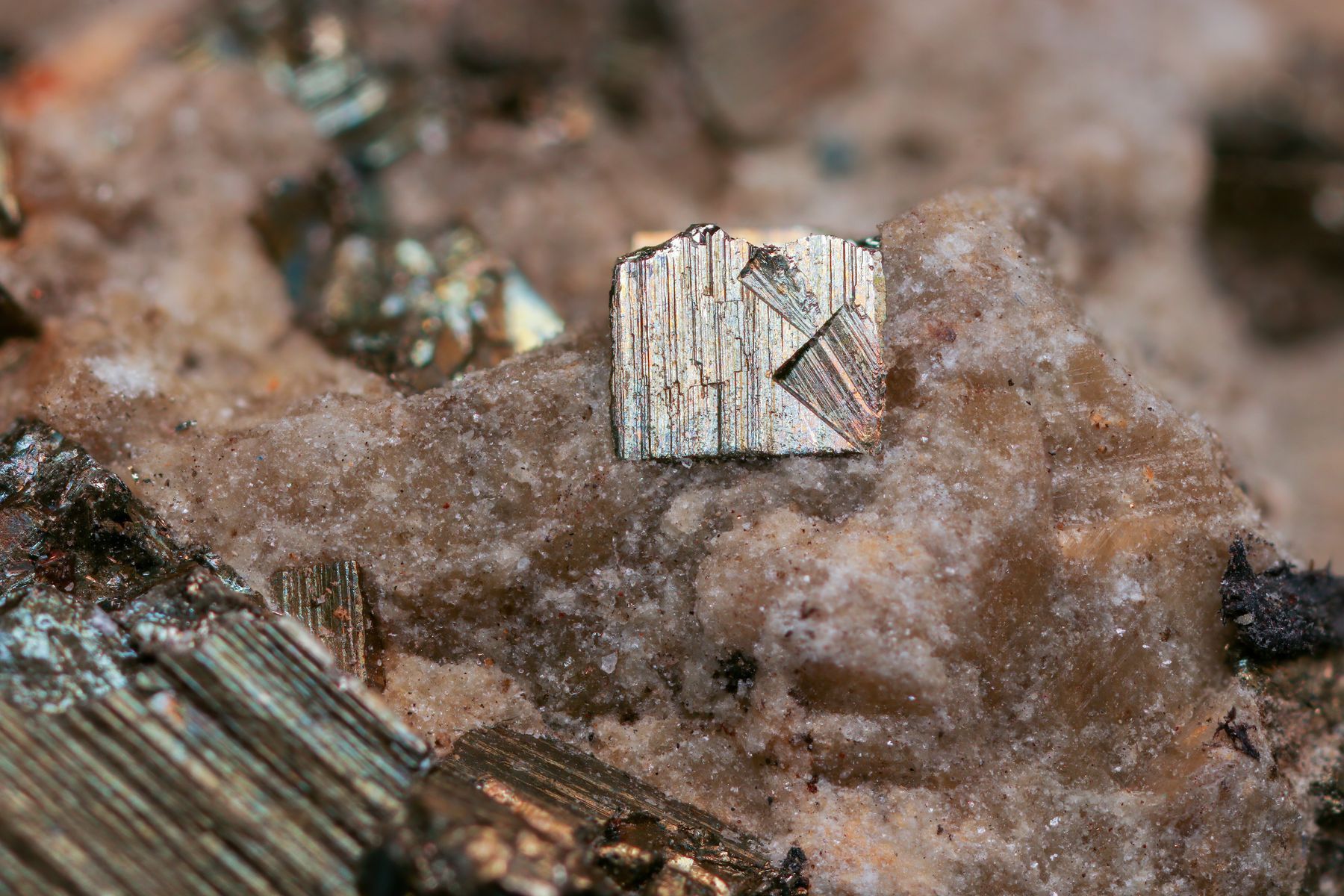
What pyrite actually is
Pyrite is a compound of iron and sulfur that crystallises in the cubic (isometric) system, which is why it so often grows as neat cubes and other blocky, symmetrical shapes (see the seven crystal systems). It forms in a remarkably wide range of settings: from hot hydrothermal fluids in ore veins, in metamorphic rocks, and at low temperature in oxygen-poor muds, where bacteria help produce the sulfide. That last setting explains why pyrite is so common in black shales and coal, and why fossils are sometimes preserved in shining pyrite — a process covered in our guide to pseudomorphs.
The name comes from the Greek pyr, fire, because pyrite throws sparks when struck hard against steel. It has been used to start fires, as a source of sulfur and sulfuric acid, and as an ore-hunting clue, since gold and copper minerals sometimes occur in the same veins. On its own, though, pyrite has little value as an ore of iron.
Field tests for pyrite
No single property proves pyrite, but it passes a short checklist that its look-alikes fail. Work through the tests in order, on a fresh surface if possible.
Look at colour and luster
Fresh pyrite is a pale brass-yellow with a bright metallic luster. It is paler and more “cold” than gold, which is a deep, warm buttery yellow. Exposed pyrite can tarnish to a darker brass or develop a brown rusty coating as it weathers to iron oxides, so judge colour on a clean face. Colour alone is never enough, as our guide to mineral colour explains, but that particular brassy shine is the first clue.
Check the crystal shape
Pyrite is famous for its cubes, which can be razor-sharp and mirror-faced. Look closely with a hand lens: many cubes carry fine parallel grooves called striations, and the grooves on neighbouring faces run at right angles to each other. Other common forms are the pyritohedron, a twelve-sided crystal with five-sided faces that is almost unique to pyrite, and the octahedron. Interlocking cubes can form penetration twins (see crystal twinning), and pyrite also grows as granular masses, nodules, radiating discs and fine glittering grains scattered through rock. Our guide to crystal habit shows how to read these shapes.
Test hardness and tenacity
Pyrite is hard for a metallic mineral: about 6 to 6.5 on the Mohs scale. A steel knife or nail will not scratch it, and a sharp corner can scratch glass. It is also brittle: tap a small grain with a hammer and it shatters into dark powder rather than flattening. That single test separates it from gold, which is soft and malleable, as explained in our guide to mineral tenacity. Pyrite has poor cleavage and breaks with an uneven to conchoidal fracture.
Run a streak test
Rub the specimen firmly across the back of an unglazed ceramic tile. Pyrite leaves a greenish-black to brownish-black streak. Gold leaves a golden-yellow streak, so this is one of the fastest ways to settle the fool’s-gold question. Because pyrite is harder than many streak plates are tough, press firmly and use a sharp edge.
Feel the weight
Pyrite has a specific gravity of about 5.0, roughly twice that of quartz, so a hand-sized piece feels distinctly heavy. Gold, at around 19.3, is nearly four times heavier still: a gold nugget the size of a pea feels astonishingly dense, while a similar pyrite grain does not.
Notice the smell
When pyrite is struck, ground or cut, it can release a sharp sulfur smell. Freshly crushed powder or a grinding wheel makes this obvious. It is a useful supporting clue, described in our guide to taste and smell tests — but never taste sulfide minerals.
Pyrite at a glance
Key properties
- Formula → FeS2, iron sulfide
- Colour → pale brass-yellow, tarnishing darker
- Luster → bright metallic
- Hardness → 6 to 6.5, brittle
- Streak → greenish-black to brownish-black
- Specific gravity → about 5.0
Quick checks
- Use a lens — look for striated cubes and pyritohedra
- Try a knife — pyrite resists scratching
- Streak it — dark powder, never yellow
- Tap a grain — it shatters instead of flattening
- Try a magnet — pyrite does not respond
Look-alikes to rule out
Several brassy or golden minerals can pass for pyrite at a glance. Each one fails at least one of the tests above.
- Gold is deep yellow, soft (2.5 to 3), malleable and extremely heavy, leaves a yellow streak and never tarnishes. It usually occurs as flakes, grains or wires rather than sharp cubes. Our gold panning guide covers how to sort real flakes from impostors in the pan.
- Marcasite has the same chemical formula as pyrite but a different (orthorhombic) structure. It is paler, often almost tin-white on fresh surfaces, and forms spear-shaped, cockscomb or radiating crystals rather than cubes. It also tends to decay faster in humid air.
- Chalcopyrite, a copper iron sulfide, is a deeper, slightly greenish yellow and much softer (3.5 to 4), so a knife scratches it easily. It often tarnishes to iridescent blue and purple, as described in optical effects in minerals.
- Pyrrhotite is bronze rather than brass-coloured, softer (about 3.5 to 4.5), and usually weakly magnetic. A small magnet is the quickest separator; see testing minerals with a magnet.
- Weathered mica (often golden biotite) glitters in streams but is soft, flaky and light, and splits into thin flexible sheets.
- Brass or other metal scrap can turn up near old workings. Metal bends or dents and lacks crystal faces.
Where pyrite turns up
Because it forms in so many environments, pyrite is one of the most widespread minerals a rockhound will meet. Look for it in road cuts through black shale, in coal-mine dumps, in limestone and dolomite quarries, in quartz veins and in the heavy sands at the bottom of a gold pan. Concretions in shale sometimes have pyrite cores or crusts (see concretions), and pyritized fossils such as ammonites and brachiopods are prized finds. In the Southeast, Graves Mountain in Georgia is one well-known collecting site where pyrite occurs alongside other minerals. As always, confirm land status and permissions before collecting, and read our page on collecting ethics and the law. New to the hobby? Start with how to start rockhounding.
Cleaning and keeping pyrite
Pyrite can be rinsed in water and dried immediately and thoroughly; avoid long soaks. Rust-coloured iron stains are best removed only with methods suitable for sulfides, as explained in how to clean rock finds. The bigger long-term problem is pyrite decay (sometimes called “pyrite disease”): in humid air, some pyrite and especially marcasite slowly oxidise, sprouting white or yellow powdery sulfate crusts and releasing acid that can damage labels and boxes. Store specimens in dry, stable conditions, keep them away from damp basements, and check them every few months. Record each piece with its locality, as shown in our guide to cataloging a rock collection.
Frequently asked questions
How can you tell pyrite from gold?
Pyrite is pale brass-yellow, hard enough to resist a steel knife, brittle, and leaves a greenish-black streak. Gold is deep yellow, soft enough to dent with a pin, malleable, much heavier and leaves a golden-yellow streak. The streak and a gentle tap with a hammer usually settle it in seconds.
What is the hardness of pyrite?
Pyrite measures about 6 to 6.5 on the Mohs scale. A steel knife or nail will not scratch it, and a sharp edge can scratch glass, but quartz can scratch it.
Why does pyrite form perfect cubes?
Pyrite crystallises in the cubic (isometric) crystal system, so its atoms stack in a symmetrical pattern that naturally produces cubes, pyritohedra and octahedra. Fine striations on the faces record how the crystal grew.
What is the difference between pyrite and marcasite?
Both are iron sulfide, FeS2, but they have different crystal structures. Pyrite is cubic and usually forms cubes or pyritohedra; marcasite is orthorhombic, paler, and forms spear-shaped or cockscomb crystals. Marcasite is also more prone to crumbling in humid air.
Is pyrite magnetic?
No. Natural pyrite does not respond to an ordinary magnet. A brassy mineral that is attracted to a magnet is more likely to be pyrrhotite.
Is pyrite safe to handle?
Handling solid pieces is generally fine, but avoid breathing dust when cutting or grinding, do not taste it, and wash your hands afterwards, since some pyrite contains traces of arsenic.
Want a real pyrite specimen to compare your finds against?
Sponsored — partner shop · Minerals Kingdom
Pyrite is simple to confirm once you stack the clues. Check the brassy luster, look for striated cubes under a hand lens, scratch-test it against the Mohs scale, and finish with a dark streak.
Found something glittering in your pan instead? Our guide on how to pan for gold shows how to sort real gold from fool’s gold at the creek.
Written by The Field & Stone Editors · Published by KEVALEX Group.