 FIELD
How to identify opal: precious, common and fake
Opal is the only common gem made of water-bearing silica with no crystal structure, and its flashing play-of-color is hard to fake well. A handful of checks on color pattern, luster, hardness, weight and the side profile separate natural opal from doublets, synthetics, plastic and glassy look-alikes.
Opal is hydrated amorphous silica: the same silicon dioxide as quartz, but holding several percent of water and lacking an ordered crystal lattice. Most opal in the ground is plain “common opal” or potch with no fire at all; only a small fraction is precious opal with the moving rainbow patches collectors chase. Because bright opal is valuable, the market is also full of assembled stones, lab-grown material, resin and glass. This guide shows how to identify opal in rough and cut form with simple tests, explains the main types, and lists the imitations and look-alikes worth ruling out. It pairs well with our guides to optical effects in minerals, hardness and specific gravity.
What opal actually is
Opal forms at low temperature, near the surface, when silica-rich water seeps into cracks, cavities and pore spaces and slowly deposits a gel of silica. As the water drains away, the gel hardens into opal containing roughly 3 to 10 percent water, sometimes more. There is no repeating crystal structure, so opal is classed as a mineraloid rather than a true mineral (see rock vs. mineral). Its chemistry is written SiO2·nH2O.
In precious opal, the silica settles as countless tiny spheres, each a few hundred nanometres across, stacked in tidy rows like oranges in a crate. Light passing through that regular grid is diffracted and split into spectral colors, producing play-of-color. Larger spheres can produce reds and oranges; smaller ones give mostly blues and greens. In common opal the spheres are jumbled or of mixed sizes, so the stone shows a milky or glassy body color but no flashes. Opal grows in volcanic rocks such as rhyolite and basalt, in sandstones and ironstones, and as a replacement of wood, shell and bone; some of the finest petrified wood is opalised, as covered in how to identify petrified wood.
Field tests for opal
No single test proves opal, but natural opal passes a short checklist that most fakes fail somewhere. Work through these in order.
Watch the play-of-color move
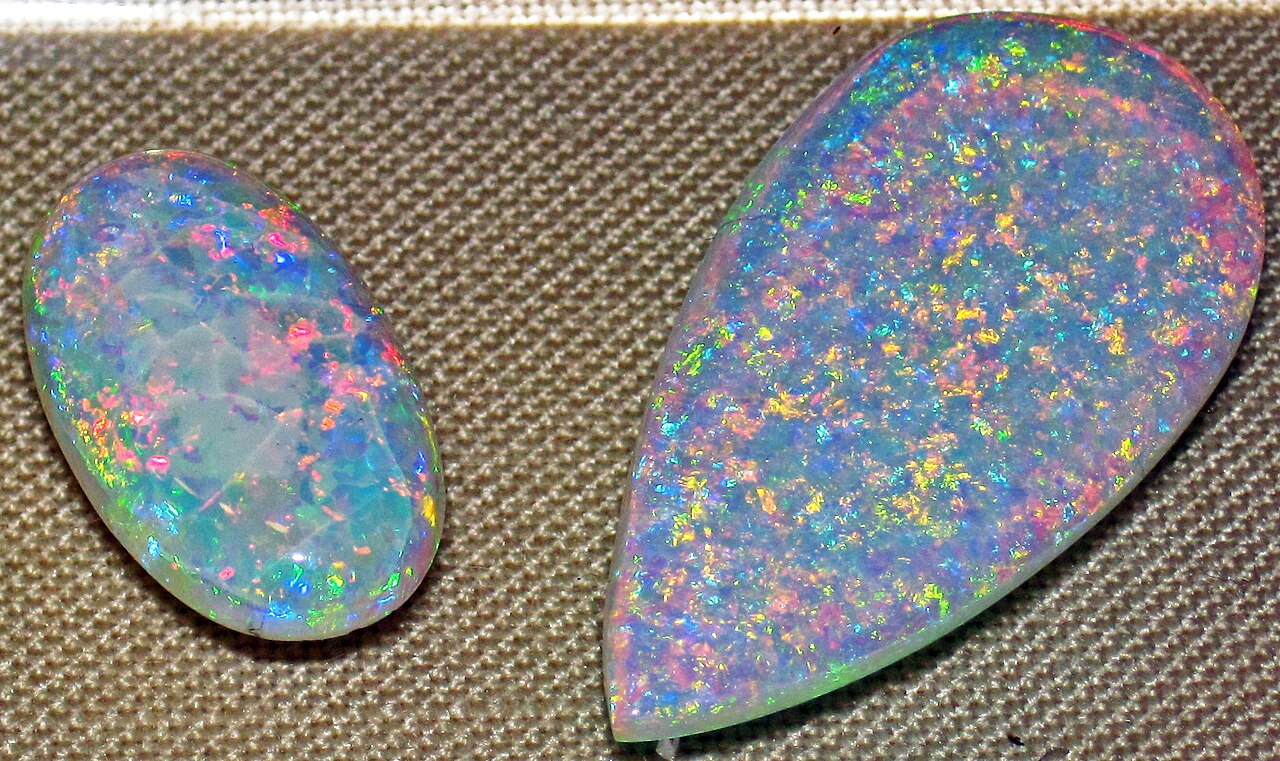
Tilt the stone slowly under a single light source. Natural play-of-color appears as irregular patches, flashes or pinpoints that change color and position with angle and fade at the edges of each patch. Patterns vary across the stone and rarely repeat. Very orderly honeycomb, “lizard skin” or columnar patterns, or colors that look painted on the surface, are warning signs of a lab-grown stone or imitation. Remember that common opal has no play-of-color at all, so absence of fire does not rule out opal.
Look at luster and fracture
Opal has a vitreous to slightly waxy or resinous luster, softer-looking than the bright glassiness of quartz (compare in our luster guide). Broken surfaces show conchoidal fracture with smooth, curved, shell-like faces and no cleavage. Rough pieces often carry a chalky or crazed white skin, so judge the stone on a clean surface. A hand lens helps you see color patches, sand inclusions and any fine surface cracks.
Test hardness carefully
Opal measures about 5.5 to 6.5 on the Mohs scale: it scratches glass weakly or not at all and is easily scratched by quartz. Never scratch a cut or bright piece. On rough material, test only a hidden corner of potch or matrix. Plastic imitations are far softer and can be marked with a steel pin; glass imitations are close to opal in hardness, so this test mostly flags resin.
Feel the weight
Opal is light for a stone, with a specific gravity of about 1.9 to 2.3, noticeably lower than quartz at 2.65 and much lower than most glass at about 2.4 to 2.6. A stone that feels heavy for its size is suspect. A plastic imitation, at around 1.2, feels almost weightless and warm to the touch.
Check the side profile
For cut stones this is the most useful test. Look at the girdle from the side with a lens. A doublet shows a thin slice of opal glued to a dark backing of potch, ironstone, glass or plastic, with a straight join line. A triplet adds a clear dome of quartz or glass on top, which gives the stone a glassy, slightly magnified look and a flat-topped appearance under angled light. Solid opal shows continuous material from top to bottom, often with natural body color or potch running through it.
Try UV light and transparency
Hold a thin edge to a bright light: much opal is translucent, and fire opal can be transparent (see transparent, translucent and opaque). Under a shortwave or longwave lamp many opals glow. Clear hyalite opal often fluoresces a vivid green from trace uranium, and much white and common opal gives a whitish to bluish glow, as described in our fluorescent minerals guide. Fluorescence varies too much to prove opal, but a bright green response from clear, glassy botryoidal crusts strongly suggests hyalite.
Types of opal you may meet
Opal is named by body color, transparency and setting. Recognising the main types makes identification faster and explains why two genuine opals can look completely different.
Natural types
- White or light opal → milky body with pastel play-of-color
- Black opal → dark grey to black body, intense contrasting fire
- Boulder opal → thin opal veins left on brown ironstone
- Fire opal → transparent yellow to red body, with or without play-of-color
- Common opal and potch → opaque to translucent, no flashes
- Hyalite → clear, glassy, bubbly crusts, often green under UV
Quick checks
- Tilt it — fire should shift and change color with angle
- Side view — look for glue lines and dark backings
- Heft it — opal feels lighter than glass or quartz
- Use a lens — watch for repeating cells or painted-looking color
- Wet a corner — hydrophane changes when it absorbs water
Fakes, synthetics and treatments
Most problems arise with cut stones and jewellery rather than with rough you dig yourself. Learn these patterns before buying.
- Doublets and triplets are genuine thin opal assembled with backings and caps. They are honest products when sold as such, but less valuable than solid opal; the side profile gives them away.
- Lab-grown (synthetic) opal has the same silica-sphere structure but often shows a regular columnar, snakeskin or “chicken-wire” cell pattern under a lens, with uniform color patches that look too perfect.
- Plastic and resin imitations are soft, very light and warm, and may show mould marks or a slightly greasy look.
- Glass imitations such as “Slocum stone” contain flat, foil-like flakes of color and may show round gas bubbles. So-called opalite sold in shops is usually man-made glass with a bluish milky glow but no true play-of-color.
- Smoke- or sugar-treated opal is porous opal darkened to imitate black opal. Under magnification the dark color sits in tiny specks or near the surface rather than in the body.
Look-alikes to rule out
Several natural stones show colorful optical effects that beginners mistake for opal fire.
- Labradorite shows broad, single-color flashes from one direction only, has flat cleavage faces and visible twinning stripes, and is a crystalline feldspar.
- Moonstone shows a soft bluish-white glow that floats across the stone, not separate spectral patches.
- Fire agate shows bubbly, layered iridescence in brown chalcedony; it is harder (about 7) and heavier. See our Arizona fire agate site guide and agate, jasper and chert guide.
- Coated “aura” quartz has a metallic, oily rainbow film only on the surface of crystal faces; the inside is clear quartz, as explained in how to identify quartz.
- Iridescent obsidian shows sheen bands in black volcanic glass; see how to identify obsidian.
- Chalcedony and milky quartz can resemble common opal but are harder (about 7) and heavier.
Where to look for opal in the United States
The best-known American precious opal comes from volcanic ground in the Great Basin and the northern Rockies. Nevada’s Virgin Valley opal mines produce famous black fire opal, much of it opalised wood, and offer fee digs. In Idaho, the Spencer opal mines yield thin-layered precious opal often cut into triplets. Common opal turns up in cavities in rhyolite, in geodes and thundereggs, and in many western volcanic fields. Always confirm land status and collecting rules before digging, and remember that collecting is prohibited in national parks.
Cleaning and keeping your finds
Rinse opal in lukewarm water with a soft brush and a little mild soap, then let it dry slowly at room temperature (more in how to clean rock finds). Some fresh opal, especially from Virgin Valley, is stored in water because it can craze as it dries; ask the mine how their material behaves. Keep opal away from harder stones that could scratch it, never tumble it with quartz, and wrap each piece separately. Doublets and triplets should not be soaked, as water can weaken the glue line.
Frequently asked questions
How can you tell if an opal is real?
Natural opal shows irregular play-of-color patches that shift with angle, a vitreous to waxy luster, hardness around 5.5 to 6.5 and a low weight. Check the side of cut stones for glue lines that reveal doublets or triplets, and use a lens to look for the regular cell patterns typical of lab-grown opal.
What is the difference between precious and common opal?
Both are hydrated silica. In precious opal the silica spheres are uniform and neatly stacked, so they diffract light into play-of-color. In common opal the spheres are irregular, so the stone shows only body color with no flashes.
What is the hardness of opal?
Opal measures about 5.5 to 6.5 on the Mohs scale. It is softer than quartz, which will scratch it, so it needs gentle handling and separate storage.
How do you spot an opal doublet or triplet?
Look at the stone from the side. A doublet has a thin opal layer glued to a dark backing, and a triplet adds a clear quartz or glass cap on top. Both show a straight join line, while solid opal is continuous from top to bottom.
Is opal a mineral?
Not strictly. Opal lacks an ordered crystal structure, so it is classed as a mineraloid. Chemically it is silica with water, SiO2·nH2O.
Why does opal crack?
Opal contains water, and some material loses it quickly when exposed to dry air or heat, which causes fine surface cracks called crazing. Drying new finds slowly and avoiding heat reduces the risk.
Want a real opal specimen to compare your finds against?
Sponsored — partner shop · Minerals Kingdom
Opal is easiest to confirm when you stack the clues. Watch how the fire moves, read the side profile with a hand lens, compare its weight using specific gravity, and learn the light effects behind it in optical effects in minerals.
Once identified, give each piece a number and a label; our guide to cataloging a rock collection shows how.
Written by The Field & Stone Editors · Published by KEVALEX Group.