 FIELD
FIELD How to identify petrified wood
It weighs like stone and rings like stone, but it still carries the grain, the rings and sometimes the bark of a tree that died a hundred million years ago.
Petrified wood is fossil wood in which the original organic material has been replaced or infilled by minerals — usually silica — while the internal anatomy of the tree survives. That is what makes it identifiable: a genuine piece keeps growth rings, longitudinal grain, knots and often bark texture, all rendered in hard, glassy stone. Learn to read those structures and you can separate real petrified wood from the water-worn sticks of jasper and banded chert that fool most beginners.
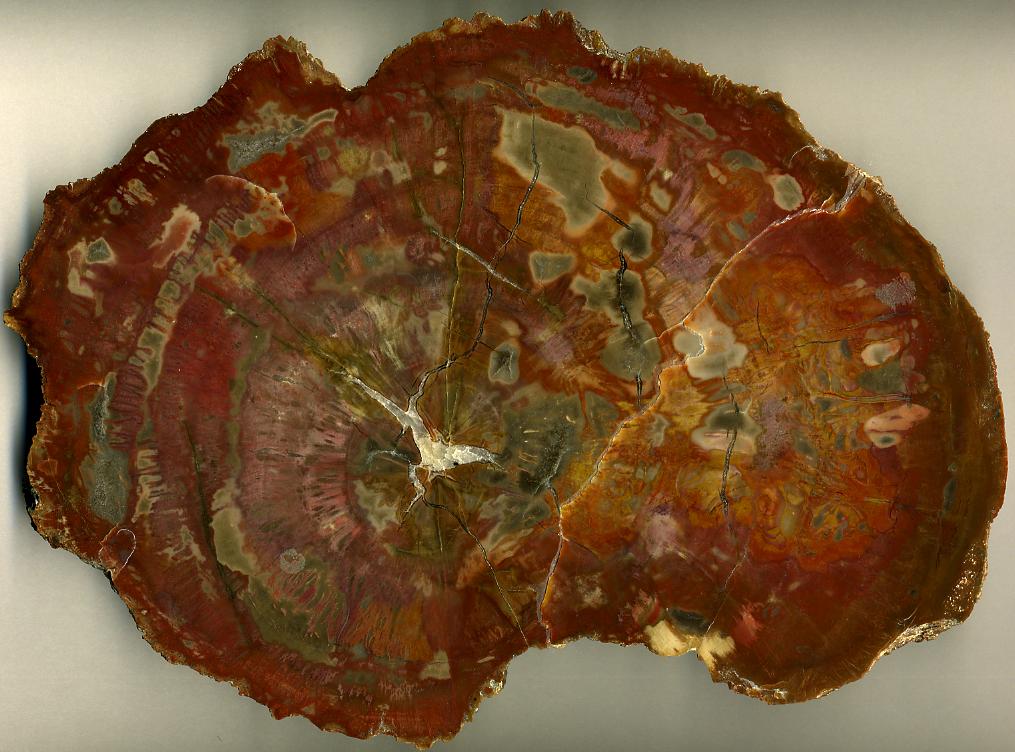
What petrified wood actually is
The everyday word “petrified” hides a more precise process called permineralization. When a fallen tree is buried quickly — by volcanic ash, river sediment or a mudflow — it is sealed away from the oxygen that would otherwise rot it. Groundwater carrying dissolved silica then seeps through the wood, and that silica precipitates inside the cell walls and the empty spaces between them. Over long spans of time the organic material breaks down and is replaced molecule by molecule, but the mineral cast that grows in its place preserves the original three-dimensional structure with astonishing fidelity. The end result is quartz — usually chalcedony, sometimes opal — in the exact shape of wood. Trace metals give the colours: iron oxides for red, orange and yellow, manganese for pink and black, chromium or copper compounds for green.
The five clues that say “petrified wood”
- Growth rings — concentric bands on a cut or broken cross-section, sometimes irregular but always roughly circular around a centre.
- Longitudinal grain — parallel lines running the length of the piece, like the grain on a split log. Very few mineral patterns imitate this convincingly.
- Bark or bark texture — a rough, fissured outer rind that contrasts sharply with the smooth interior.
- Cell structure under a lens — at 10× you may see rows of tiny tubes or pores. This is the single most conclusive clue.
- Weight and hardness — it is noticeably heavier than a piece of wood the same size, and being silica it will not be scratched by a steel knife.
The look-alikes that catch people out
Silicified wood is far from the only stone that comes in log-like sticks. Jasper and banded chert are the same silica family and can weather into elongated, brown-red pieces with parallel banding that reads as grain from a distance — the difference is that the bands wander and cross each other instead of tracking a consistent axis. Concretions can form long cylindrical shapes with no internal structure at all. Fulgurites and slag from old smelters produce branching, root-like forms. And plain weathered driftwood that has picked up mineral staining can look convincingly stony until you lift it and find it far too light. The general rules for telling real fossils from mineral mimics are covered in our guide to telling a fossil from a rock, and the silica look-alikes themselves are separated in agate vs. jasper vs. chert.
Likely petrified wood
- Rings around a visible centre
- Parallel grain along one axis
- Rough bark rind on the outside
- Heavy, hardness about 7
Likely something else
- Banding that crosses and wanders
- No consistent long axis to the pattern
- Light for its size, or scratches easily
- Bubbles or glassy froth (slag)
Simple tests you can run in the field
Start with the hand lens. Find the flattest broken face, wet it with a drop of water and look for repeating rows of cells or the fine tubes that carried sap. Nothing else on the ground produces that kind of organised, repeating microstructure. Next, run a hardness check: silicified wood sits at roughly 7 on the Mohs hardness scale, so a steel knife blade (about 5.5) will slide off it rather than bite, and the piece will scratch glass. Then weigh it in your hand — genuine petrified wood is dense, around 2.6 grams per cubic centimetre, and beginners are routinely surprised by how heavy a small piece feels. Check the break as well: silica fractures conchoidally in smooth, shell-like curves, quite unlike the splintery break of real wood. Finally, look at the surface luster — petrified wood is typically waxy to vitreous on a fresh face, and dull only where it has weathered.
Where petrified wood turns up
Fossil wood forms wherever trees were buried fast and silica-rich groundwater followed, which in practice means volcanic and river-basin sediments. In the United States it is widespread across the West — the Triassic Chinle Formation of Arizona is the most famous source, and Washington, Oregon, Wyoming, Utah, Nevada and the Dakotas all produce good material, with Washington and North Dakota naming it their state gem and state fossil respectively. Eastern states yield it too, generally in smaller and less colourful pieces. Before you collect anywhere, check who owns the ground: national parks and monuments prohibit collecting entirely — Petrified Forest National Park being the obvious example — while many areas of BLM land allow limited personal collecting of petrified wood under published daily and annual weight limits. Our collecting ethics & the law page covers how to work that out before you fill a bucket.
Cleaning and finishing a find
Because petrified wood is essentially quartz, it takes a superb polish and is forgiving to work with. Start with a simple wash and a soft brush to shift mud from the bark texture, following the approach in how to clean your rock and mineral finds. Avoid strong acids: the wood itself will survive, but a carbonate matrix or any calcite infill will not, and you can lose fine structure in the process. Solid, crack-free pieces tumble beautifully and are a good beginner project — see how to tumble rocks. Fractured or punky pieces are better left as display specimens, since they tend to fall apart in the barrel. A cut and polished cross-section remains the best way to show off growth rings.
Frequently asked questions
How can you tell if a rock is petrified wood?
Look for growth rings on a cross-section, parallel grain along the length and bark texture on the outside. Under a hand lens you may see preserved cell structure. It is also heavy for its size and hard enough to scratch glass.
Is petrified wood a rock, a fossil or a mineral?
It is a fossil made of minerals. The original wood has been replaced by silica — usually chalcedony or opal — so chemically it behaves like quartz while structurally it preserves the anatomy of a tree.
How hard is petrified wood?
Silicified wood is roughly 7 on the Mohs scale, the same as quartz. A steel knife will not scratch it, and the piece will scratch glass. Opalised wood can be slightly softer, around 5.5 to 6.5.
What is the difference between petrified wood and jasper?
Both are silica. Jasper has no biological structure, so its banding wanders and crosses at random. Petrified wood keeps a consistent long axis with rings and grain that follow the shape of the original trunk or branch.
How long does it take wood to petrify?
The classic estimate is millions of years, but the key variable is chemistry rather than time alone. Rapid burial and silica-rich groundwater are what matter, and laboratory work has produced partial silicification far faster than natural conditions do.
Is it legal to collect petrified wood?
It depends entirely on the land. Collecting is banned in national parks and monuments, allowed with permission on private land, and permitted in limited personal quantities on much BLM land under published weight limits. Always confirm the rules for the specific area first.
Want polished petrified wood for your collection?
Sponsored — partner shop · Minerals Kingdom
Petrified wood sits where fossils and silica minerals overlap — read it alongside how to tell a fossil from a rock, agate vs. jasper vs. chert and the Mohs hardness scale. Because its shape is inherited from the original wood, petrified wood is itself a classic pseudomorph. New to the hobby? Start with how to start rockhounding.
Written by The Field & Stone Editors · Published by KEVALEX Group.