 FIELD
How to identify turquoise: real, dyed and fake
Turquoise is one of the most imitated stones on earth. Its waxy luster, moderate hardness, matrix patterns and the way color sits in the stone separate natural material from dyed howlite, magnesite, plastic and other blue-green look-alikes.
Turquoise is a hydrous copper aluminium phosphate that forms near the surface in dry country, usually close to weathered copper deposits. It is opaque, sky-blue to green, and almost always massive rather than crystalline — and because good natural material is scarce, a large share of what is sold as “turquoise” is treated, reconstituted or simply something else. This guide explains how to identify turquoise with field and kitchen-table tests, how to recognise the common treatments, and which look-alikes to rule out. Use it alongside our guides to luster, hardness and the streak test.
What turquoise actually is
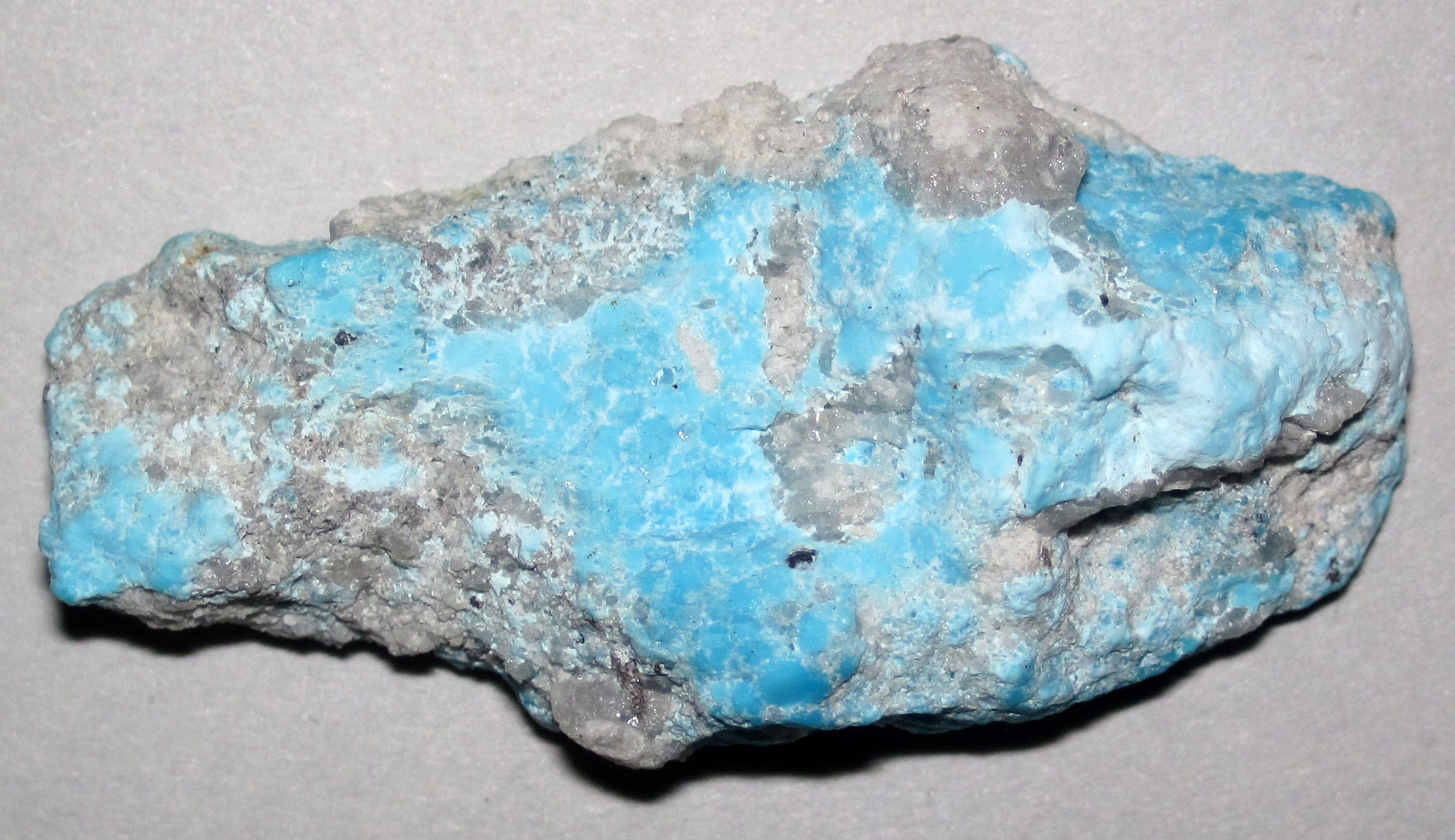
Mineralogically, turquoise is CuAl6(PO4)4(OH)8·4H2O, the copper member of the turquoise group. It belongs to the triclinic crystal system, but visible crystals are extremely rare; what collectors find are veins, crusts and nodules made of microscopic crystals packed together. That fine-grained texture explains much of its behaviour: turquoise is slightly porous, it absorbs oils and water, and its luster is soft and waxy rather than glassy.
Turquoise forms where acidic, copper-bearing groundwater percolates through aluminium-rich rocks and meets phosphorus, typically in the oxidised upper parts of porphyry copper deposits in arid climates. Copper gives the blue; iron replacing some of the aluminium shifts the colour towards green, and heavily iron-rich material can look olive or yellow-green. The dark veining known as matrix is fragments of the host rock — often iron oxides such as limonite, or chert and quartzite — caught between the turquoise. Fine webs of thin matrix lines are called spiderweb turquoise.
Key properties at a glance
Diagnostic properties
- Colour → sky blue, robin’s-egg blue, blue-green to apple green
- Luster → waxy to dull, never strongly glassy
- Hardness → about 5 to 6 on the Mohs scale; porous material is softer
- Specific gravity → about 2.6 to 2.9
- Streak → white to pale greenish
- Diaphaneity → opaque, rarely translucent on very thin edges
Where it grows
- Habit → veins, crusts, nodules and “nuggets”
- Host rocks → altered volcanic and intrusive rocks near copper deposits
- Climate → arid and semi-arid regions
- Companions → chrysocolla, malachite, limonite, quartz, variscite
Field tests for turquoise
No single check settles it. Natural turquoise passes a short chain of simple tests that most imitations fail somewhere along the way.
Read the luster and surface
On a clean, dry surface, natural turquoise shows a waxy to dull luster, the same soft sheen you see on chalcedony. Polished pieces can look brighter, but a strongly glassy or plastic-like shine is a warning sign. Under a hand lens, natural material often shows small pale spots, slight colour zoning and a fine, even granular texture; dyed material looks unnaturally uniform.
Look at how the colour sits in the stone
This is the most useful home test. In natural turquoise the matrix lines sit in the stone, and the blue runs right up to them. In dyed stones, colour concentrates in cracks and pores: veins look dark blue or almost black at their edges, the colour is deeper along fractures than in the body of the stone, and a fresh chip or drill hole may reveal a white or grey interior. That last clue is especially telling on beads. Our guide to mineral color explains why colour alone is the least reliable clue.
Check hardness
Turquoise sits around 5 to 6 on the Mohs scale: a steel knife blade will barely mark good material, while it will easily scratch howlite and magnesite, which sit closer to 3.5 to 4. Chalky, porous turquoise can be softer, so treat a low result with caution rather than as proof. Always test on a hidden spot of rough material — never on finished jewellery.
Streak and weight
Rubbed on unglazed porcelain, turquoise leaves a white to pale greenish streak; a strongly blue streak points to dye or a coating. With a specific gravity of about 2.6 to 2.9, turquoise feels a little heavier in the hand than plastic or resin imitations, which are noticeably light and often feel warm.
The acetone swab
Many dyed stones give themselves away when a cotton swab dampened with acetone (nail-polish remover) is rubbed on an inconspicuous spot: blue or green colour comes off on the cotton. A clean swab does not prove a stone is natural, because some dyes are sealed under resin, but coloured cotton is a strong sign of dye.
Natural, stabilised, reconstituted and imitation
Most turquoise on the market falls into one of five categories, and sellers are expected to disclose which one applies.
- Natural — cut and polished with nothing added beyond, at most, a light surface wax. Only hard, low-porosity material survives this way, and it is the most valued.
- Stabilised — porous turquoise impregnated with a clear resin or polymer so it becomes harder, holds a polish and keeps its colour. This is the most common treatment and is acceptable when disclosed.
- Dyed or colour-enhanced — pale turquoise with colour added, usually combined with stabilisation.
- Reconstituted (block) — turquoise powder or chips bonded with resin into blocks, often with artificial “matrix” lines that look too regular.
- Imitation — any other material dyed or manufactured to look like turquoise.
Separating natural from stabilised turquoise reliably usually requires laboratory methods such as infrared spectroscopy, which detects the resin. Keep that in mind before paying a premium for an undocumented “natural” label.
Look-alikes to rule out
- Dyed howlite is the classic fake. It is softer (about 3.5) and lighter, its veins are grey-black rather than brown, and dye pools along those veins; a chip shows a white interior.
- Dyed magnesite behaves similarly, with a hardness around 3.5 to 4.5 and a chalky white core. Like other carbonates, it reacts to dilute acid when powdered; see the acid test.
- Chrysocolla is a brighter, often more cyan blue-green copper silicate and is usually much softer, unless it is silicified inside quartz or chalcedony.
- Variscite is an aluminium phosphate that is typically apple to yellowish green and somewhat softer; it occurs in the same desert districts, notably in Nevada and Utah.
- Amazonite is a green to blue-green feldspar with visible flat cleavage and a fine white grid of streaks, features turquoise never shows.
- Smithsonite can be blue-green but is much denser (around 4.3 to 4.5) and shows a pearly to glassy luster.
- Glass, ceramic and plastic often show round bubbles, mould marks, unnaturally even colour or a warm, light feel.
Green material is also easily confused with jade; our jade identification guide covers the differences in toughness and luster.
Where turquoise is found in the United States
The American Southwest is classic turquoise country. Turquoise is the official state gem of Arizona and New Mexico, and the state semiprecious gemstone of Nevada, which is home to many small producing mines. Well-known names include Kingman, Bisbee and Sleeping Beauty in Arizona, the historic Cerrillos district in New Mexico, and Royston and Lander County in Nevada; Colorado and California have smaller occurrences. Nearly all productive ground is under mining claims or on private or tribal land, so random surface collecting is rarely an option. Some operations offer fee digs, and loose fragments occasionally turn up in tailings with the owner’s permission. Read our collecting ethics and the law page before heading out, and if you are new to the hobby start with how to start rockhounding.
Caring for turquoise
Because turquoise is porous, it absorbs skin oils, perfume, cosmetics and cleaning chemicals, and untreated stones can slowly shift from blue towards green. Clean finds with plain water and a soft brush (see how to clean rock finds), avoid ultrasonic cleaners, solvents and prolonged heat, and store pieces apart from harder stones that could scratch them. Label each specimen with its locality and any known treatment; our guide to cataloging a rock collection shows how.
Turquoise has carried cultural and spiritual meaning for thousands of years, from Ancestral Puebloan and Aztec work to Persian and Tibetan traditions. Those meanings are part of its history and belief; they are not established scientific or medical properties.
Frequently asked questions
How can you tell if turquoise is real?
Look for a waxy luster, colour that runs evenly up to the matrix lines rather than pooling in cracks, a hardness near 5 to 6, a white to pale greenish streak and a solid weight in the hand. Dyed howlite and magnesite are softer and often show a white interior when chipped. For valuable pieces, only a laboratory can confirm natural versus stabilised material.
What is stabilised turquoise?
Stabilised turquoise is natural but porous turquoise that has been impregnated with a clear resin or polymer to harden it, improve its polish and fix its colour. It is the most common form on the market and is acceptable when the seller discloses the treatment.
What is the hardness of turquoise?
Turquoise measures about 5 to 6 on the Mohs scale. Dense natural material is near the top of that range, while chalky, porous turquoise can be noticeably softer.
What stone is most often sold as fake turquoise?
Dyed howlite is the most common imitation, followed by dyed magnesite, reconstituted block material and plastic. Howlite is softer, has grey-black veining and shows a white interior where it is chipped or drilled.
Why is some turquoise green?
Copper produces the blue colour, while iron replacing some of the aluminium in the structure shifts it towards green. Untreated turquoise can also turn greener over time as it absorbs oils and moisture.
Can you find turquoise while rockhounding?
Occasionally, but most turquoise ground in the Southwest is under mining claims or on private or tribal land. Look for fee-dig operations or ask permission to search tailings, and confirm land status before collecting anything.
Want a documented turquoise specimen to compare your finds against?
Sponsored — partner shop · Minerals Kingdom
Turquoise is easiest to confirm when you stack the clues. Read the soft waxy luster, scratch-test rough material against the Mohs scale, check how much light gets through with our diaphaneity guide, and watch where the colour gathers.
For another stone that is often faked with dyed or glass imitations, see how to identify obsidian.
Written by The Field & Stone Editors · Published by KEVALEX Group.