 FIELD
How to identify fluorite: cubes, cleavage and glow
Fluorite comes in almost every colour, so colour alone will never name it. Four quick checks — a hardness of 4, perfect octahedral cleavage, cubic crystals and a frequent glow under UV light — separate it from quartz, calcite, amethyst and coloured glass.
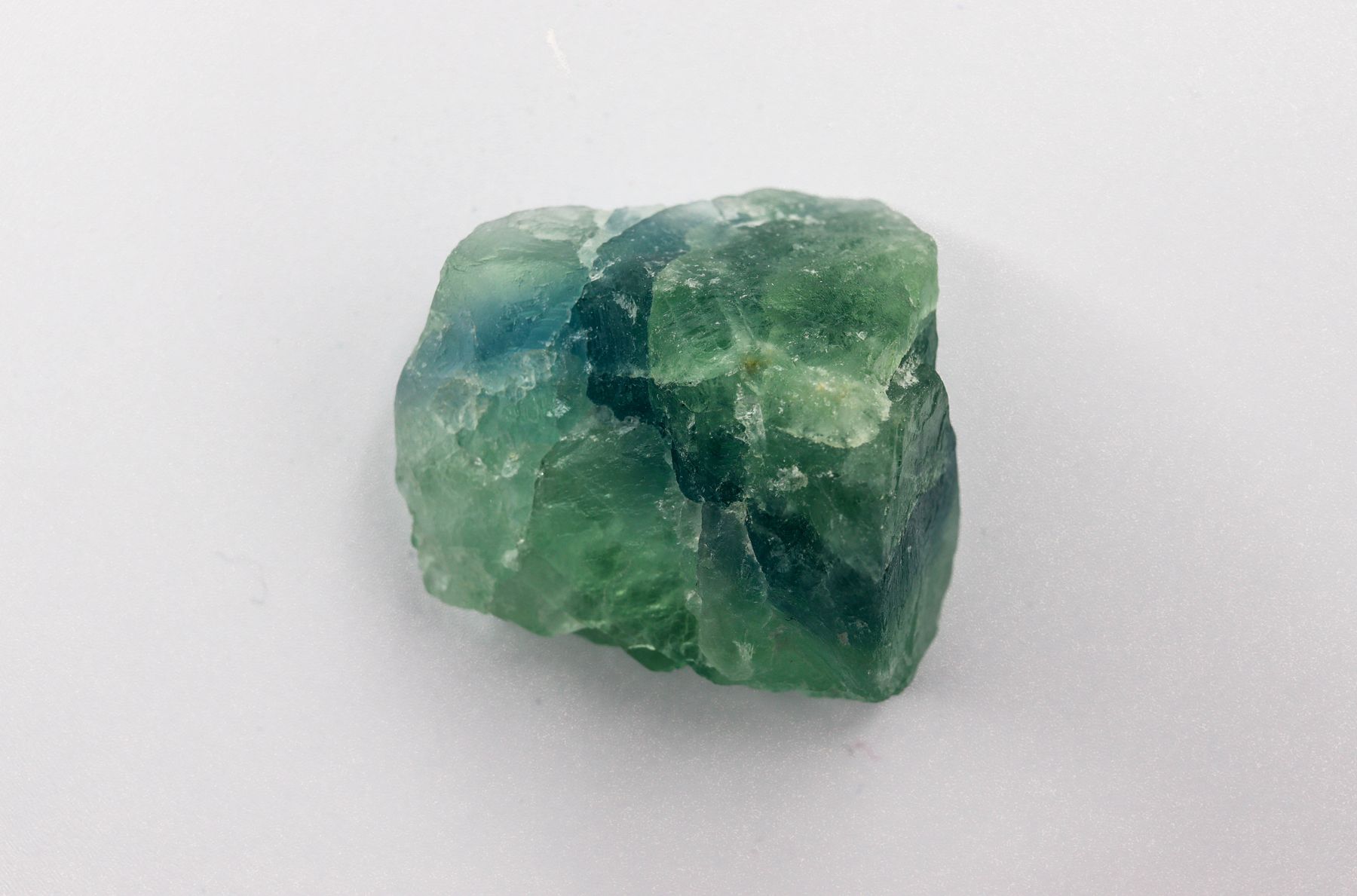
Fluorite is calcium fluoride (CaF2), one of the most colourful and collectable minerals on Earth. It forms glassy cubes and cleavage chunks in purple, green, blue, yellow, pink, colourless and nearly every shade between, often banded in several colours at once. That variety is exactly why beginners confuse it with quartz, amethyst, calcite or tumbled glass. This guide shows how to identify fluorite with simple field and kitchen-table tests, explains why it glows under ultraviolet light, lists the look-alikes worth ruling out and points to the classic American localities. It builds on our guides to hardness, cleavage and fracture and crystal habit.
What fluorite is
Fluorite is a halide mineral made of calcium and fluorine. It crystallises in the cubic (isometric) crystal system, which explains its favourite shapes: cubes, octahedrons and, more rarely, twelve-sided dodecahedrons. Most fluorite grows from warm, mineral-rich hydrothermal fluids moving through cracks and cavities, typically in limestone and dolomite or in veins alongside quartz, calcite, barite, galena and sphalerite. It also occurs in some granites and pegmatites.
Pure fluorite is colourless. The famous purples, greens, blues and yellows come from trace elements such as rare-earth ions and from tiny defects in the crystal lattice, many of them caused by natural radiation over geological time. Colour can change from one growth layer to the next, which is why so many specimens show sharp colour zoning. As our guide to mineral color explains, that makes colour useful for admiring fluorite but useless for proving what it is.
The name comes from the Latin fluere, “to flow”, because fluorite has long been added to furnaces as a flux that helps metal ores melt. Industrially it is still called fluorspar, and it remains the main source of fluorine for the chemical and steel industries.
Field tests for fluorite
No single test proves fluorite, but the mineral has an unusually distinctive set of properties. Run through the checks below and most specimens identify themselves within a few minutes.
Hardness: exactly 4
Fluorite is the reference mineral for 4 on the Mohs scale. A steel knife blade or nail (about 5.5) scratches it easily, while a copper coin (about 3) does not. That single test separates it from its two most common look-alikes: quartz and amethyst (7) are too hard for steel to mark, and calcite (3) is soft enough for a copper coin to scratch. Test on a hidden edge, because fluorite bruises and chips readily. Our Mohs hardness scale guide explains the technique.
Cleavage: four perfect directions
This is the clue experienced collectors reach for first. Fluorite has perfect octahedral cleavage in four directions, so it splits along flat, mirror-bright planes that meet at angles of about 70.5 and 109.5 degrees. Broken pieces often show triangular faces or tidy step patterns, and many “octahedrons” sold at shows are simply cubes that have been carefully cleaved. Look inside a translucent piece with a hand lens and you will often see internal cleavage cracks glinting like flat mirrors. Quartz, by contrast, has no cleavage and breaks with curved conchoidal fracture.
Crystal shape
Sharp cubes are the classic fluorite habit, sometimes with interpenetrating twins where two cubes grow through each other (see crystal twinning). Octahedrons and modified cubes with bevelled edges also occur. Quartz forms six-sided prisms with pointed terminations and calcite forms rhombs and dogtooth scalenohedrons, so a true cube in a glassy, coloured mineral is a strong hint. Halite and pyrite also make cubes, but halite tastes salty and dissolves in water and pyrite is metallic and brassy.
Luster, streak and weight
Fluorite has a vitreous (glassy) luster on crystal faces and fresh cleavage planes, as described in our luster guide. Its streak is white whatever the colour of the specimen; see the streak test. With a specific gravity of about 3.18, fluorite feels noticeably heavier in the hand than quartz or calcite (about 2.65 and 2.71) of the same size, though not as heavy as barite.
Acid: no fizz
A drop of dilute hydrochloric acid or strong vinegar is a quick way to rule out calcite, which fizzes. Fluorite does not react. The acid test guide covers safe handling, and a clear calcite rhomb can be confirmed further with the double refraction test, which fluorite does not show.
Fluorescence under UV light
Fluorite gave its name to the word fluorescence, and many specimens glow under ultraviolet light, most often blue to violet, sometimes green, yellow or white. The glow comes from trace impurities such as europium and other rare-earth elements, so it varies by locality and many fluorites do not glow at all. Treat fluorescence as a bonus clue rather than a test: a strong reaction supports fluorite, but a dead specimen can still be fluorite. Longwave and shortwave lamps often give different results; our guide to fluorescent minerals and UV light explains how to use them safely.
Fluorite at a glance
Key properties
- Formula → CaF2, calcium fluoride
- Hardness → 4 (the Mohs reference mineral)
- Cleavage → perfect, octahedral, in four directions
- Crystal system → cubic; cubes and octahedrons
- Luster and streak → vitreous; white streak
- Specific gravity → about 3.18
Quick checks
- Steel scratches it — a copper coin does not
- Look for flat triangular cleavage — not curved fracture
- Drop of acid — no fizz, unlike calcite
- UV lamp — a blue or violet glow is a good sign
- Heft it — heavier than quartz of the same size
Look-alikes to rule out
Several common minerals and materials can pass for fluorite at a glance. Each fails at least one of the tests above.
- Quartz and amethyst are much harder (7), form hexagonal prisms and break with conchoidal fracture instead of flat cleavage. Purple fluorite is often sold, innocently or not, as amethyst.
- Calcite is softer (3), fizzes in acid and cleaves into rhombs rather than octahedrons. Clear pieces show double refraction.
- Halite forms cubes and cleaves in three directions at right angles, but it is soft (about 2.5), tastes salty and dissolves in water; see taste and smell tests for the cautions.
- Apatite can be green, blue or purple, but it is harder (5), forms hexagonal prisms and has poor cleavage.
- Glass and resin show round bubbles, mould seams and conchoidal fracture, never cleavage. Brightly coloured “fluorite” spheres and points sold cheaply should be checked carefully.
- Barite and celestine can be colourless, blue or yellow, but they form tabular blades, feel heavier (specific gravity about 4.5 and 4.0) and cleave differently.
Where fluorite is found in the United States
The most famous American fluorite came from the Illinois–Kentucky fluorspar district around Cave-in-Rock and Hardin County, Illinois, which produced the purple and yellow cubes that made fluorite the Illinois state mineral. Those mines are now closed, so district specimens circulate through clubs, shows and dealers; see our Illinois and Kentucky state guides. Other notable sources include the Elmwood mine in Tennessee, the Pikes Peak region and mining districts of Colorado, New Mexico’s old fluorspar mines and the zinc-lead mines of the Midwest. Fluorescent fluorite also features in classic collections from Franklin and Sterling Hill.
In the field, look in mine dumps and road cuts through limestone and mineralised veins, especially where you also see galena, sphalerite, barite or calcite. Always confirm ownership and access before collecting: many dumps sit on private or claimed land, and collecting is prohibited in national parks. New to the hobby? Start with how to start rockhounding and our page on collecting ethics and the law.
Cleaning and caring for fluorite
Rinse fluorite in lukewarm water with a drop of mild soap and a soft brush, then let it dry at room temperature. Avoid acids, hot water, ultrasonic cleaners and sudden temperature swings, all of which can cloud or crack it; our guide on how to clean rock finds covers gentler options. Store pieces apart from harder minerals that could scratch them, and away from bright windows. Because it is soft and cleaves easily, fluorite is a poor candidate for the rock tumbler and is usually cut only by experienced lapidaries.
Fluorite is also widely marketed as a “healing” or “focus” crystal. Those uses belong to modern folklore and crystal tradition, not to mineralogy: there is no scientific evidence that fluorite has medical or psychological effects, and it should never replace professional care.
Frequently asked questions
How can you tell if a stone is fluorite?
Check for a hardness of 4 (steel scratches it, copper does not), flat octahedral cleavage in four directions, cubic or octahedral crystals, a glassy luster, a white streak and no fizz in acid. A blue or violet glow under UV light is a helpful extra sign.
What is the difference between fluorite and amethyst?
Amethyst is purple quartz with a hardness of 7, hexagonal crystals and conchoidal fracture. Purple fluorite is much softer at 4, forms cubes and splits along flat cleavage planes. A steel knife will scratch fluorite but not amethyst.
Does all fluorite glow under UV light?
No. Fluorescence depends on trace impurities, so it varies by locality. Many fluorites glow blue or violet under longwave UV, but some do not glow at all, so a lack of fluorescence does not rule fluorite out.
How hard is fluorite?
Fluorite is the standard for 4 on the Mohs hardness scale. It is harder than calcite and a copper coin but softer than apatite, a steel knife blade and quartz.
Why does fluorite come in so many colours?
Pure fluorite is colourless. Trace elements, especially rare-earth ions, and natural radiation damage in the crystal lattice create colour centres that produce purple, green, blue, yellow and other shades, often in bands.
Is fluorite safe to handle?
Handling solid fluorite specimens is generally considered safe. Wash your hands afterwards, keep specimens away from small children, and do not heat, grind or put fluorite in acid at home.
Want a labelled fluorite specimen to compare your finds against?
Sponsored — partner shop · Minerals Kingdom
Fluorite is simple to confirm once you stack the clues. Scratch-test it against the Mohs scale, look for flat cleavage, rule out calcite with the acid test and finish with a UV lamp.
Once identified, give each piece a number and a label; our guide to cataloging a rock collection shows how.
Written by The Field & Stone Editors · Published by KEVALEX Group.