 FIELD
FIELD Crystal habit: recognizing crystal shapes
The shape a mineral naturally grows into — a needle, a cube, a grape-like crust — is one of the first things you notice and one of the most useful clues to what it is.
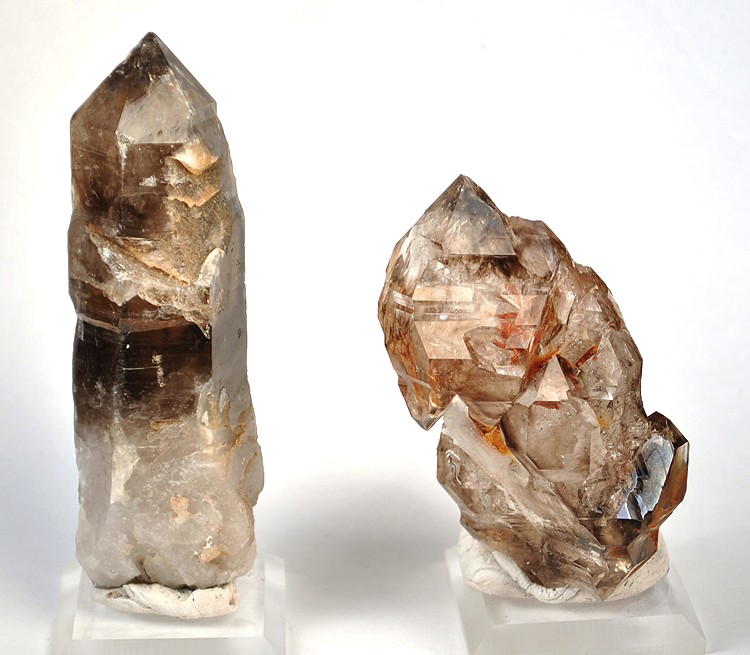
Crystal habit is the characteristic external shape a mineral tends to take when it grows. It reflects the mineral’s internal atomic structure combined with the space and conditions it grew in, and because certain minerals almost always favour certain shapes, habit is a fast first filter when you are trying to name a specimen. Quartz points, pyrite cubes and botryoidal “bubbly” hematite are all recognisable at a glance.
What habit actually describes
Habit is about overall shape, not about what happens when you break the mineral. A well-formed crystal that grew with room to spare shows flat crystal faces and clean geometry; a crowded one may be stubby or distorted while still keeping its basic form. Habit sits alongside the other diagnostic properties — it is separate from cleavage (how a mineral breaks) and from hardness, and works best when you read all of them together.
Common single-crystal habits
- Prismatic — long, columnar crystals like quartz and tourmaline.
- Tabular — flat, plate-like crystals, as in some feldspars and barite.
- Bladed — flat and elongated like a knife blade, typical of kyanite.
- Acicular — slender needles, as in rutile and natrolite.
- Cubic — well-formed cubes, seen in pyrite, halite and galena.
- Octahedral — eight-sided crystals like fluorite, magnetite and diamond.
- Dodecahedral — twelve-sided crystals, the hallmark of garnet.
Common aggregate habits
Many minerals rarely form single tidy crystals and instead grow as masses or crusts. Botryoidal habit — rounded, grape-like lumps — is common in hematite, malachite and chalcedony. Druse (or druzy) is a carpet of tiny crystals coating a surface, familiar from the lining of a geode. Dendritic habit forms branching, tree-like patterns, seen in native copper and manganese oxides. Others include fibrous (thread-like, as in some serpentines), radiating (crystals fanning out from a point), reniform (kidney-shaped) and plain massive, where no individual crystals are visible at all.
Single-crystal habits
- Prismatic — quartz, tourmaline
- Cubic — pyrite, halite, galena
- Octahedral — fluorite, magnetite
- Dodecahedral — garnet
Aggregate habits
- Botryoidal — hematite, malachite
- Druzy — geode and vug linings
- Dendritic — native copper, pyrolusite
- Massive — no visible crystals
Why the same mineral takes different shapes
Habit is not perfectly fixed, because growth conditions change the outcome. A crystal that grows slowly in an open cavity can develop large, sharp faces, while the same mineral crystallising fast in a crowded seam may end up granular or massive with no faces at all. Temperature, the chemistry of the fluid and the presence of impurities all play a part. Calcite is famous for this — it has been described in hundreds of different habits — and quartz ranges from glassy prisms to shapeless massive vein material. That is exactly why habit is a strong first clue but never a stand-alone verdict.
Using habit to narrow an ID
Some habits are distinctive enough to point almost straight to a mineral. Pyrite often grows as cubes with fine parallel striations on their faces. Garnet favours rounded twelve- or twenty-four-sided crystals with no cleavage. Tourmaline forms striated prisms with a rounded-triangular cross-section. When you spot a signature shape like these, you can confirm it quickly with a second test — a streak check or a hardness scratch — and understand how the specimen fits the wider rock-versus-mineral picture.
Frequently asked questions
What is crystal habit in minerals?
Crystal habit is the characteristic external shape a mineral tends to grow into, such as prismatic, cubic or botryoidal. It reflects the mineral’s internal atomic structure together with the conditions it formed in.
What is the difference between crystal habit and cleavage?
Habit describes the shape a mineral grows into, visible on an unbroken crystal. Cleavage describes how a mineral splits when you break it. One is about growth, the other about breakage.
Why does the same mineral have different habits?
Growth conditions vary. Space, temperature, fluid chemistry and impurities all affect the result, so a mineral can form sharp crystals in an open cavity but grow massive or granular in a crowded seam. Calcite is a well-known example.
Which minerals have a cubic habit?
Pyrite, halite and galena commonly grow as cubes. Pyrite cubes often carry fine parallel striations on their faces, which helps separate them from other cubic minerals.
What is a botryoidal habit?
Botryoidal means a rounded, grape-like cluster of bulbous surfaces. It is common in hematite, malachite and chalcedony, and forms when crystals grow outward from many closely spaced points.
Can crystal habit alone identify a mineral?
Not reliably on its own, because many minerals share habits and some take several forms. Use habit as a strong first clue, then confirm with hardness, streak and cleavage.
Want well-formed crystals to study habit?
Sponsored — partner shop · Minerals Kingdom
Habit is one clue among several — pair it with cleavage and fracture, the Mohs hardness scale , the streak test and how to read mineral luster. New to the hobby? Start with how to start rockhounding.
Written by The Field & Stone Editors · Published by KEVALEX Group.