 FIELD
FIELD Crystal twinning: recognising twinned crystals in the field
Now and then a crystal looks as if two individuals have grown into one another at a deliberate angle — a re-entrant notch, a cross, a heart, a mirrored elbow. That is twinning, and once you know the common patterns you will see them everywhere.
Crystal twinning is the symmetrical intergrowth of two or more crystals of the same mineral, joined by a definite geometric rule rather than by chance. The two parts share a common lattice plane or axis, so instead of a random cluster you get a single, orderly object with a mirror, a rotation or an inversion built into it. Recognising a twin is useful in two ways at once: it is often striking enough to be diagnostic, and it tells you something real about how the crystal grew. This guide explains what a twin is, names the patterns you will actually meet, and shows how to tell a genuine twin from a broken or doubled lump.
What a twin actually is
Every crystal is built on a repeating internal framework, the lattice. In a twin, two regions of that framework meet across a shared boundary and are related by a specific symmetry operation — most often a reflection across a plane, sometimes a rotation about an axis, occasionally an inversion through a point. The rule that governs a particular junction is called a twin law, and it is not arbitrary: it uses directions that already exist in the crystal’s own structure, which is why a given mineral tends to twin the same way again and again. The visible signature is a change of direction that looks too neat to be accidental — facets that step, notch or mirror where a single crystal would run straight. Twinning usually happens as the crystal grows, though some twins form later when a mineral is stressed or transforms from one structure to another.
Contact, penetration and repeated twins
It helps to sort twins by how the two individuals are arranged. Three broad kinds cover most of what you will find.
- Contact twins — two halves joined along a flat composition plane, so the crystal looks like one individual reflected across a mirror. The tell-tale is a re-entrant angle, a notch that points inward where a normal crystal face would never dip.
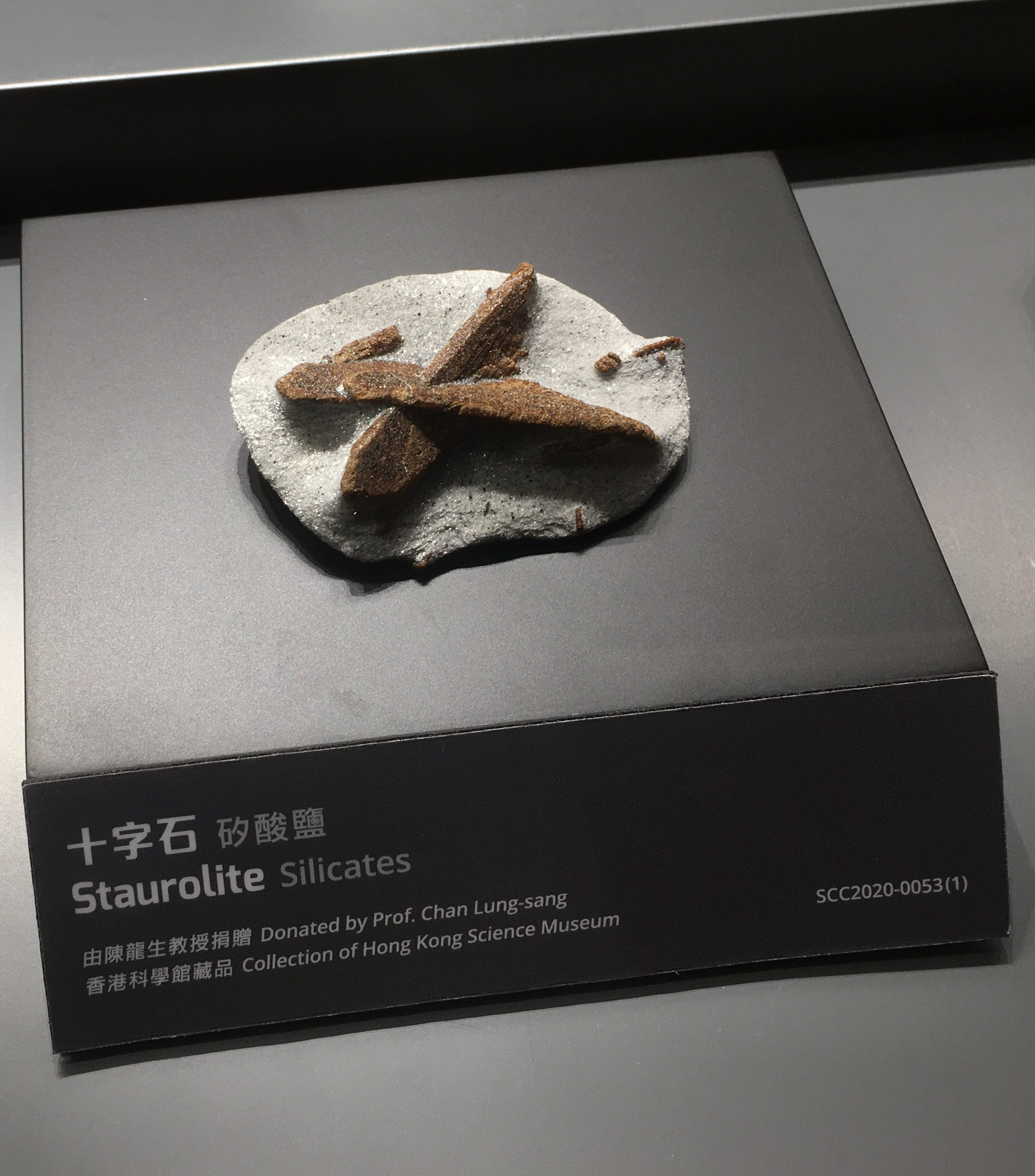
- Penetration twins — two individuals that appear to pass straight through one another, giving crosses, X-shapes and interlocked cubes. Staurolite’s cross and the « iron cross » of pyrite are classic examples.
- Repeated (multiple) twins — the same law applied over and over. When the layers are thin and parallel this is polysynthetic twinning, seen as fine parallel striations on plagioclase feldspar; when they fan around a point it is cyclic twinning, as in the six-sided « wheels » of aragonite or rutile.
Common twin laws
- Carlsbad, Baveno & Manebach — feldspars
- Spinel law — spinel, magnetite, diamond
- Iron cross — pyrite penetration twins
- Japan law — contact-twinned quartz
- Swallowtail — gypsum (selenite)
Minerals that twin often
- Plagioclase feldspar — fine polysynthetic stripes
- Staurolite — right-angle and 60° crosses
- Calcite & aragonite — contact and cyclic twins
- Rutile, cassiterite — elbow & knee twins
- Fluorite, galena — interpenetrant cubes
How to spot a twin in the field
The single most reliable sign is the re-entrant angle: run your eye around the outline and look for any place where the surface dips inward into a notch, because an untwinned crystal is convex and never does this. Next, look for mirror symmetry — do two halves reflect each other across a clean plane? Then check for fine parallel striations on a flat face, especially on feldspar, where light catches alternating polysynthetic lamellae and one half may extinguish while the other stays bright as you tilt the piece. Crosses and interlocked shapes that are too regular to be a chance cluster point to penetration twins. A hand lens helps enormously; so does wetting the specimen or turning it under a single light, the same trick that reveals optical effects. Twinning is a property of a single mineral individual, so first make sure you are looking at one crystal and not two separate grains that merely touch.
Why twinning matters for identification
Twinning is worth learning because it is often more diagnostic than colour, which misleads, or than a rough estimate of specific gravity. Some habits are effectively fingerprints: staurolite’s natural cross, the swallowtail of gypsum, the elbow twins of rutile and cassiterite, and the fine repeated striations that separate plagioclase from the potassium feldspars. Twinning also interacts with cleavage, because a cleavage direction can change orientation across the twin plane, and it can complicate the reading of crystal habit if you mistake a twin for a distorted single crystal. Used alongside luster and hardness, a confidently recognised twin narrows the list of candidates fast.
Cautions and common mistakes
The commonest error is to call any doubled or clustered crystal a twin. A true twin obeys a symmetry law and shows a re-entrant angle or mirrored geometry; a random parallel growth or a simple cluster of separate grains does not, even though the crystals sit side by side. A broken and re-cemented crystal can also fake the look of a junction, so check that the « twin » is continuous and unbroken across the boundary. Beware, too, of reading every stripe as polysynthetic twinning — growth striations along the length of a quartz or tourmaline prism are surface texture, not internal twin lamellae, and they run the wrong way. Finally, remember that a great many perfectly ordinary crystals are not twinned at all; twinning is a bonus clue when it is present, not something to force onto a specimen. When in doubt, look for the notch and the mirror, and be honest if they are not there.
Frequently asked questions
What is crystal twinning?
Crystal twinning is the symmetrical intergrowth of two or more crystals of the same mineral, joined across a shared plane or axis by a definite geometric rule called a twin law. The result is a single orderly object with a mirror, rotation or inversion built into it, rather than a random cluster.
What is a re-entrant angle?
A re-entrant angle is a notch where the outline of a crystal dips inward instead of bulging outward. Single crystals are convex and never show one, so a re-entrant angle is the most reliable field sign that you are looking at a twin.
What is the difference between contact and penetration twins?
A contact twin has two halves joined along a flat composition plane, so one half looks reflected across the other. A penetration twin has two individuals that appear to pass through one another, producing crosses and interlocked shapes such as staurolite’s cross or pyrite’s iron cross.
Which minerals commonly show twinning?
Plagioclase feldspar (fine polysynthetic striations), staurolite (crosses), gypsum (swallowtail), calcite and aragonite, rutile and cassiterite (elbow twins), and pyrite, fluorite and galena (interpenetrant cubes) all twin readily and predictably.
How can I tell a twin from a random cluster of crystals?
A twin obeys a symmetry law: it shows a re-entrant notch, mirrored halves or a regular cross, and the lattice is continuous across the junction. A random cluster or parallel growth is just separate grains touching, with no shared symmetry and no re-entrant angle.
Does twinning help identify a mineral?
Yes. Because each mineral tends to twin the same way, a recognised twin is often diagnostic — the fine stripes of plagioclase, the cross of staurolite or the swallowtail of gypsum can identify the mineral more reliably than colour.
Want a twinned crystal for your collection?
Sponsored — partner shop · Minerals Kingdom
Twinning sits alongside the other things you read off a crystal in the field — crystal habit, the seven crystal systems, cleavage and fracture and luster. One mineral can also mimic another’s shape entirely, which is the subject of pseudomorphs. New to the hobby? Start with how to start rockhounding.
Written by The Field & Stone Editors · Published by KEVALEX Group.