 FIELD
How to identify malachite: banding, green streak and fakes
Malachite is the green copper mineral with the swirling bands. A pale green streak, a low hardness, a heavy feel and a fizz in cold acid separate it from chrysocolla, dyed stone, glass and resin copies.
Malachite is a copper carbonate mineral, famous for its rich green colour and concentric light-and-dark banding. It forms where copper ore meets air and water, so rockhounds find it as green crusts, rounded lumps and velvety tufts in old copper mines and their dumps, often next to blue azurite. Because it is popular in jewellery and decor, it is also one of the most imitated green stones on the market. This guide explains how to identify malachite with simple field and kitchen-table tests, how to tell it from its look-alikes, and how to handle it safely. It builds on our guides to the streak test, the acid test and the Mohs hardness scale.
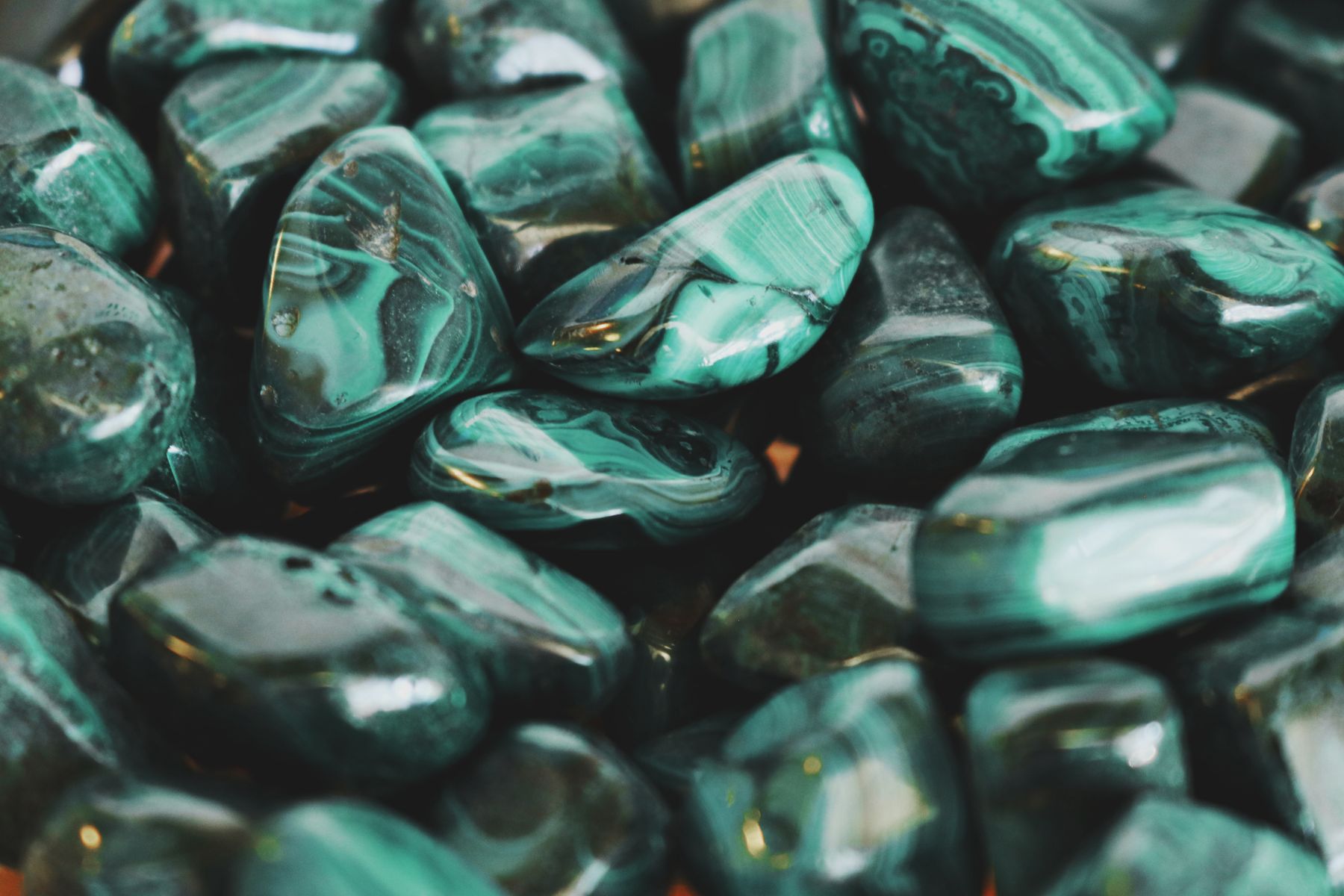
What malachite actually is
Malachite is a basic copper carbonate with the formula Cu2CO3(OH)2, containing roughly 57 percent copper by weight. It crystallises in the monoclinic system, but distinct crystals are rare and usually tiny. Most malachite grows as botryoidal (grape-like) masses, stalactites, crusts and radiating fibres, which is where the banding comes from: each layer records a pulse of copper-rich water depositing new mineral on the surface below. Our guide to crystal habit explains these shapes.
It is a secondary mineral. Primary copper sulfides such as chalcopyrite break down near the surface, and the dissolved copper reacts with carbonate from groundwater or limestone wall rock. That is why malachite marks the weathered, oxidised top of a copper deposit and why prospectors long used its green stain as a pointer to ore below.
Field tests for malachite
Colour gets you started, but as our page on mineral colour warns, colour alone proves nothing. Stack the following clues.
Look at colour and banding
Natural malachite is opaque green, from pale mint to almost black-green, and massive pieces show curved, concentric bands that follow the rounded growth surface. Broken botryoidal lumps reveal bullseye or ripple patterns, while fibrous pieces have a silky sheen that shifts as you tilt them. Bands that are perfectly straight, repeat exactly or look printed are a warning sign.
Run a streak test
Rub an unpolished edge on the back of a ceramic tile. Malachite leaves a light green streak. That single result rules out many imitations: most glass and resin copies are too hard or too soft to leave a green powder, and dyed stones usually streak white. Read more in our streak test guide.
Check the hardness
Malachite is soft, about 3.5 to 4 on the Mohs scale. A steel knife or a glass plate will scratch it easily, while a copper coin (about 3) barely marks it. Glass imitations are near 5.5 and will not be scratched by a knife in the same way. Test only on a hidden spot of a polished piece.
Feel the weight
With a specific gravity of roughly 3.6 to 4.0, malachite feels noticeably heavy for its size, much heavier than quartz, agate or plastic of the same volume. A resin copy feels light and warm in the hand.
Try a drop of cold dilute acid
Like other carbonates, malachite effervesces in cold dilute hydrochloric acid, and the drop turns faintly green as copper dissolves. Household vinegar reacts more slowly. Use this only on a rough specimen or a hidden spot, since acid etches polished surfaces permanently; our acid test guide covers the method and safety.
Optional: the flame test
A few grains held in a flame colour it green, the typical signature of copper. This confirms copper but not malachite specifically, since chrysocolla and other copper minerals do the same. See our flame test page.
Malachite at a glance
Key properties
- Formula → Cu2CO3(OH)2, copper carbonate
- Hardness → 3.5 to 4 (scratched by a knife)
- Streak → light green
- Specific gravity → about 3.6 to 4.0, heavy for its size
- Luster → silky in fibres, vitreous to adamantine in crystals, dull when earthy
- Acid → fizzes in cold dilute HCl
Quick checks
- Bands — curved and irregular, never printed-looking
- Streak — green powder, not white
- Knife — scratches easily on a hidden spot
- Heft — heavier than agate or resin
- Neighbours — blue azurite, rusty limonite, copper staining
Look-alikes and fakes to rule out
Several green materials, natural and man-made, are sold or found as “malachite”. Each fails at least one test above.
- Chrysocolla is a blue-green copper silicate that often grows with malachite. It is bluer, usually softer and more brittle, sticks slightly to a moist tongue, and does not fizz in acid.
- Turquoise is harder (5 to 6), bluer and does not effervesce. Our turquoise guide covers its own fakes.
- Brochantite, atacamite and pseudomalachite are other green copper minerals found in the same oxidised zones. None of them fizz in acid, which is the quickest way to separate them in the field.
- Glass and resin imitations have regular, repeating stripes, bubbles under a hand lens, a light weight (resin) or a hardness near 5.5 (glass), and no green streak.
- Reconstituted malachite is crushed malachite bound in resin. It shows angular fragments set in a matrix and feels lighter and warmer than solid stone.
- Dyed stones such as dyed agate or howlite show colour concentrated in cracks and a white streak.
- Green fluorite and serpentine lack copper banding; fluorite has cubic cleavage and serpentine feels waxy and streaks white.
Azurite, pseudomorphs and associated minerals
Malachite and deep blue azurite share the same ingredients and often grow together, sometimes intergrown as “azurmalachite”. Azurite is less stable at the surface, and over time it can turn into malachite while keeping its original crystal shape. These green crystals with a blue mineral’s outline are classic pseudomorphs and are prized by collectors. Malachite can also replace native copper and cuprite. Finding green and blue copper minerals together, with rusty limonite and quartz, is a strong hint that you are in the oxidised zone of a copper deposit.
Where to look for malachite
In the United States, the classic localities are the copper districts of Arizona, including Bisbee, Morenci and Ray, along with smaller occurrences in New Mexico, Utah, Nevada and elsewhere in the West. Our Arizona rockhounding guide is a starting point. Worldwide, much of the decorative malachite on the market comes from the Katanga copper belt in the Democratic Republic of the Congo, and the Ural Mountains of Russia were historically famous for it. Most active mines are closed to the public, so look for permitted fee-digs, club field trips and old dumps on land where collecting is allowed. Always confirm land status and rules first, and read our collecting ethics page.
Cleaning and caring for malachite
Malachite is soft and reacts with acids, so clean it with plain lukewarm water and a soft brush only. Avoid vinegar, rust removers, ammonia and harsh cleaners, and skip ultrasonic baths for fragile botryoidal pieces; more tips are in how to clean rock finds. Store it away from harder stones that can scratch it, and do not tumble it with quartz-hardness rocks. Then give it a number and a label as shown in how to catalog a rock collection.
Malachite in tradition
Malachite has been used as a pigment and ornamental stone since antiquity, ground into green paint and eye cosmetics in ancient Egypt and carved into vases and panels in imperial Russia. In crystal-healing and folk traditions it is often called a stone of “transformation” or protection. These are cultural beliefs, not scientific findings: there is no evidence that malachite has any medical effect, and it should never replace professional medical advice.
Frequently asked questions
How can you tell if malachite is real?
Real malachite is opaque green with curved, irregular banding, leaves a light green streak, is soft enough for a knife to scratch (3.5 to 4), feels heavy for its size and fizzes in cold dilute acid. Glass, resin and dyed stones fail one or more of these tests.
What is the streak colour of malachite?
Malachite leaves a light green streak on an unglazed ceramic tile. Dyed imitations usually leave a white streak.
What is the hardness of malachite?
Malachite measures about 3.5 to 4 on the Mohs scale. A steel knife scratches it easily, so polished pieces scratch and dull with careless handling.
What is the difference between malachite and chrysocolla?
Both are green copper minerals that often grow together. Malachite is a carbonate with distinct green banding that fizzes in acid; chrysocolla is a bluer copper silicate that does not fizz and often feels slightly sticky to a damp tongue.
Is malachite toxic to handle?
Handling a polished stone is generally considered low risk, but malachite dust is harmful if inhaled or swallowed. Never sand or cut it dry, keep it out of drinking water, and wash your hands after handling rough specimens.
Where is malachite found in the United States?
The best-known US localities are the Arizona copper districts, such as Bisbee, Morenci and Ray, with smaller finds across New Mexico, Utah and Nevada. Collecting is limited to permitted sites and land where it is allowed.
Want a genuine malachite specimen to compare your finds against?
Sponsored — partner shop · Minerals Kingdom
Malachite is easy to confirm once you stack the clues. Check the green streak, scratch-test it on the Mohs scale, read its silky surface with our luster guide, and finish with a careful acid test.
If you are new to the hobby, start with how to start rockhounding and our explainer on rock vs. mineral.
Written by The Field & Stone Editors · Published by KEVALEX Group. Traditional beliefs are described for cultural interest only and are not medical advice.