 FIELD
FIELD Concretions: how to identify them
Round, heavy and oddly perfect, concretions are among the most misidentified objects a rockhound picks up — taken for fossil eggs, cannonballs, geodes or even meteorites. Here is what they really are.
A concretion is a hard, usually rounded mass that forms inside a body of sedimentary rock when minerals precipitate from groundwater and cement the grains together around some centre. Because they are tougher than the mudstone, shale or sandstone that hosts them, concretions weather out whole as the softer rock erodes away, and they turn up as smooth balls, discs, pipes and knobbly clusters that look far too regular to be natural. That regularity is exactly why they are so often mistaken for something they are not — a dinosaur egg, a cannonball, a geode, a fossil or a meteorite. This guide explains how concretions form, how to recognise one, and how to tell it apart from the things it imitates, using the same evidence-based habits as any other field test.
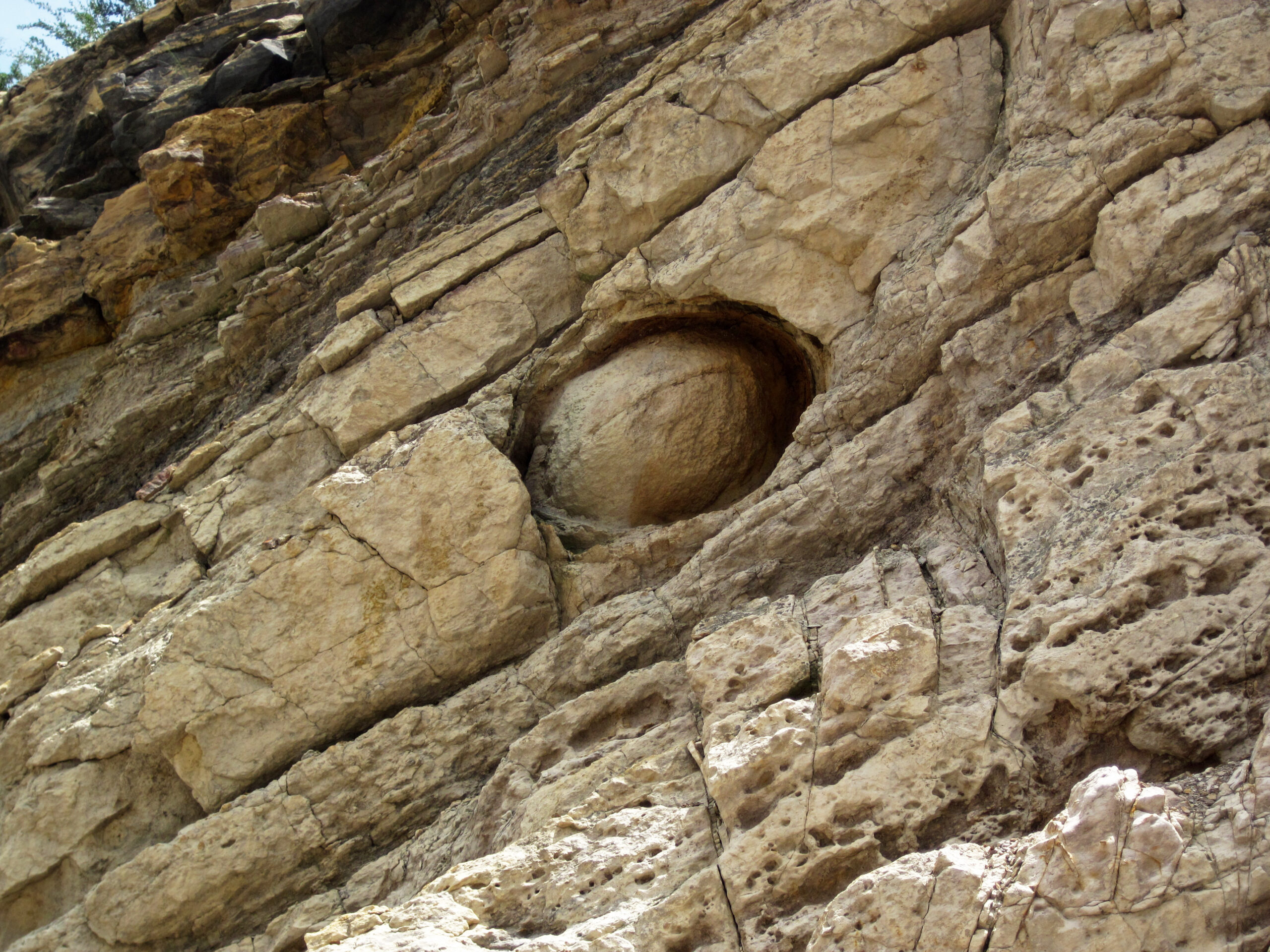
What a concretion is
A concretion is not a rock type of its own but a structure that grows within an existing sedimentary rock after the sediment is laid down. Groundwater moving through the pores of mud or sand carries dissolved minerals — most often calcite, but also silica, iron oxides, or the iron carbonate siderite — and where conditions are right those minerals precipitate and glue the surrounding grains into a compact, cemented mass. The result is a body that is chemically much like its host but far harder and denser, because its pore spaces have been filled in. Crucially, a concretion is a body of the host sediment cemented together, so it usually contains the same sand or clay grains as the rock around it — a fact that helps distinguish it from things that grew in an open cavity.
How concretions form
Most concretions grow around a nucleus — a scrap of shell, a leaf, a fish bone, a grain of a different mineral — that changes the local chemistry of the pore water just enough to start mineral precipitation. From that seed the cement spreads outward through the surrounding sediment, and because it often spreads at a similar rate in all directions it builds the sphere or ellipsoid that makes concretions look so deliberate. Growth happens early, while the sediment is still soft and porous, which is why concretions can enclose delicate fossils in three dimensions — the hard cement forms around them before the sediment compacts and flattens everything else. Some concretions are tiny; others, like the famous spherical boulders that weather out of coastal cliffs, reach several metres across and take an enormous span of time to grow.
Signs of a concretion
- Rounded, spherical, disc- or pipe-shaped
- Solid all the way through when broken
- Made of the same grains as the host rock
- Often a visible nucleus at the centre
- Harder and denser than the surrounding rock
Concretion, geode, nodule or fossil?
The confusion is understandable, because all of these are hard, rounded objects that weather out of softer rock, but the differences are clear once you know what to check. A concretion is solid throughout and made of cemented host sediment. A geode is a hollow rock with a cavity lined by inward-pointing crystals — break or shake it and you find or hear the void — and a nodule is a solid mass, often of silica such as flint or agate, that contrasts sharply in composition with its host rather than sharing its grains. A fossil may be enclosed within a concretion, but a fossil itself shows biological structure: the texture of bone, the symmetry of a shell, the cells of petrified wood. When a rounded lump splits to reveal an ammonite or a fish, you have a fossil-bearing concretion; when it splits to plain, even-grained rock, it is a concretion and nothing more. Comparing what you have against the three great rock families and the geode guide will place almost any specimen.
Where to find concretions
Look for concretions wherever fine-grained sedimentary rock is actively eroding: coastal cliffs and their beaches, river cutbanks, badlands, road cuts and quarry spoil in shale, mudstone and sandstone country. Because they resist weathering, concretions collect where the soft host has been stripped away — scattered across a beach below a crumbling cliff, or standing proud of a slope like set marbles. The United States has celebrated localities: the ironstone concretions of the Midwest, the sandstone spheres of the desert Southwest, and the fossil-bearing concretions prized in several shale formations. As always, confirm you are on land where collecting is permitted before you take anything, and read the exposure with the same eye you would bring to a geologic map, since the map tells you which formations carry them.
Cautions and common mistakes
The commonest error is the dinosaur-egg mistake: a smooth, rounded concretion is not a fossil egg, and genuine eggs are rare, show shell structure and internal layering, and are almost never loose on a beach. Second, do not assume a heavy, dark, rounded stone is a meteorite — iron-rich concretions are common and fool people constantly; a real meteorite shows a fusion crust, is strongly attracted to a magnet and usually shows bright metal on a filed edge, tests a concretion will fail. Third, resist breaking every lump hoping for a geode; most concretions are solid all the way through, and a hand lens on a broken edge quickly shows the ordinary sediment grains inside. Finally, remember that a concretion can genuinely host a fine fossil, so if a split reveals biological structure treat the find with care — and check local rules, because fossils on public land are protected in many places.
Frequently asked questions
What is a concretion?
A concretion is a hard, usually rounded mass that forms inside sedimentary rock when minerals precipitate from groundwater and cement the surrounding grains together, often around a nucleus such as a shell or leaf. Being harder than the host rock, it weathers out whole as the softer rock erodes.
How can you tell a concretion from a geode?
Break it or heft it. A concretion is solid and dense all the way through and made of the same grains as its host rock. A geode is hollow, with a cavity lined by inward-pointing crystals, and feels light for its size. If there is a void or crystal lining, it is a geode, not a concretion.
Are concretions fossils?
Not in themselves, but they can contain them. Concretions often grow around a fossil nucleus and can preserve delicate remains in three dimensions. The concretion is the cemented rock; the fossil is the biological structure inside it. A rounded lump that splits to plain, even-grained rock is a concretion with no fossil.
Is a round rock a dinosaur egg?
Almost never. Smooth, rounded concretions are frequently mistaken for fossil eggs, but genuine eggs are rare, show distinct shell structure and internal layering, and are not found loose on beaches. A featureless round stone weathering from shale or sandstone is far more likely a concretion.
How do concretions form?
Groundwater moving through porous sediment carries dissolved minerals such as calcite, silica or iron compounds. Around a nucleus, those minerals precipitate and cement the surrounding grains into a hard mass, usually growing outward at a similar rate in all directions to build a sphere or ellipsoid, while the sediment is still soft.
Where do you find concretions?
Look where fine-grained sedimentary rock is actively eroding: sea cliffs and their beaches, river cutbanks, badlands, road cuts and quarry spoil in shale, mudstone and sandstone. Because they resist weathering, concretions gather where the softer host rock has washed away. Always confirm collecting is permitted first.
Prefer a crystal specimen to a mystery lump?
Sponsored — partner shop · Minerals Kingdom
Concretions sit at the crossroads of several field puzzles — sort yours out with the guides to geodes, thundereggs and nodules, telling a fossil from a rock, and the three rock families. A hand lens on a broken edge settles most cases, and if your clear crystal doubles print it is calcite showing double refraction, not a concretion at all.
Written by The Field & Stone Editors · Published by KEVALEX Group.