 FIELD
FIELD Radioactive minerals: testing rocks with a Geiger counter
A handful of minerals give off a faint, steady tick on a Geiger counter. Knowing which ones — and how to handle them safely — turns radioactivity into just another field test.
Radioactive minerals contain unstable atoms — chiefly of uranium and thorium — whose nuclei decay over time and emit ionising radiation. That radiation is invisible and odourless, but it is simple to detect with an inexpensive instrument, which makes radioactivity a genuine diagnostic property in the same family as magnetism or the acid test. Only a small number of minerals are radioactive enough to register clearly, but they include some of the most vivid specimens a rockhound will ever see. This guide explains what makes a mineral radioactive, names the ones you are most likely to meet, shows how to test a rock with a Geiger counter, and — just as importantly — how to collect and store them sensibly.
What makes a mineral radioactive
An atom is radioactive when its nucleus is unstable and sheds energy to reach a steadier state. In minerals the culprits are almost always the two long-lived heavy elements uranium and thorium, along with radioactive potassium-40 in trace amounts. Uranium-238, uranium-235 and thorium-232 each sit at the head of a long decay chain, transforming step by step through a series of daughter isotopes — radium, radon, polonium and others — until they finally settle as stable lead. Each step releases radiation of three kinds: heavy, short-range alpha particles, lighter beta particles, and penetrating gamma rays. A Geiger counter registers this activity as a rising count rate. Because the decay is a property of the atomic nucleus, it is completely unaffected by weathering, heat or crystal form: a uranium atom locked inside autunite is exactly as radioactive as one inside dull, massive uraninite.
The minerals you are most likely to meet
Radioactive species fall into two groups. Primary minerals crystallised with uranium or thorium built in, while secondary minerals formed later as those elements were dissolved, moved and redeposited near the surface — and the secondary ones are usually the colourful, collectable specimens.
- Uraninite (pitchblende) — the primary uranium ore, black, heavy and strongly radioactive.
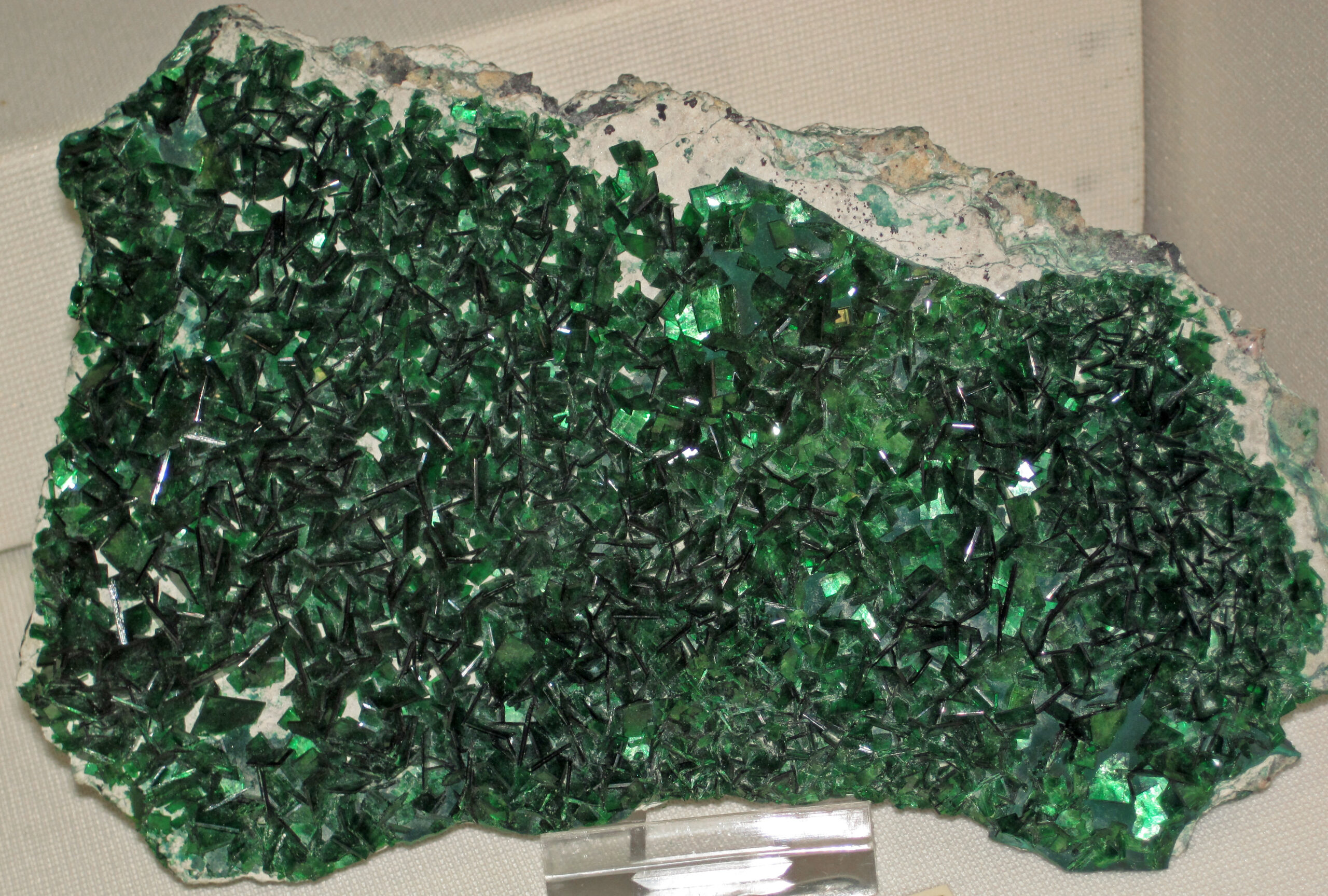
- Autunite and torbernite — secondary uranium phosphates in vivid lemon-yellow and emerald-green tabular crystals; autunite fluoresces bright green under UV.
- Carnotite and tyuyamunite — soft, canary-yellow uranium-vanadium minerals that dust sandstones of the Colorado Plateau.
- Thorite and monazite — thorium-bearing minerals; monazite is a common heavy grain in placer and beach sands.
- Zircon, allanite and samarskite — accessory minerals in granites and pegmatites that carry enough uranium or thorium to register.
Strongly radioactive
- Uraninite / pitchblende — uranium oxide
- Autunite — uranium phosphate (UV-green)
- Torbernite — copper uranium phosphate
- Carnotite — uranium-vanadium
Weakly to moderately radioactive
- Monazite — thorium phosphate, in sands
- Thorite — thorium silicate
- Zircon — accessory in granite
- Allanite, samarskite — pegmatite minerals
How to test a rock with a Geiger counter
A Geiger–Müller counter is the standard tool. Inside is a gas-filled tube that produces an electrical pulse each time a particle of radiation passes through it; the meter reports these as counts per minute (CPM) or as a dose rate. To test a specimen, first take a background reading a metre or two away from any suspect rock — typical natural background is a low, irregular tick — then bring the tube slowly up to the mineral. A radioactive specimen makes the count climb sharply and steadily as the tube nears the surface, and fall away again as you withdraw it. Hold the probe close but not touching, and test a fresh face rather than a weathered rind. Bear in mind that most inexpensive counters detect mainly beta and gamma radiation; the alpha particles that dominate uranium decay are stopped by the tube wall, by a scrap of paper, even by a few centimetres of air, so a counter without a thin « alpha window » will under-read a genuinely hot rock. For collectors who want to confirm uranium specifically, an ultraviolet lamp is a useful partner test: autunite and many secondary uranium minerals glow a vivid green, tying this guide to fluorescent minerals and UV light.
Collecting and storing radioactive minerals safely
Radioactive specimens are collected and displayed the world over, and reasonable handling keeps the risk very low. The two sensible concerns are dust and radon. Do not grind, saw or lick a radioactive mineral, because the real hazard is inhaling or swallowing tiny particles rather than simply holding a solid piece; wash your hands after handling and keep specimens away from food. Uranium minerals continuously give off radon, a radioactive gas, so store them in a ventilated display rather than a sealed box, and keep any collection out of bedrooms and other rooms where people spend long hours. Keep pieces modest in size, label them clearly, and store them away from children and pets. None of this is cause for alarm — it is the same common sense a collector applies to sharp tools or heavy specimens. This is general collecting guidance, not medical advice; anyone with specific health concerns should consult a qualified professional.
Why radioactivity helps identify minerals
Radioactivity is valuable precisely because so few minerals possess it. A bright green crust could be malachite, chrysocolla or torbernite, but only torbernite will move the needle on a counter — so a positive reading instantly separates a uranium mineral from its harmless look-alikes, a distinction that colour alone can never make. In heavy-mineral sands, a faint but real count points to monazite among the darker grains. Used together with fluorescence, colour, crystal form and heft, radioactivity narrows the field fast and confirms an identification that would otherwise rest on appearance alone. Like the Mohs hardness scale, it is one clear line of evidence among several.
Cautions and common mistakes
The first mistake is to assume every yellow or green mineral is radioactive: sulphur, malachite and countless others are inert, and only a nucleus containing uranium or thorium will register. The second is to expect a glow — many radioactive minerals do not fluoresce, and many fluorescent minerals are not radioactive, so the two tests overlap only partly. Do not trust a phone « Geiger counter » app; a real detector needs a proper sensor, and a cheap counter that reads only gamma will badly underestimate an alpha-rich uranium specimen. Be wary, too, of confusing genuine radioactive minerals with manufactured curiosities such as old uranium glass or the tiny americium source in a smoke detector — these are radioactive, but they are not minerals. Finally, remember that natural background radiation varies from place to place, so always compare a suspect rock against a fresh background reading rather than a single absolute number.
Frequently asked questions
What are radioactive minerals?
Radioactive minerals are those containing unstable atoms — almost always uranium or thorium — whose nuclei decay and emit ionising radiation. That radiation can be detected with a Geiger counter, which makes radioactivity a diagnostic property much like magnetism or reaction to acid.
Which minerals are radioactive?
The main ones are uraninite (pitchblende), the secondary uranium minerals autunite, torbernite, carnotite and tyuyamunite, and the thorium minerals monazite and thorite. Accessory minerals such as zircon, allanite and samarskite can also carry enough uranium or thorium to register.
How do you test a rock for radioactivity?
Use a Geiger counter. Take a background reading away from the rock, then bring the tube slowly toward a fresh face and watch for a sharp, steady rise in counts per minute. A counter with a thin alpha window reads uranium minerals far more accurately than a gamma-only model.
Are radioactive minerals dangerous to collect?
Reasonable handling keeps the risk low. The real concerns are inhaling dust and the build-up of radon gas, so avoid grinding or licking specimens, wash your hands afterwards, store pieces in a ventilated display, and keep them out of bedrooms and away from children. This is general guidance, not medical advice.
Do all uranium minerals glow under UV light?
No. Autunite and several secondary uranium minerals fluoresce a vivid green, but many radioactive minerals do not glow at all, and plenty of non-radioactive minerals fluoresce brightly. Use ultraviolet light as a supporting clue alongside a Geiger counter, never as a substitute for one.
Can I use a smartphone as a Geiger counter?
Not reliably. Phone apps lack a proper radiation sensor and cannot measure a specimen the way a Geiger–Müller tube does. For any real testing you need a dedicated counter, ideally one with an alpha window to catch the short-range radiation that dominates uranium decay.
Want a uranium mineral for your collection?
Sponsored — partner shop · Minerals Kingdom
Radioactivity sits alongside the other quick tests you carry into the field — the Mohs hardness scale, magnetism and the UV fluorescence that so often accompanies uranium minerals. New to the hobby? Start with how to start rockhounding, then add a Geiger counter to your kit once you know what you are looking for.
If you keep specimens at home, add a handling note to the label; see how to label and store a rock collection for a simple system.
Written by The Field & Stone Editors · Published by KEVALEX Group.