 FIELD
FIELD Mineral color: the most seductive and least reliable clue
Color is the first thing you notice and the first thing that leads you astray. The same mineral can come in half the rainbow, and wildly different minerals can share a shade — so color is a starting point, never a verdict.
Color is the property beginners trust most and experts trust least. It is genuinely useful for a small set of minerals, but for most it is treacherous: a single mineral like quartz appears clear, purple, pink, yellow, brown or black, while a dozen unrelated minerals all show up green. This guide explains why color misleads, what actually produces it, and how to fold it into an identification without letting it run the show. For a color clue you can lean on, see its far more reliable cousin, the streak test.
The clue everyone reaches for first
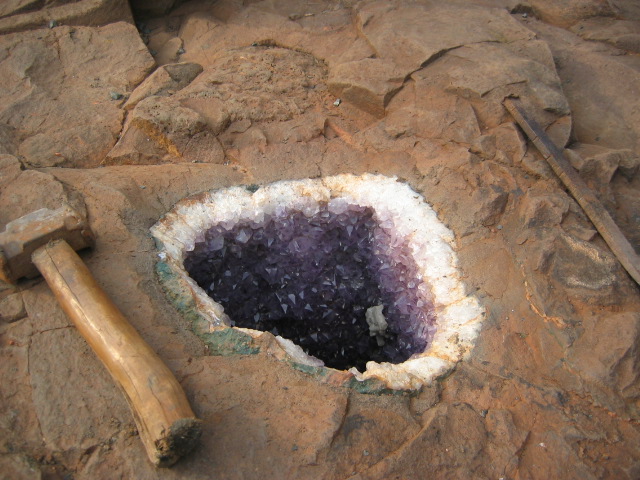
There is a good reason color is the opening move: it is instant, it needs no tools, and now and then it is decisive. A vivid green crust really does suggest copper; a brassy metallic cube really is worth a second look. The trouble is that color is produced by such small quantities of impurity, or by such subtle quirks of crystal structure, that it varies enormously within a single species and repeats across many. Rely on it alone and you will call every purple crystal amethyst and every red one garnet, when the purple might be fluorite and the red might be rhodochrosite. The skill is knowing the rare cases where color is diagnostic and treating everything else with healthy suspicion.
Idiochromatic and allochromatic minerals
The single most useful idea here is the split between minerals whose color is essential and those whose color is accidental. It is the difference between a color you can trust and one you cannot.
- Idiochromatic minerals owe their color to an element that is part of their basic recipe. The color is consistent and genuinely diagnostic — malachite is always green, azurite always blue, sulfur always yellow, because copper and sulfur are built into the formula.
- Allochromatic minerals are colorless when pure and take their color from trace impurities or structural defects. The color is inconsistent and largely useless for identification — quartz, fluorite, beryl, corundum and tourmaline each span most of the spectrum.
- Pseudochromatic color is not body color at all but an optical trick of the surface or interior, covered in our guide to optical effects in minerals.
Color is diagnostic
- Malachite — always green (copper)
- Azurite — always deep blue (copper)
- Sulfur — bright yellow
- Cinnabar — scarlet red
Color barely helps
- Quartz — clear, purple, pink, smoky
- Fluorite — purple, green, blue, yellow
- Corundum — ruby red or sapphire blue
- Tourmaline — nearly every color
What actually causes a mineral’s color
Color comes from the way a mineral’s atoms absorb some wavelengths of light and let the rest through to your eye. In idiochromatic minerals a transition metal — copper, iron, manganese, chromium — is an essential ingredient, so the absorption, and the color, are built in and reliable. In allochromatic minerals the same metals appear only as trace impurities: a few iron atoms turn colorless corundum into blue sapphire, a trace of chromium turns it into ruby, and the identical mineral results either way. Other causes are subtler still. Color centers — defects in the crystal lattice, often activated by natural radiation — give smoky quartz its brown and amethyst its purple. Charge transfer between neighboring iron and titanium atoms produces the blue of sapphire. And inclusions — foreign minerals trapped inside — lend color from outside the host, as flecks of green mica color aventurine or scaly hematite reddens quartz. Because all of these hinge on trace amounts, tiny differences produce very different colors in the same species.
How to use color without being fooled
Treat color as a prompt, not a proof. Note it, then immediately reach for the tests that do not lie. The most powerful pairing is with streak: the color of a mineral’s powder is far more constant than the color of the lump, which is exactly why a black, red or brown iron mineral is pinned down by its streak rather than its surface. Add hardness, crystal habit, luster and diaphaneity, and color takes its proper place as one voice among several. When color is reliable — the green of copper minerals, the yellow of sulfur — it is because you are looking at an idiochromatic species, and a moment’s thought about whether the color is essential or accidental will tell you how much weight it deserves.
Cautions and common mistakes
Several things distort the color you see before you even begin. Tarnish and weathering coat a mineral in a film of an unrelated color — bright bornite tarnishes to a peacock iridescence, and many sulfides dull to grey or brown, so scratch to a fresh surface before judging. Lighting shifts color markedly: some stones look one color in daylight and another under warm indoor light, an effect strong enough in a few gems to be diagnostic in its own right but a nuisance for everyday identification. Beware, too, of treatments — dyeing, heating and irradiation are common in the trade and can give a mineral a color it never had in the ground. And remember that some minerals are pleochroic, showing different colors from different viewing angles because the crystal absorbs light differently along its axes. In every case the remedy is the same: distrust the color, find a fresh clean surface, and let the other properties cast the deciding vote.
Frequently asked questions
Why is color unreliable for identifying minerals?
Because most minerals are allochromatic — colorless when pure and colored only by trace impurities or defects. That means one mineral can appear in many colors and many minerals can share one color, so body color alone rarely names a species.
What is the difference between idiochromatic and allochromatic minerals?
Idiochromatic minerals get their color from an element that is essential to their formula, so the color is consistent and diagnostic (malachite, azurite, sulfur). Allochromatic minerals are colorless when pure and take variable color from trace impurities (quartz, fluorite, corundum).
What causes color in minerals?
Chiefly transition metals such as iron, copper, manganese and chromium — either built into the formula or present as traces — plus lattice defects called color centers, charge transfer between atoms, and colored inclusions. All of these change which wavelengths of light the mineral absorbs.
Why can the same mineral be different colors?
Because tiny changes in trace impurities or structural defects shift the color dramatically. Quartz is clear when pure but becomes amethyst, citrine, rose or smoky quartz with different traces of iron, manganese, aluminium and natural irradiation.
Is streak more reliable than color?
Usually, yes. The color of a mineral’s powder — its streak — is far more constant than the color of the whole specimen, which is why streak is a standard identification test and body color is only a starting hint.
Which minerals can you identify by color alone?
Only idiochromatic ones, where color is essential — green malachite, blue azurite, yellow sulfur, scarlet cinnabar. Even then, confirm with streak, hardness and habit, because look-alikes exist for almost every color.
Want a colorful reference set to compare?
Sponsored — partner shop · Minerals Kingdom
Color works best as one test among many — run it with the streak test, the Mohs hardness scale, mineral luster, diaphaneity and crystal habit. New to the hobby? Start with how to start rockhounding.
Written by The Field & Stone Editors · Published by KEVALEX Group.