 FIELD
FIELD Fluorescent minerals & UV light
Under ultraviolet light, a drab grey rock can blaze red and green. Here’s the physics behind the glow — and how to collect it.
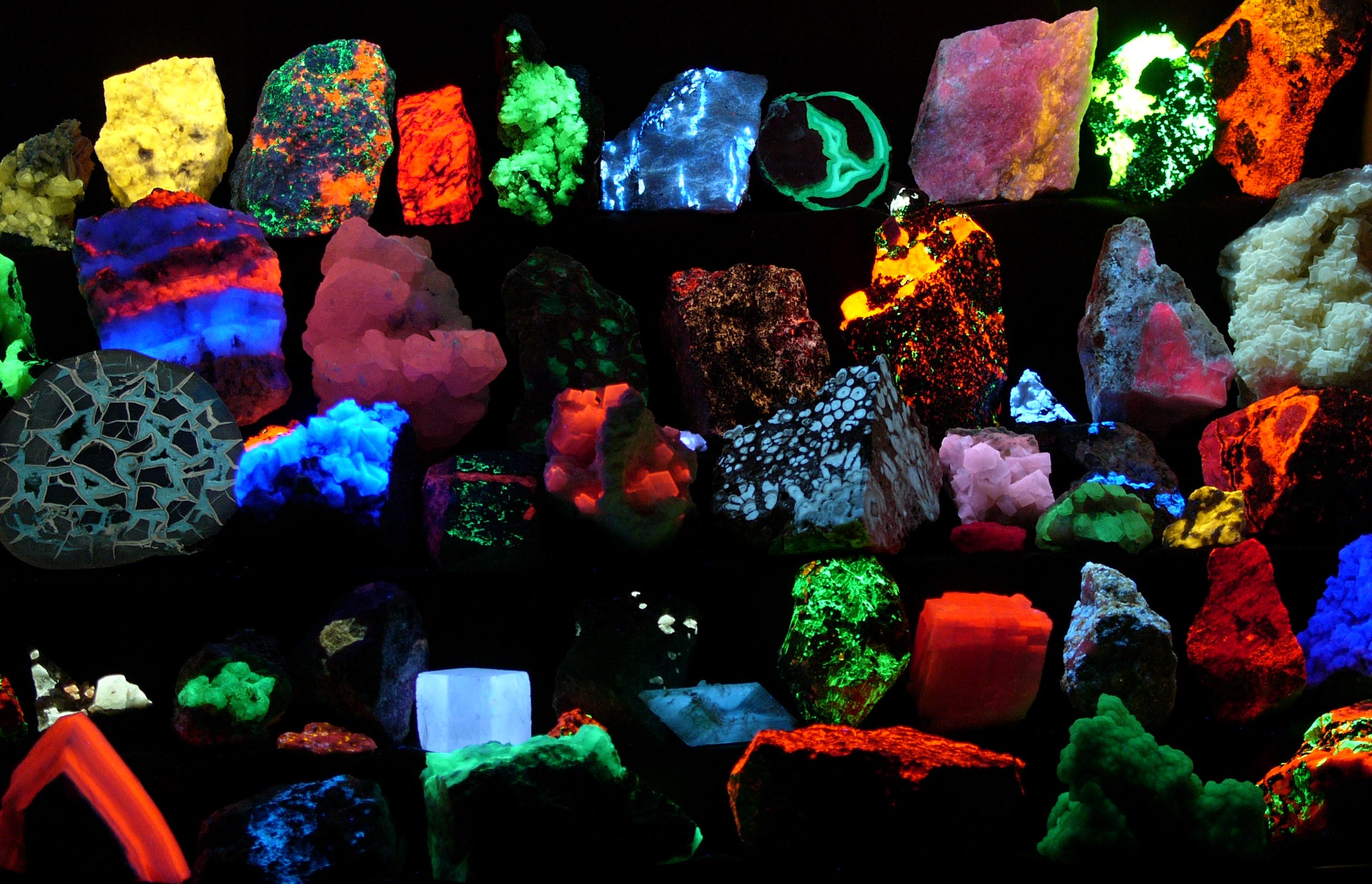
A handful of minerals do something remarkable: shine an ultraviolet lamp on them in the dark and they glow in intense colours the eye never sees in daylight. This effect, called fluorescence, is one of the most popular corners of the hobby — and, unlike much of mineralogy, it rests on well-understood physics.
What fluorescence actually is
Fluorescence is a form of photoluminescence. Ultraviolet light carries more energy than visible light. When UV strikes certain minerals, electrons in the crystal absorb that energy and jump to a higher energy state. Almost immediately they drop back down, releasing the energy as light — but at a longer, lower-energy wavelength that falls in the visible range. The result is a glow whose colour depends on the mineral and its trace chemistry, not on the colour of the lamp.
The glow stops the instant the lamp is switched off. If a mineral keeps glowing for seconds or minutes afterward, that lingering effect is called phosphorescence — the same process, just slower to release its energy.
Why some minerals glow and others do not
The glow usually comes from tiny amounts of “activator” elements built into the crystal — manganese, uranium, lead, chromium or rare-earth elements. A pure mineral may not fluoresce at all, while the same mineral with a trace of manganese glows brilliantly. This is why fluorescence is often locality-specific: calcite from one mine glows red, while chemically similar calcite from elsewhere stays dark. Some elements also quench fluorescence, absorbing the energy silently, which is why iron-rich specimens tend not to glow.
Shortwave vs. longwave UV
Not all ultraviolet is the same, and the difference matters enormously to collectors:
Longwave (UVA, ~365 nm)
- Closer to visible light; safer and cheaper
- The band in ordinary “black lights”
- Makes many minerals glow, but often less dramatically
Shortwave (UVC, ~254 nm)
- Higher energy; triggers the most spectacular displays
- Requires a special lamp with a filter
- Hazardous to eyes and skin — protection is essential
A specimen can glow one colour under longwave and a completely different colour under shortwave. Serious fluorescent collectors carry a lamp that offers both.
Classic fluorescent minerals
- Calcite — often glows red or pink, usually from manganese.
- Willemite — brilliant green under shortwave; the star of Franklin, New Jersey.
- Fluorite — the mineral that gave fluorescence its name; typically blue to violet.
- Scheelite — bright blue-white, and a genuine prospecting clue for tungsten ore.
- Aragonite, hyalite opal, autunite and some agates — a range of greens and yellows.
The single most famous locality is the Franklin–Sterling Hill district of New Jersey, where willemite and calcite together produce a green-and-red display that made the area “the fluorescent mineral capital of the world.”
How to hunt fluorescent minerals
Fluorescing is best done after dark or in a fully shaded space, because daylight overwhelms the glow. Many collectors visit mine dumps and quarries at night with a portable shortwave lamp, scanning tailings for flashes of colour that are invisible by day. Bring spare batteries, the correct eye protection, and always confirm you have permission and legal access before entering any mine property. At home, a dark closet or a UV viewing box lets you test finds one by one.
Frequently asked questions
Why do some minerals glow under UV light?
Because they absorb high-energy ultraviolet and re-emit it as lower-energy visible light. The effect usually depends on trace “activator” elements such as manganese or uranium in the crystal.
What is the difference between fluorescence and phosphorescence?
Both re-emit absorbed UV as visible light. Fluorescence stops the moment the lamp is off; phosphorescence continues to glow for a while afterward.
Is shortwave or longwave UV better?
Shortwave (254 nm) produces the most dramatic displays but needs a special, more expensive and hazardous lamp. Longwave (365 nm) is cheaper and safer. Many minerals respond differently to each.
Is UV light dangerous?
Shortwave UV can burn eyes and skin quickly. Always wear UV-blocking eyewear, never look at the lamp, and keep the beam off skin and away from others.
Where can I see fluorescent minerals?
The classic site is Franklin and Sterling Hill, New Jersey — see our guide to Franklin & Sterling Hill fluorescent minerals.
Want fluorescent specimens?
Sponsored — partner shop · Minerals Kingdom
New to collecting? Read how to start rockhounding before heading out with a lamp after dark.
Written by The Field & Stone Editors · Published by KEVALEX Group.